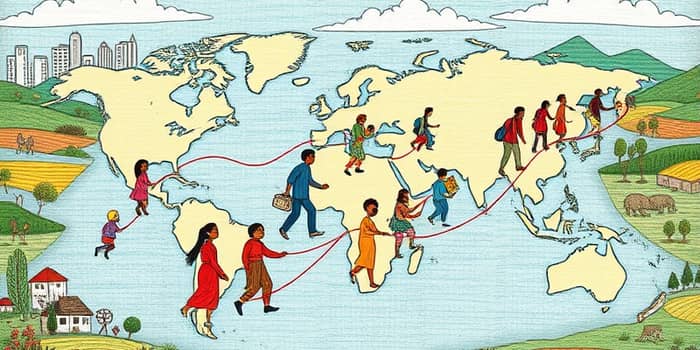
International migration has become one of the most transformative forces shaping the 21st century. As people cross borders in search of opportunity, safety, and connection, economies and societies in both origin and destination countries are being redefined.
By mid-2024, approximately 304 million individuals lived outside their country of birth—roughly 3.7% of the global population. This movement has profound implications for labor markets, public finances, demographic structures, and political debates worldwide.
1. The Global Magnitude and Evolution
Since 1960, when just 77.1 million people were recorded as international migrants, the stock has more than quadrupled in size. While crises like the 2008 financial collapse and the COVID-19 pandemic temporarily dampened flows, long-run growth has remained robust.
- Labor and family migrants form the bulk of long-term flows.
- More than 100 million people are forcibly displaced, including refugees and asylum seekers.
- Distinct categories such as international students, temporary workers, and high-skilled professionals add complexity.
This expansion reflects both deepening globalization and structural shifts in workforce needs, aging populations, and geopolitical instability.
2. Destinations and Origins: A Dual Perspective
Over half of all migrants reside in Northern America and Europe, drawn by economic opportunities, family ties, and established communities. The United States alone hosts more than 50.6 million migrants—around 18% of the global total—despite representing just 5% of world population.
Meanwhile, major origin regions include Central and Southern Asia, Latin America and the Caribbean, and parts of Europe. India, Mexico, Russia, China, and Syria rank among the top sending countries, each with unique diaspora patterns and challenges.
In Gulf Cooperation Council states like the UAE and Qatar, migrants can make up over 75% of the population, illustrating how labor market demands shape demographic profiles.
3. Recent Developments in OECD Countries and the United States
OECD economies admitted 6.2 million new permanent immigrants in the latest year—a 15% increase over 2019 levels. Family migration remains the leading category, while the mobility of health professionals and skilled workers has drawn particular attention.
The 2025 International Migration Outlook emphasizes the role of firms in integration: recruitment practices, language training, and credential recognition all influence migrant productivity and social inclusion.
In the United States, the immigrant population reached a post-World War II peak of 53.3 million (15.8% of residents) in January 2025, before recording a modest decline due to departures and deportations. Immigrants account for nearly 19% of the labor force, underpinning essential sectors from agriculture to healthcare.
4. Economic Channels: How Migration Shapes Economies
Migration’s impact unfolds through four primary channels: labor markets and productivity; public finances; remittances and origin-country development; and long-run growth, demographics, and innovation.
- Labor markets and productivity
- Public finances and welfare systems
- Remittances and development
- Demographics, growth, and innovation
Each channel carries opportunities and challenges for policy makers and communities alike.
4.1 Labor Markets and Productivity
International migrants comprised nearly 5% of the global workforce in 2019, spanning all skill levels but often concentrated in agriculture, construction, hospitality, and care services. They fill critical labor shortages while also competing in local markets.
Economic research generally finds that migrant inflows have modest effects on native wages, sometimes slightly negative for low-skilled workers in the short term but neutral or positive over time as economies adjust. Migrant complementarities can boost productivity in sectors requiring diverse skill sets.
4.2 Public Finances and Welfare States
Working-age migrants typically contribute income, payroll, and consumption taxes, often arriving younger than native populations. This alleviates pension and healthcare strains in aging societies.
However, short-term costs—particularly for refugees and low-skilled newcomers—can pressure local services like schools and housing. National tax revenues may offset these costs over the long run, but uneven spatial impacts fuel political debates.
4.3 Remittances and Origin-Country Development
Remittances reached a record US$719 billion in 2019, with US$548 billion flowing to low- and middle-income countries. Even during the COVID-19 downturn, migrants sent home over US$700 billion, underscoring resilience in global financial linkages.
These transfers support household consumption, education, and healthcare, often lifting families out of poverty. Yet reliance on remittances can also expose economies to external shocks and limit domestic financial deepening.
4.4 Demographics, Growth, and Innovation
By stabilizing dependency ratios, migration can deliver a critical demographic dividend. Young, working-age migrants offset declining fertility in many advanced economies, supporting sustainable growth trajectories.
Moreover, migrants are disproportionately represented among entrepreneurs and innovators. Research shows that foreign-born inventors and founders contribute disproportionately to patent filings and startup creation, fueling long-run productivity gains and diversification of knowledge networks.
Conclusion
Migration transcends borders and categories, intersecting with development, inequality, and globalization. Its economic effects are multifaceted—impacting wages, public budgets, remittance flows, and demographic profiles.
Crafting effective migration policy requires a holistic view that balances short-term integration costs with long-term benefits. Investments in language training, credential recognition, and anti-discrimination measures can unlock the full potential of migrants’ contributions.
Ultimately, migration is not merely a movement of labor; it is a catalyst for innovation, cultural exchange, and economic resilience. By embracing the complex global dynamics at play, societies can build more inclusive, dynamic, and prosperous futures—truly going beyond borders.
References
- https://www.oecd.org/en/publications/2025/11/international-migration-outlook-2025_355ae9fd/full-report/recent-developments-in-international-migration-movements-and-labour-market-inclusion-of-immigrants_203de29e.html
- https://www.oecd.org/en/publications/2025/11/international-migration-outlook-2025_355ae9fd.html
- https://www.migrationpolicy.org/article/top-statistics-global-migration-migrants
- https://www.oecd-events.org/ifms2025
- https://www.pewresearch.org/short-reads/2025/08/21/key-findings-about-us-immigrants/
- https://www.un.org/en/global-issues/migration