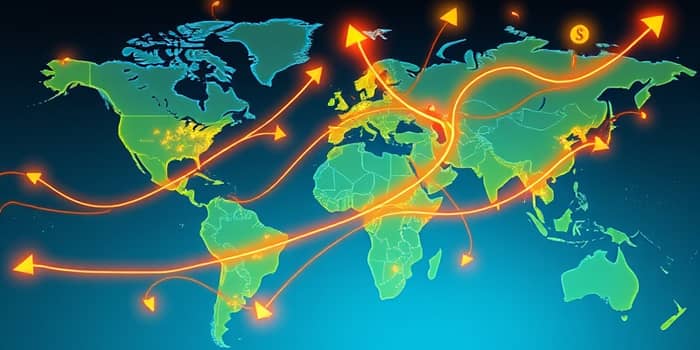
Capital flows shape the contours of modern finance, weaving a tapestry that spans continents and markets. From massive foreign direct investments to nimble short-term portfolio shifts, these movements of money drive growth, stir volatility, and redefine economic possibilities worldwide.
Definition and Importance
At its core, a capital flow represents the transfer of financial resources across borders or within domestic markets. This includes equity securities, debt instruments, bank deposits, loans, remittances, and more. Captured in a nation’s financial account, these flows explain how countries finance trade deficits, build reserves, and support development.
Driven by motives such as seeking higher returns and risk diversification, capital flows can rival trade in scale. Between 1995 and 2003, industrial nations saw average annual gross flows of $4.9 trillion—about ten times greater than net flows. Their magnitude underscores the pivotal role these movements play in global stability and prosperity.
Categories of Capital Flows
To navigate the complexity of cross-border finance, analysts classify flows by market, duration, investor type, and direction. Each category exhibits unique traits, influencing policy responses and investment strategies.
- By Market: Shifts between stock and bond markets reveal sector rotations—such as the surge into technology stocks during the COVID-19 rally.
- By Duration: Long-term foreign direct investment (FDI) brings stability and control, while short-term “hot money” chases momentary gains and moves swiftly.
- By Source: Official flows stem from central bank reserves and multilateral institutions; private flows flow from global investors seeking portfolio diversification.
Within these broad categories, subtypes—like bank loans, sovereign bonds, and remittances—add further layers of nuance. Policymakers tailor regulations to steer desirable forms of finance and curb destabilizing ones.
Drivers and Dynamics
Capital flows respond to a tapestry of economic signals. Key among them are interest rate differentials and exchange rate expectations. When a country raises rates, it invites inflows of yield-seeking capital; conversely, rising global uncertainty often triggers outflows to safe havens.
Modern digital ecosystems grant unprecedented speed. Funds can enter emerging markets at the first hint of higher growth, then exit just as quickly at the sign of trouble. This high mobility and sudden reversals amplify cycles, enriching economies in boom times and destabilizing them in downturns.
Case in point: during the 2008 financial crisis, investors evacuated equities en masse, fleeing to government bonds and cash. Similarly, in 2020, surging optimism about technology’s resilience sparked massive inflows into big-tech stocks globally.
Economic Impacts and Risks
When harnessed effectively, capital inflows fill investment gaps, bolster infrastructure, and accelerate industrialization. FDI can bring cutting-edge technology and managerial expertise, while portfolio funds deepen domestic capital markets.
Yet the same flows can introduce fragility. A rapid withdrawal of short-term capital can strain foreign exchange reserves, trigger currency devaluations, and force abrupt monetary tightening. Such volatility can derail growth, especially in emerging economies.
Large net inflows often coincide with widening inequality, as skilled workers and entrepreneurs capture disproportionate gains. Addressing this requires targeted social policies and inclusive growth frameworks.
Policy Considerations and Future Trends
Governments deploy a spectrum of tools—from reserve requirements and transactional taxes to volume caps—to shape inflow quality. The aim is to deter speculative hot money while welcoming stable, growth-oriented investments.
Looking ahead, digital finance and cross-border fintech platforms promise to reshape capital mobility. Enhanced data analytics and real-time reporting could offer early warnings of destabilizing surges or reversals.
Regional dynamics are also shifting. Asia, led by economies like the UAE and Singapore, is attracting record FDI through business reforms and strategic sovereign wealth allocations. By 2031, the UAE aims to more than double its cumulative FDI inflows, exemplifying a trend toward domestic supply-chain resilience.
Best Practices for Stakeholders
- For policymakers: calibrate controls to balance stability with openness, and invest in data systems for timely insights.
- For investors: assess a country’s macroeconomic fundamentals—growth prospects, political stability, and currency trajectories—to manage risk.
- For development institutions: channel concessional finance into infrastructure and capacity building to complement private flows.
Conclusion
Capital flows are both an opportunity and a challenge—a vital source of funds for development, yet a potential catalyst for instability. By fostering informed policy design and adopting prudent financial strategies, nations and investors can harness global capital for sustainable, inclusive growth.
Understanding the mechanics, categories, and impacts of these financial currents empowers stakeholders to chart a course toward shared prosperity, transforming the movement of money into a force for positive change.
References
- https://longbridge.com/en/learn/fund-flow-terminology-103697
- https://www.scirp.org/journal/paperinformation?paperid=82645
- https://www.tradingview.com/chart/MSFT/k8IqQa0h-Capital-Flows-Concept-and-Characteristics/
- https://www.tandfonline.com/doi/full/10.1080/1540496X.2025.2482723?src=
- https://corporatefinanceinstitute.com/resources/economics/capital-flows/
- https://www.weforum.org/stories/2025/02/why-capital-flows-have-the-potential-to-change-the-economic-status-quo/
- https://www.econlib.org/library/Enc/InternationalCapitalFlows.html
- https://openknowledge.worldbank.org/entities/publication/bacb3261-a013-55a6-8aa0-f90322e149f4
- https://diversification.com/term/capital-flows
- https://www.nber.org/programs-projects/projects-and-centers/8297-economic-consequences-rise-capital-flows
- https://fiveable.me/key-terms/principles-macroeconomics/capital-flows
- https://www.urban.org/policy-centers/metropolitan-housing-and-communities-policy-center/projects/capital-flows