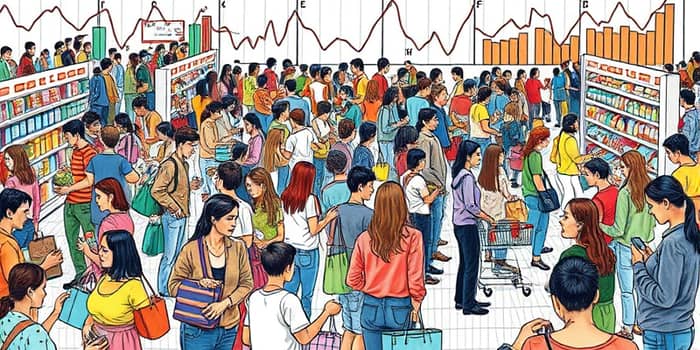
Consumer behavior stands at the heart of every economic turning point. When households choose to spend freely or tighten their belts, they dictate the pace of growth, the depth of recessions, and the strategies businesses must adopt to thrive.
Understanding Consumer Spending as an Economic Engine
Consumer spending accounts for about two-thirds of GDP in advanced economies. This immense share means that fluctuations in household purchases ripple through employment, wage growth, and investment decisions.
In prosperity, expanding incomes and falling unemployment boost confidence and spending. In downturns, caution prevails and essentials dominate budgets.
Economic Booms: The Rise of Optimism and Discretionary Purchases
During expansions, households feel empowered. Job security and rising wages spark discretionary spending on non-essentials such as high-end electronics, dining out, and vacations.
Retailers and service providers capitalize on this buoyancy by introducing innovative products and premium experiences. Consumers indulge, and businesses chase higher margins.
- Unemployment falls sharply
- Consumer Confidence Index peaks
- Purchase of luxury and impulse items soars
- Credit use and borrowing increase
Recessions and the Frugality Revolution
When economic clouds gather, a shift occurs. Households confront uncertainty and adopt spending cutbacks driven by caution. Discretionary purchases plummet as consumers focus on essentials like food, rent, and medication.
Brands face weakened loyalty as price and functionality become primary differentiators. Discount retailers and online marketplaces often capture this cautious spending.
- 64% of shoppers assess need before buying
- 60% seek lowest available price
- 59% buy only what fits their budget
- AOV drops as consumers buy smaller baskets
Psychological Drivers: Confidence, Scarcity, and Social Comparison
The Consumer Confidence Index acts as a barometer for future spending. High confidence encourages riskier purchases; low confidence spurs saving.
Three psychological hallmarks illustrate consumer responses:
- React: Immediate cutbacks and deal hunting
- Cope: Adjusting budgets and seeking value
- Adapt: Permanently altered buying habits
Environmental uncertainty and resource scarcity amplify these reactions. Consumers restrict choices, reallocate budgets, and often compare themselves to peers, impacting visible consumption of status goods.
The Extended Purchase Journey: Research, Compare, Decide
In 2025, data reveals that while clicks grew 18% and orders rose 12%, total spending increased by just 0.4%. This gap highlights deeper consideration phases, as shoppers research prices, read reviews, and hunt for deals.
A longer journey means conversion rates fell. In fact, conversion rates fell by 5% year-over-year, and average order value dropped 10% as consumers filled carts carefully rather than indulging in impulsive bulk buys.
Brand loyalty wanes when coupons, peer reviews, and comparison platforms hold sway. Companies must adapt by providing transparent pricing and flexible promotions.
Implications for Businesses and Policymakers
Understanding these shifting patterns is vital for inventory management, pricing strategies, and forecasting demand. Real-time sentiment analysis and advanced analytics become indispensable tools.
Companies can respond by:
- Tailoring messaging: luxury narratives in booms, value-focused in downturns
- Optimizing assortments: emphasize essentials during slowdowns
- Strengthening loyalty: offer personalized deals and flexible payment plans
Policymakers, too, rely on consumer metrics. A weakening Consumer Confidence Index may signal the need for stimulus measures, while surging spending could warrant caution against overheating.
Conclusion: Harnessing Consumer Insights for Economic Resilience
Consumer behavior remains the cornerstone of economic cycles. As households navigate prosperity and hardship, their collective choices determine the rhythm of growth and contraction.
By analyzing spending trends, psychological drivers, and research-driven habits, businesses can align strategies effectively, and policymakers can craft timely interventions.
Ultimately, embracing the dynamic interplay between consumer actions and economic outcomes fosters resilience, innovation, and sustainable prosperity.
References
- https://www.maddyness.com/uk/2024/01/24/how-the-cost-of-living-crisis-changes-the-way-shoppers-think/
- https://theusim.com/news/how-economic-conditions-and-consumer-confidence-impact-advertising-effectiveness
- https://www.bcg.com/publications/2022/consumer-spending-during-recession
- https://impact.com/affiliate/consumer-spending-trends-2025/
- https://thedecisionlab.com/insights/business/the-consumer-upside-of-an-economic-downturn
- https://www.ey.com/en_gl/insights/consumer-products/changing-consumption-will-reshape-business-priorities
- https://nielseniq.com/global/en/insights/commentary/2024/the-macroeconomic-impacts-of-shifting-consumer-mindsets/