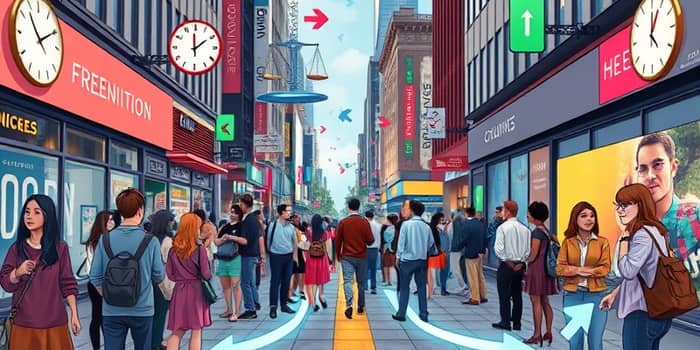
Every decision we make, from selecting a morning coffee to deciding on a career change, is shaped by hidden psychological forces.
Behavioral economics reveals systematic biases and predictable errors that underpin these choices, offering us a roadmap to better outcomes.
Understanding Behavioral Economics
Behavioral economics merges insights from psychology with economic theory to explain how people actually behave under uncertainty and emotion.
In classical economics, agents are assumed to have complete information, unwavering self-control, and the ability to calculate every outcome. These assumptions ignore how real humans process information and manage impulses.
Instead, behavioral economists embrace bounded rationality and bounded willpower, acknowledging that our minds have limited capacity and our impulses often override long-term goals.
Pioneers like Herbert Simon coined bounded rationality, highlighting our mental shortcuts. Daniel Kahneman and Amos Tversky developed prospect theory, illustrating how context shifts value perception. Richard Thaler introduced nudging and mental accounting, while Cass Sunstein applied these ideas to public policy. Today, scholars like Katy Milkman and Sendhil Mullainathan expand the field with cutting-edge research.
Key Concepts That Shape Our Decisions
These core ideas demystify why we deviate from “rational” economic behavior. By recognizing them, we can design environments that guide us toward better choices.
Prospect Theory and Loss Aversion
Prospect theory upends the notion that people evaluate wealth in absolute terms. Instead, each outcome is judged as a gain or loss relative to a personal reference point.
The value function in prospect theory is concave for gains and convex for losses, meaning we experience diminishing sensitivity with larger gains and escalate discomfort with losses.
Losses loom larger than gains: a $50 loss hurts more than a $50 gain pleases. This drives risk-averse behavior in gain scenarios but risk-seeking behavior to avoid losses.
Consider an investor who refuses to sell a declining stock, hoping it will rebound. This fear of locking in a loss often leads to greater regret if the stock keeps falling.
- Homeowners demand more money to sell than they’d pay to buy the same house.
- Drivers hire expensive insurance plans to sidestep rare but frightening accidents.
- Consumers cling to subscriptions they scarcely use rather than face cancellation fees.
Heuristics and Cognitive Biases
Heuristics are mental shortcuts used under uncertainty. They speed decisions but introduce distortions.
These biases often operate unconsciously, guiding judgments in predictable ways.
- Anchoring: The first piece of information anchors our estimates, even if arbitrary.
- Availability: We overemphasize memorable events, like vivid news stories, over statistical realities.
- Representativeness: We judge probability by resemblance, neglecting base rates and true likelihoods.
- Hot-hand fallacy & Gambler’s fallacy: We see patterns in randomness, believing winning streaks will continue or losses will reverse.
Retailers leverage these biases by displaying an “original price” next to a sale price, making discounts feel more substantial through anchoring.
Self-Control, Time Inconsistency, and Present Bias
Present bias leads us to overweight immediate satisfaction at the expense of long-term well-being. This conflict between short-term impulses and future goals is at the heart of procrastination.
Simple tasks like paying debts, studying for exams, or sticking to a diet become battlegrounds between our present self and future self.
Commitment devices, such as automatic bill pay or locking away tempting snacks, help bridge this gap by removing the lure of instant gratification.
Self-handicapping arises when individuals sabotage their own performance to protect self-esteem. A worker might delay starting a project so that failure can be blamed on lack of time rather than lack of skill.
Social Preferences, Norms, and Herd Behavior
We are wired for community. A concern for fairness reciprocity and social approval shapes countless decisions.
Social norms exert immense power, from wearing similar attire in office settings to following the crowd during sales events. When people see their peers adopting a behavior, they assume it’s the correct choice.
One dramatic example occurred during the early days of the COVID-19 pandemic when seeing neighbors stockpile essentials triggered widespread panic buying, despite ample overall supply.
Choice Architecture and Nudges
Choice architecture is about structuring decisions to promote better outcomes without coercion. Even a small change in how options are presented can lead to dramatic shifts in behavior.
Nudges harness behavioral insights to guide choices while preserving freedom. They respect autonomy but employ subtle cues to foster desirable actions.
- Default options: Automatic enrollment in retirement plans has quadrupled participation rates in many organizations.
- Salience: Highlighting healthier menu items makes them more likely to be chosen.
- Simplification: Reducing paperwork and complexity lifts uptake of beneficial programs like vaccines or energy rebates.
Governments around the world have established nudge units to apply these techniques to tax collection, environmental conservation, and public health initiatives.
Applications Across Everyday Domains
The true power of behavioral economics comes from its broad applicability. Let’s explore how these concepts play out in different spheres of life.
Money and Personal Finance
Investors frequently succumb to the disposition effect, selling winners too soon and holding losers too long. They fight against their own tendencies to realize a loss, even when cutting losses is the rational move.
In salary negotiations, the initial offer anchors the discussion. Candidates who propose a higher starting point often secure better compensation packages.
Mental accounting divides money into categories—bonus, gift, refund—leading people to spend “found” money differently than their regular income.
Work, Productivity, and Career Growth
Within organizations, subtle cues influence productivity. Friendly reminders and progress trackers nudge employees toward completing tasks.
In hiring, framing job descriptions to emphasize mission and purpose rather than just requirements can attract a more motivated candidate pool. One telecom firm doubled its applications by switching language to “join our team improving lives.”
Even small defaults, like setting the standard meeting time at a worker’s optimal alert hours, can boost focus and morale.
Health, Lifestyle, and Well-Being
People often struggle to stick to healthy routines, but behavioral tools provide solutions. Commitment contracts—agreements that impose a cost if goals aren’t met—can double gym attendance rates.
Food labeling that uses traffic-light colors instead of numerical calories leverages salience to promote better dietary choices without removing freedom.
Mental accounting can also apply to health budgets. Setting aside a “wellness fund” for classes or gym membership can increase usage by creating a separate mental bucket.
Digital Life, Shopping, and Consumer Choices
E-commerce platforms heavily utilize behavioral triggers. Countdown timers tap urgency, while personalized recommendations exploit social proof.
Subscription services often default to auto-renewal, banking on inertia to retain customers. Cancellation barriers, like multiple confirmation screens, further reduce churn.
Online reviews and star ratings serve as powerful social signals, guiding buyers toward products endorsed by others.
Public Policy and Community Impact
Behavioral insights have revolutionized policy design. For instance, sending tax reminders highlighting that “9 out of 10 neighbors paid on time” can significantly increase compliance.
Energy consumption fell when households received letters comparing their usage to that of efficient neighbors, tapping both social norms and competitive instincts.
Nudge-based programs in several countries have improved organ donation rates by switching from opt-in to opt-out systems, leading to thousands of additional donors each year.
Summary Table of Tools and Effects
Harnessing Behavioral Insights for Better Outcomes
By understanding the interplay of biases, heuristics, and social influences, we can reshape environments for improved decisions.
Organizations can design products and services that align with human behavior. Policymakers can craft regulations that yield cooperation rather than resistance.
Individuals armed with this knowledge can build systems to overcome pitfalls—automating savings, setting healthy defaults, and seeking accountability partners.
Embracing these ideas is more than theoretical; it empowers us to navigate a world full of subtle influences with clarity and purpose.
As you move through daily life, remember that every choice point is an opportunity. Pause, reflect on the unseen forces at play, and embrace mindful decision-making to unlock your full potential.
References
- https://thedecisionlab.com/insights/business/3-applications-of-behavioral-economics-in-the-real-world
- https://sixthfactor.com/3-applications-behavioral-economics-real-world/
- https://sixthfactor.com/5-examples-behavioral-economics-everyday-life/
- https://pmc.ncbi.nlm.nih.gov/articles/PMC4871624/
- https://verifiedinvesting.com/blogs/education/behavioral-economics-in-everyday-life-financial-decision-making-beyond-the-exchange-floor
- https://news.uchicago.edu/explainer/what-is-behavioral-economics
- https://insidebe.com/articles/behavioral-economics-in-business-sector/
- https://globalyouth.wharton.upenn.edu/articles/world-economy/5-truths-about-behavioral-economics-and-studying-consumer-behavior/