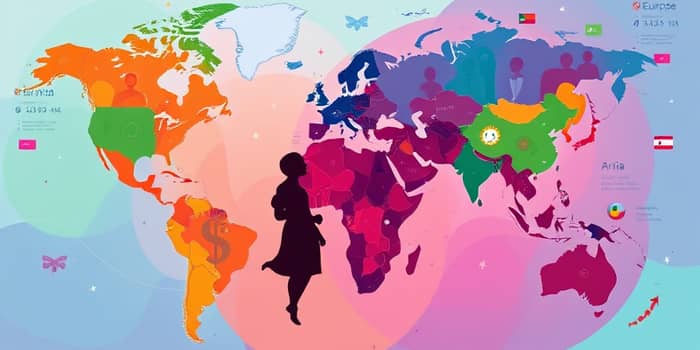
Global population dynamics are undergoing a profound transformation that will shape markets, policies, and societies in coming decades. This article delves into the data, regional contrasts, and the economic forces unleashed by shifting age structures worldwide.
Global Population Trends: Current and Future
As of 2025, the world population stands at approximately 8.2 billion, growing at roughly 0.85% per year—around 70 million additional people annually. This rate has slowed markedly from a peak of 2.3% in the early 1960s. Projections suggest the global population will peak near 10.3 billion in 2084 before a gradual decline to around 10.2 billion by 2100.
Key drivers of this slowdown include urbanization, widespread access to family planning, rising education levels—especially among women—and evolving social norms. By mid-century, the global fertility rate is expected to fall below the replacement threshold of 2.1 births per woman, marking a historic demographic inflection point.
Regional Contrasts: Growth Hubs and Aging Centers
The story of global demographics is one of stark contrasts. In Asia, which houses 4.8 billion people, growth has slowed to 0.59% annually. India’s population will swell to about 1.7 billion by 2061 before plateauing, while China is projected to decline to 633 million by 2100.
Africa emerges as the fastest-growing continent, with a 2.29% annual increase and 1.5 billion inhabitants in 2025. Sub-Saharan nations like Nigeria and Ethiopia will drive over 60% of global growth by century’s end, fueling an exploding youth demographics in Africa and creating vast markets.
Europe presents the opposite trend: a declining total population of 744 million, shrinking by 0.09% per year, and a median age of 42.8. Nearly 18% of Europeans are over 65, fueling shrinking labor force boosting dependency ratios and straining public finances.
Economic and Market Impacts of Aging and Growth
Aging populations in developed markets are ushering in the silver economy catering to aging populations. In Japan, nearly one-third of residents are over 65, and there are 50 seniors for every 100 working-age adults. Elevated dependency ratios strain pensions, healthcare systems, and fiscal budgets, risking economic stagnation without reform.
Conversely, regions with youthful populations offer the demographic dividend in emerging economies. Expanding workforces in Africa and South Asia will spur demand for education, digital services, consumer goods, and infrastructure. Businesses can capture these emerging markets through targeted investment in mobile technology, housing, and financial inclusion.
Migration flows will become increasingly vital to sustaining aging labor pools in wealthier nations, yet they may also ignite political tensions over integration, wages, and public services. Resource pressures—on water, food, and energy—will intensify where rapid growth outpaces infrastructure development.
Sector-Specific Opportunities and Challenges
- Healthcare: Demand for geriatric care, pharmaceuticals, and health-tech innovations will surge in high-income aging societies.
- Finance: Pension reforms, new retirement products, and services for an older clientele will reshape capital markets.
- Consumer Goods: Youth-driven consumption in growth regions contrasts with demand for age-friendly housing, leisure, and wellness products in mature markets.
- Urban Development: Rising urbanization in Asia and Latin America fuels real estate, mobility, and smart-city solutions, while underdeveloped infrastructure in parts of Africa presents both risk and potential.
Policy and Business Responses for a Demographic Revolution
Governments and companies must embrace the transformational power of demographic transitions or risk being overtaken by them. Key adaptation strategies include:
- Labor Market Reform: Incentivizing later retirement, skill development, and flexible work arrangements.
- Immigration Policies: Balancing the need for labor with social cohesion and integration measures.
- Healthcare Expansion: Scaling insurance systems, digital health platforms, and preventive care.
- Education and Training: Promoting lifelong learning to equip both young and aging workers for evolving industries.
The choices made today will determine whether demographics become a source of renewed growth or a drag on global prosperity. The uneven regional impact on market dynamics underscores the urgency for tailored, forward-looking strategies.
In this era of shifting population landscapes, success belongs to those who anticipate and innovate. By aligning policy, business models, and investment with demographic realities, societies can transform age-old challenges into engines of sustainable growth and shared opportunity.
References
- https://www.pewresearch.org/short-reads/2025/07/09/5-facts-about-how-the-worlds-population-is-expected-to-change-by-2100/
- https://www.visionofhumanity.org/after-the-peak-challenges-of-a-shrinking-world/
- https://www.worldometers.info/world-population/
- https://blogs.worldbank.org/en/opendata/world-population-day--trends-and-demographic-changes
- https://en.wikipedia.org/wiki/Population_growth
- https://www.un.org/en/global-issues/population
- https://www.census.gov/newsroom/stories/world-population-day.html
- https://www.cbo.gov/publication/61164