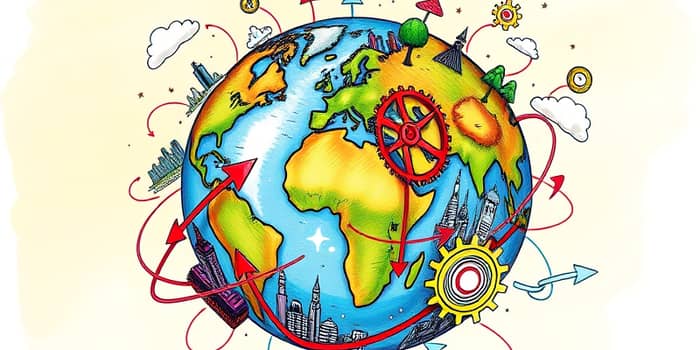
In a world bound together by trade, finance, and technology, the consequences of domestic policy often reach far beyond national borders. These ripple effects—known as spillovers—can shape growth, stability, and welfare in unexpected ways.
Conceptual Foundations
At its core, an economic spillover is an impact—positive or negative—felt in one region or sector due to decisions made elsewhere. Unlike narrow externalities, which focus on unpriced side effects in production and consumption, spillovers operate at a macro and geo-economic scale. They underscore how a single policy in a major economy can trigger unintended cross-border consequences across diverse geographies.
Modern economies are highly interdependent global systems. Monetary, fiscal, trade, regulatory, and environmental policies are rarely contained within a country’s frontier. Recognizing these linkages is essential for policymakers who wish to anticipate and manage the wider effects of their actions.
Types of Spillovers
Spillovers can manifest through various dimensions:
- Economic Spillovers: Changes in output, employment, inflation, and trade balances across regions.
- Financial Market Spillovers: Transmission of asset price shocks, capital flows, and risk sentiment.
- Environmental Spillovers: Transboundary pollution, climate impacts, and resource depletion.
- Social and Political Spillovers: Migration shifts, institutional reforms, and social stability effects.
Each category can be further divided into local (within-country) and international spillovers. For example, federal spending in one state may boost neighboring states, just as U.S. monetary tightening can strain emerging markets.
Main Channels of Transmission
Understanding how policies transmit beyond their origin is crucial. Key channels include:
- Trade Links: A slowdown in a major market reduces import demand, cutting exports and growth in trading partners.
- Capital Flows and Investment: Interest rate shifts drive cross-border lending, borrowing costs, and currency valuations.
- Supply Chains: Disruptions in one hub—natural disasters, port closures—cascade through production networks globally.
- Expectations and Market Sentiment: News of banking troubles or policy shifts can trigger flight-to-safety behavior, impacting asset prices worldwide.
Labor mobility and migration also play roles, though they often require complementary research to quantify their full effects.
Quantitative Estimates
Empirical studies shed light on the magnitude of spillovers. A rule of thumb suggests that a 1% decline in GDP in a major trading partner often reduces the GDP of a tightly linked small economy by 0.2–0.5 percentage points. Similarly, a 100 basis point rate hike by the U.S. Federal Reserve can raise borrowing costs in emerging markets by 30–70 basis points, slowing growth and investment.
Positive vs. Negative Spillovers
Policy actions can yield both benefits and costs abroad. Recognizing these dualities empowers better decision-making.
Positive Spillovers include:
- Technological innovation that diffuses internationally.
- Foreign direct investment (FDI) bringing infrastructure and know-how to host countries.
- Public education systems producing skilled labor, benefiting global firms and economies through migration and knowledge exchange.
Negative Spillovers can take the form of:
- Cross-border pollution and climate damages from industrial emissions.
- Protectionist trade measures that dampen growth and provoke retaliatory moves.
- Monetary tightening in large economies that raises global borrowing costs and triggers currency stress.
Historical Case Studies
The lessons of history illustrate the stakes of ignoring spillovers:
The Great Depression (1929–1939): Originating in the U.S., a stock market crash and banking panics led to a collapse of international lending. Rising tariffs under the Smoot–Hawley Act exacerbated a global trade contraction. Unemployment soared worldwide, and political instability followed.
Policy insight: Domestic financial and trade measures, if misaligned with global stability, can deepen and prolong crises on a planetary scale.
The 2008 Global Financial Crisis: A collapse of mortgage markets in the U.S. triggered a cascade of losses in European banks and beyond. Contagion spread through capital flow reversals, credit freezes, and plummeting confidence. Even countries with sound fundamentals felt the pinch as investor sentiment turned risk-averse.
Policy insight: Coordinated macroprudential regulation and timely liquidity provision are essential to contain financial spillovers and restore stability.
Policy Implications and Debates
Given the complexity of spillovers, policymakers face tough choices:
- Domestic objectives must be weighed against cross-border externalities. Carbon taxes or emissions trading schemes should reflect transboundary climate costs.
- International coordination—through institutions like the IMF, WTO, and climate bodies—can internalize global benefits and costs.
- Macroprudential tools and capital flow management can help mitigate volatile financial spillovers while preserving open markets.
Debates continue over the optimal degree of policy cooperation. Some advocate for binding agreements on tax competition, climate action, and financial regulation, while others stress national sovereignty and flexibility.
Conclusion: Navigating an Interconnected World
As economies grow ever more entwined, the unintended consequences of policy cannot be ignored. Spillovers underscore a simple truth: no country is an island. Whether through trade, finance, supply chains, or shared environment, actions taken in one place reverberate globally.
To ensure that policies yield mutual gains rather than widespread costs, governments must embrace foresight, transparency, and cooperation. By anticipating spillovers and designing frameworks to share benefits and mitigate harms, the global community can chart a path toward inclusive, sustainable prosperity.
References
- https://en.wikipedia.org/wiki/Spillover_(economics)
- https://www.poems.com.sg/glossary/financial-terms/spillover-effect/
- https://www.stlouisfed.org/on-the-economy/2023/aug/decomposing-economic-impact-local-spillover-effects
- https://corporatefinanceinstitute.com/resources/economics/spillover-effect/
- https://sdgtransformationcenter.org/spillovers
- https://archive.unescwa.org/spillover-effects
- https://learnfinanceterms.com/term/spillovers
- https://legal-resources.uslegalforms.com/s/spillover