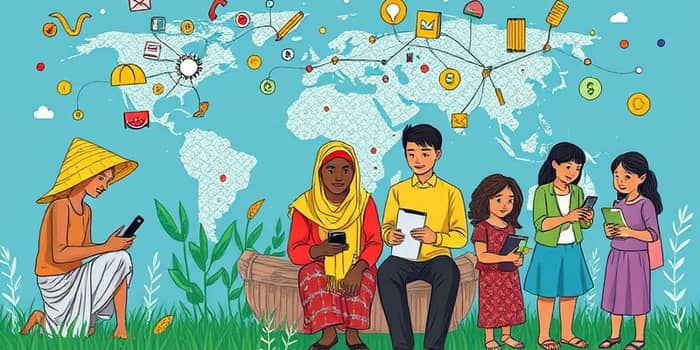
Financial inclusion remains one of the most transformative forces for global prosperity. By ensuring that every individual and business can access affordable financial services, societies unlock new pathways to growth, resilience, and well-being.
What Is Financial Inclusion?
At its core, financial inclusion means that individuals and businesses have reliable access to the financial tools they need—payments, savings, credit, and insurance.
This concept is recognized by the World Bank and the UN as fundamental for economic development. Indeed, it underpins 7 out of the 17 UN Sustainable Development Goals and is a proven catalyst for reducing poverty and inequality.
The Global State of Financial Inclusion in 2025
Recent data show remarkable progress: 79% of adults worldwide (4.9 billion people) now hold an account with a bank or mobile money provider, up from 51% in 2011.
This trend spans all regions, though disparities persist. A snapshot of regional account ownership and formal savings illustrates the landscape:
Despite gains, 1.3 billion adults remain unbanked. Over half of them live in eight countries: Bangladesh, China, Egypt, India, Indonesia, Mexico, Nigeria, and Pakistan.
India exemplifies concerted national efforts. Its FI-Index rose from 64.2 in 2024 to 67.0 in 2025, with 559.8 million beneficiaries under the PMJDY program and female account ownership exceeding 55%.
Digital Transformation: The Role of Mobile Money and Fintech
Digital finance has fueled much of the recent inclusion wave. Mobile money accounts are now held by 15% of adults globally, and 65% of Indian adults own a mobile phone.
Governments and private sector innovators have rolled out digital payment systems and direct cash transfers, enabling millions to receive subsidies, pay bills, and save securely.
However, challenges persist. Nearly 16% of adults in developing economies lack any mobile phone access, and 1.6 billion accounts lie inactive, particularly in rural and remote areas.
Persistent Barriers and Gaps
Key obstacles to full inclusion include:
- Gender disparities: Women in Sub-Saharan Africa and MENA are still far less likely to hold accounts.
- Rural and low-income populations often face geographic and economic hurdles.
- Regulatory constraints and lack of interoperability stall fintech innovation.
- Financial literacy remains low despite large-scale educational initiatives.
Overcoming these barriers requires targeted interventions and continued investment in infrastructure.
Measuring Inclusion: From Access to Financial Health
While account ownership is vital, the sector increasingly emphasizes quality, usage, and outcomes. India’s FI-Index, for instance, assesses access (35%), usage (45%), and quality (20%) across 97 indicators.
This shift reflects a global trend toward tracking financial resilience and well-being—the ability to weather shocks, build assets, and avoid unsustainable debt.
Policy Approaches and Best Practices
Leading nations have adopted comprehensive strategies to advance inclusion:
- Expanding banking infrastructure and agent networks in underserved regions.
- Implementing interoperable digital IDs and payment platforms.
- Launching direct benefit transfers to deliver subsidies and wages efficiently.
- Pursuing regulatory reforms that foster fintech growth and protect consumers.
India’s multi-year National Strategy for Financial Inclusion and Education demonstrates how coordinated roadmaps can drive measurable progress.
The Road Ahead: Strategies for the Next Chapter
To bridge the remaining gaps, stakeholders must focus on:
- Integrating digital tools with robust financial literacy programs.
- Designing gender-specific and rural outreach initiatives.
- Leveraging public-private partnerships for scalable solutions.
- Advancing global cooperation to share best practices and mobilize resources.
By aligning innovation with inclusive policies, the world can ensure that financial inclusion becomes a reality for every individual and community.
Ultimately, fostering transformative and inclusive growth requires not only expanding access but also guaranteeing that financial services truly enhance livelihoods and resilience.
References
- https://www.pib.gov.in/PressNoteDetails.aspx?NoteId=154980&ModuleId=3
- https://www.biia.com/financial-inclusion-at-record-high-but-1-3-billion-still-unbanked-world-bank-global-findex-2025-report/
- https://www.centerforfinancialinclusion.org/2025-financial-inclusion-entering-a-new-era/
- https://www.accion.org/news/world-banks-global-findex-2025-shows-progress-on-financial-inclusion-accion-reaction/
- https://www.findevgateway.org/region/financial-inclusion-global-overview
- https://www.imf.org/en/news/articles/2025/10/29/pr-25351-imf-releases-the-2025-financial-access-survey-results
- https://www.mastercard.com/us/en/news-and-trends/stories/2025/global-findex-2025-financial-inclusion.html
- https://www.worldbank.org/en/topic/financialinclusion/overview
- https://corporate.visa.com/en/sites/visa-economic-empowerment-institute/world-bank-global-findex-2025-insight.html
- https://www.cgap.org/about/financial-inclusion
- https://www.cgap.org/blog/banking-on-progress-why-next-chapter-of-financial-inclusion-is-so-important
- https://www.worldbank.org/en/publication/globalfindex
- https://www.newyorkfed.org/research/epr/2025/EPR_2025_financial-inclusion_crosignani.html