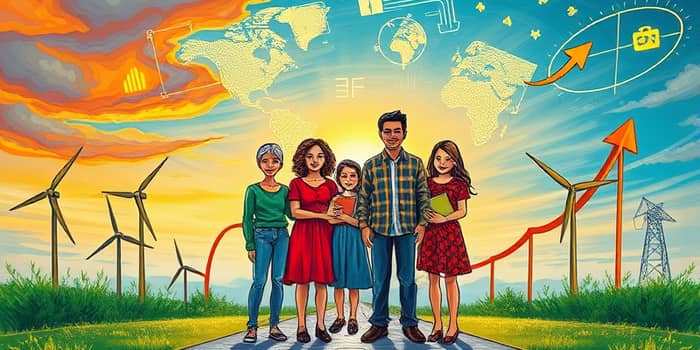
As we navigate a complex global environment from 2025 to 2030, individuals and families face unprecedented economic shifts. Slower growth rates, persistent inflationary pressures, and geopolitical fragmentation underscore the need for proactive financial planning. This article offers a comprehensive roadmap to adapt and thrive amid evolving growth forecasts, structural drivers, and market risks, empowering you with practical strategies to safeguard your wealth and seize emerging opportunities.
Global Economic Forecasts: A Measured Path Forward
Global GDP is set to expand at 3.0% in 2025 and 3.1% in 2026, a pace that sits below the 3.7% historical average. Growth rates are tempered by the normalization of post-pandemic rebounds, suggesting a return to a more sustainable but slower trajectory. Meanwhile, headline inflation in G20 economies is expected to ease from 3.4% in 2025 to 2.9% in 2026, but core inflation remains slightly sticky in advanced economies, reflecting persistent wage pressures and service sector price adjustments.
Key risks to this outlook include a resurgence of tariffs, which could elevate global trade costs, and fiscal strains stemming from high public debt levels in the United States and Europe. Conversely, breakthroughs in artificial intelligence, energy transitions toward renewables, and improvements in international policy cooperation could drive higher-than-expected growth, reinforcing the importance of maintaining flexible financial plans that can adapt to both upside and downside scenarios.
Regional Trends and Growth Projections
Different parts of the world will experience distinct growth trajectories based on domestic policy choices, demographic patterns, and sectoral strengths:
The United States may see slower GDP expansion of around 1.8% to 2.2% in 2025, slowing further in 2026. European economies face headwinds from industrial slowdowns due to high energy costs, even as they invest aggressively in renewables. In contrast, Asia—led by India’s infrastructure-driven 6.4% growth projection and China’s modest 4.4% to 4.5% outlook—remains a pivotal growth engine. Denmark stands out within Europe, with a 2.5% projection in 2025 driven by green hydrogen and femtech sectors.
Structural Drivers Shaping the Decade
Several interlocking trends will define the economic landscape from 2025 to 2030. Recognizing these forces allows investors to anticipate shifts and align their portfolios accordingly.
- Major investments in renewable energy capacity alongside continued gas-fired plants.
- High tariffs and supply chain realignments globally drive market volatility.
- Near $3 trillion US AI capital outlays signal transformative potential.
- Ageing populations straining advanced economy workforces over the coming years.
Understanding how energy transitions, geopolitical realignments, technological adoption, and demographic pressures intersect will enable you to position your assets in sectors most likely to outperform over the next five years.
Risks and Scenario Planning
Individuals and families should develop robust scenario plans that account for both negative and positive developments. This ensures greater resilience when actual economic outcomes diverge from baseline forecasts.
- Escalating trade barriers and inflationary pressures can erode purchasing power.
- Breakthroughs in clean energy and policy cooperation could boost productivity.
By contemplating worst-case scenarios such as renewed inflation spikes or asset bubble corrections alongside best-case scenarios of clean energy breakthroughs and cooperative trade agreements, you can set guardrails around your financial objectives.
Actionable Strategies for Future-Proofing Your Portfolio
Translating global macro themes into personal finance tactics requires clear, disciplined actions. Below are six core strategies to consider:
- Spread investments across geographies and asset classes to reduce concentration risk.
- Allocate to inflation-linked bonds and real assets for durable value retention.
- Invest in technology and AI education to position for automation resilience.
- Focus on green hydrogen and renewable sectors for long-term growth potential.
- Maintain manageable debt loads and avoid excess leverage in rising rate environments.
- Regularly review and adjust financial plans proactively based on new data.
Each strategy contributes to a diversified approach that balances growth potential with risk mitigation. Implementation will vary based on individual circumstances, so seek personalized advice from financial professionals as needed.
Building Long-Term Financial Resilience
Beyond tactical moves, nurturing a resilient mindset is equally important. This means setting realistic expectations, avoiding impulsive decisions, and focusing on quality assets that can endure macroeconomic volatility. Maintaining an emergency fund that covers three to six months of expenses provides a safety buffer, while disciplined portfolio rebalancing once or twice a year ensures alignment with changing risk profiles.
Conclusion: Navigating an Uncertain Horizon
The 2025–2030 period will challenge conventional assumptions about growth, inflation, and risk. Yet, armed with a clear understanding of global forecasts and structural drivers, and equipped with practical, adaptable strategies, you can improve your chances of achieving financial security and growth. Ultimately, future-proofing your finances is an ongoing journey—start today by analyzing your current asset mix, identifying gaps, and executing a plan that can flex with the economic tides.
References
- https://skaleegenkapital.com/2025-2030-global-economy-forecast/
- https://www.imf.org/en/publications/weo/issues/2025/07/29/world-economic-outlook-update-july-2025
- https://www.caixabankresearch.com/en/economics-markets/activity-growth/world-economy-2026-resilience-transition-or-disruption
- https://www.oecd.org/en/publications/2025/09/oecd-economic-outlook-interim-report-september-2025_ae3d418b.html
- https://www.conference-board.org/publications/global-economic-forecast-update
- https://www.imf.org/en/publications/weo
- https://www.worldbank.org/en/publication/global-economic-prospects