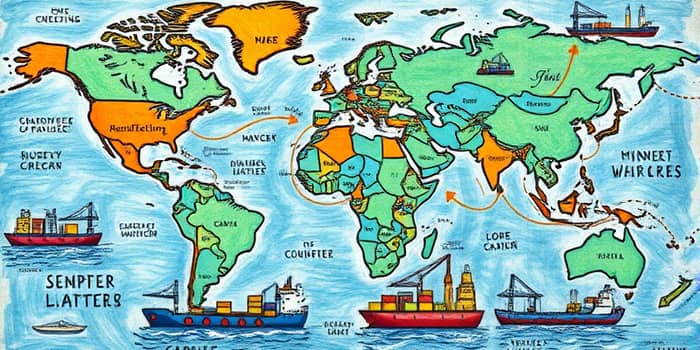
In 2025, the global economy is reshaped by strategic rivalries and policy shifts steering nations into conflict and cooperation. As tariffs rise, businesses and governments scramble to adapt, revealing both opportunity and risk in a complex landscape.
Overview: The New Era of Trade Wars
Decades of hyper-globalization have given way to strategic rivalry and renewed protectionism, as leading powers use trade barriers to secure economic and political objectives. The U.S., China, the EU and others employ tariffs not just for revenue but for leverage in broader geopolitical contests.
This shift drives a scramble for alternatives, with firms diversifying supply chains and governments crafting industrial policies to protect key sectors. The result is a mosaic of winners and losers, each shaped by geography, sector, and strategic flexibility.
Major Players and Policy Mechanisms
The United States leads with sweeping levies justified under national security, while China responds with matching duties. The EU, Canada, Japan and others deploy countermeasures, creating a cycle of escalation and temporary pauses in key industries.
These policies hinge on political concessions under national security claims, testing World Trade Organization rules and challenging long-standing trade norms. Retaliatory tariffs now shape global commerce, influencing everything from raw materials to consumer electronics.
Tariff Mechanisms: Numbers and Recent Announcements
A snapshot of headline rates highlights the intensity of these disputes and their unpredictable nature, as new levies emerge and exemptions are granted on short notice.
Such unpredictable tariff adjustments and volatility force companies to revise sourcing strategies, buffer inventories and accelerate automation investments to offset rising costs.
Winners: By Country, Region, and Sector
Certain nations and industries have emerged stronger, capitalizing on shifting flows and new trade realignments. Alternative hubs attract investment, while select sectors ride the wave of digital transformation.
- India, Vietnam, Mexico and Southeast Asian nations gain manufacturing relocations under the “China +1” strategy.
- Big Tech, Financials and Communications thrive on sustained consumer spending and digital adoption.
- Luxury brands and travel sectors outperform mass-market retailers burdened by cost inflation.
These beneficiaries demonstrate how alternative manufacturing hubs and emerging markets can capture market share when established exporters face steep levies and supply chain disruptions.
Losers: By Country, Region, and Sector
Highly export-dependent and single-market economies bear the brunt of retaliatory duties, while sectors with intricate cross-border inputs suffer under fragmented rules of origin.
- Germany, South Korea and Japan face significant pain in autos, industrial machinery and semiconductors.
- China’s GDP may lose 1–2% without aggressive stimulus, despite resilience in Asia and Africa trade ties.
- Automotive, Electronics and Consumer Staples endure higher costs and logistical bottlenecks.
These challenges stem from tariff-sensitive supply chain fragmentation, which increases production costs and forces reevaluation of long-standing manufacturing networks.
Sectoral Trends: Big Tech and Beyond
Big Tech continues to outpace the market, driven by AI, cloud computing and digital services that sidestep most tariffs. Utilities and Health Care, however, face mixed outcomes as capital projects slow under cost pressures and regulatory uncertainty.
Raw material suppliers in lightly taxed countries often enjoy a temporary boost in demand, but must plan for eventual normalization of trade barriers and potential second-order disruptions.
How Companies Are Adapting Supply Chains
Firms worldwide accelerate supply chain diversification and regionalization, investing in automation, robotics and nearshoring to reduce tariff exposure. Strategic procurement now includes multiple desktop scenarios to model cost, time and risk across dozens of jurisdictions.
- Reshoring critical component production to domestic or friendly markets.
- Forming regional clusters to leverage free trade agreements and labor pools.
- Building dynamic contracts with multiple suppliers to pivot quickly.
The Human Impact: Consumers, Workers, and Investors
Rising tariffs pass through to consumers in the form of higher prices, effectively acting as a marginal 1% tax increase on U.S. households. Workers in export industries face layoffs or relocation, while investors confront sector rotation and increased volatility.
Governments must balance protectionist impulses with social welfare considerations, deploying targeted relief and retraining programs where industrial shifts are most severe.
Future Scenarios and Strategic Responses
Several endgames are plausible: a negotiated rollback of tariffs, permanent division of trade blocs, or continued tit-for-tat escalation. Businesses should maintain risk management and resilience planning through scenario analysis and close monitoring of policy signals.
Public-private partnerships can foster innovation in critical sectors, while multilateral dialogues—despite friction—remain essential to prevent lasting fragmentation of the global system.
Expert Perspectives and Key Takeaways
Analysts caution that real winners are those who avoid the worst impacts, not those who gain dramatically. History suggests tariffs generate inefficiencies and modest gains at best, underscoring the value of adaptability, digital innovation and diversified market strategies.
Ultimately, nations and companies that embrace adaptive transformation and digital innovation will be best positioned to navigate the uncertainties ahead and emerge more resilient in the next phase of globalization.
As we chart these turbulent waters, the interplay of policy, technology and human ingenuity will define tomorrow’s economic order—revealing new winners while reminding us of the costs inherent in closing borders.
References
- https://www.axios.com/2025/08/01/tariffs-trade-war-ai-real-estate
- https://moneyfederation.com/2025/11/the-shifting-landscape-of-global-trade-winners-and-losers-in-2025.html
- https://www.troweprice.com/en/us/insights/losers-and-relative-winners-of-trumps-shapeshifting-tariff-war
- https://www.youtube.com/watch?v=QUgMYXk8Du4
- https://advisorscapital.com/portfolio/china-and-emerging-markets-trump-tariff-losers/
- https://atlasinstitute.org/the-winners-losers-and-reasons-for-a-renewed-global-trade-war/
- https://papers.ssrn.com/sol3/papers.cfm?abstract_id=5392809