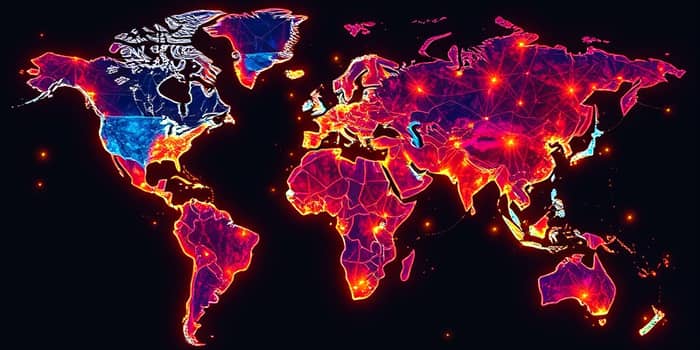
Globalization is not restarting; it is evolving into an era defined by fragmented, regionally concentrated and digitally mediated systems. This new frontier demands fresh perspectives on how economic power shifts, regions realign, and technology redraws the global map.
Historical Arc of Economic Geography
The story of economic geography spans millennia, tracing the rise and fall of regional powerhouses. From early Asia’s dominance to Europe’s Industrial Revolution surge, and North America’s 20th-century primacy, today we witness a resurgence of Asia that is reshaping the global balance once more.
The late 20th century saw liberalization in China and India, along with the Soviet bloc’s collapse, doubling the world labor force and unleashing an unprecedented integration drive. By mid-2020s, forecasts predicted a historic transfer of relative wealth from West to East, heralding a multipolar order.
Theoretical Landscapes: Flat, Curved, and Uneven Worlds
Scholars debate the shape of globalization’s terrain. Three key images illustrate these tensions:
- Flat world thesis: technology flattens distance, enabling global competition from anywhere.
- Curved world perspective: simultaneous globalization and localization create concentrated economic “peaks.”
- Uneven geography critique: persistent clusters and divides produce global “peaks and troughs.”
In reality, we see an economy neither flat nor uniformly curved but profoundly uneven, now being reshaped by digital innovation and geopolitical realignments.
Multipolar Growth and Digital Divides
Economic growth in the mid-2020s is slowing and fragile. Projections by the IMF and UN paint a picture of modest expansion, with global GDP growth easing to around 3.1% by 2026 and real trade volumes up barely 1% in early 2025. Yet risks are rising: geopolitical instability and trade policy changes now rank equally as top threats.
- Trade growth headwinds: Q1 2025 saw just 1.5% value expansion in global trade.
- Digital market concentration: five multinationals now command 48% of global digital sales.
- Shifting trade balances: US imports surged 14%, EU exports climbed 6% in early 2025.
These trends reveal a differentiated across distinct scales world: digital cores expand while peripheries scramble for inclusion.
Geo-economic Fragmentation and Rewiring Value Chains
The age of hyper-globalization gives way to geo-economic fragmentation and bloc-based trade. U.S. tariff hikes—averaging over 18%—and proposals for duties up to 60% on Chinese goods have driven nations to reorient supply chains and seek new partners.
- Tariff volatility: highest U.S. average since 1934, prompting global sourcing shifts.
- Friend-shoring surge: companies move production to allied regions to mitigate risk.
- Economic cost: financial fragmentation alone could shave up to $5.7 trillion off output.
This rewiring of global value chains underscores companies’ rising focus on friend-shoring and regional hubs, at the expense of long-distance networks.
Urban Concentration and Core–Periphery Dynamics
Even as trade diversifies, economic activity increasingly concentrates in urban corridors. Agglomeration benefits—talent pools, innovation clusters, infrastructure—create powerful peaks. Cities such as Bangalore, Shanghai, and New York link through data, finance, and transport networks, forming a digital and logistical global cities tied by telecommunication backbone. Meanwhile, rural and remote areas face underinvestment, deepening the divide.
Environmental and Demographic Dimensions
Climate change, resource scarcity, and demographic shifts further reshape geographies. Water stress in South Asia and desertification in parts of Africa force economic adaptation, while aging populations in Europe and East Asia contrast with youthful growth in Africa’s corridors. These dynamics layer onto geopolitical blocs and digital divides, creating complex trade-offs between sustainability and growth. Regions that manage resources sustainably and harness demographic dividends will become new growth frontiers.
A Call to Navigate the New Frontier
In this era of structurally uneven yet interconnected geographies, businesses, governments, and communities must adopt agile strategies. Embrace resilient supply chains, invest in digital infrastructure, and foster regional partnerships. Prioritize sustainable resource management and inclusive urban planning to bridge divides.
Globalization’s new frontier is a landscape of opportunity and challenge. By understanding its contours—historical legacies, theoretical tensions, technological revolutions, and environmental limits—we can craft policies and strategies that harness connectivity while addressing fragmentation. The task ahead is to reshape economic geographies in ways that are dynamic, equitable, and sustainable, ensuring that the next chapter of globalization uplifts all regions, not just a few.
References
- https://academic.oup.com/cjres/article-abstract/1/3/351/385861
- https://www.lazard.com/research-insights/top-geopolitical-trends-in-2025/
- https://unctad.org/publication/global-trade-update-july-2025-global-trade-endures-policy-changes-and-geoeconomic-risks
- https://www.e-ir.info/2011/07/26/on-the-necessarily-uneven-materialities-of-%E2%80%98globalization%E2%80%99-and-economic-development-why-geography-still-matters/
- https://www.weforum.org/stories/2025/08/inflection-points-7-global-shifts-defining-2025-so-far-in-charts/
- https://opened.tesu.edu/umnworldgeography/chapter/1-4-globalization-and-development/
- https://www.mckinsey.com/capabilities/strategy-and-corporate-finance/our-insights/economic-conditions-outlook
- https://ourworldindata.org/trade-and-globalization
- https://www.imf.org/en/publications/weo/issues/2025/10/14/world-economic-outlook-october-2025
- https://www.taylorfrancis.com/books/oa-edit/10.4324/9780203000403/changing-economic-geography-globalization-giovanna-vertova
- https://sk.sagepub.com/hnbk/edvol/hdbk_economicgeography/chpt/unpacking-globalization-changing-geographies-the
- https://www.edc.ca/en/article/global-economic-trends.html
- https://www.un.org/development/desa/dpad/publication/world-economic-situation-and-prospects-2025/