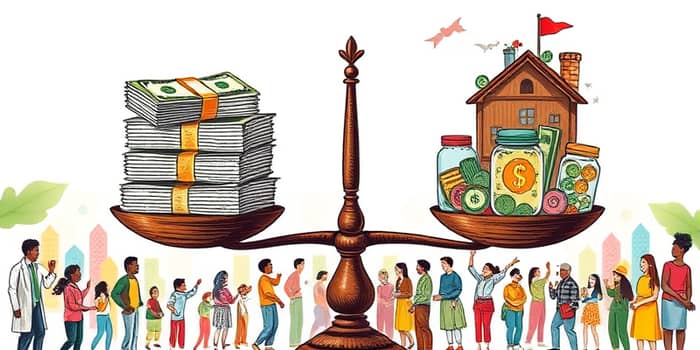
Understanding the difference between income and wealth is essential for achieving true financial stability and resilience. While both concepts are intertwined, they play distinct roles in determining our capacity to weather challenges, pursue opportunities, and improve overall well-being.
Core Definitions: Income vs. Wealth
Income refers to the flow of money received over a set period from sources such as wages, business profits, interest, dividends, rental payments, pensions, and government transfers. It is typically calculated on an annual or monthly basis and reflects how much money enters a household or individual’s budget.
Wealth, or net worth, captures a stock of resources at a given point in time. It represents the total value of assets—such as homes, vehicles, retirement accounts, stocks, and savings—minus outstanding debts like mortgages, student loans, and credit card balances.
Why does this distinction matter? Two families may earn similar salaries yet differ dramatically in their financial foundation. One might rent and struggle under debt, while the other owns property outright and holds investments, granting them financial resilience and security even if monthly incomes match.
Measuring Income and Wealth
Income is often reported as annual household figures, broken down by source (labor vs. capital), pre- versus after-tax amounts, and individual versus combined household earnings. It provides insight into regular cash flow but offers limited perspective on long-term stability.
Wealth is measured by totaling all assets and subtracting debts. Asset categories include primary and secondary residences, business equity, retirement funds, and liquid financial holdings. Debt categories span mortgages, auto loans, student loans, credit cards, and medical obligations. Surveys such as the US Survey of Consumer Finances regularly publish median and mean net worth across demographic groups.
Distribution Patterns and Concrete Data
Wealth is significantly more concentrated than income, with a small proportion of households holding the lion’s share of assets. Racial, age, and educational gaps in wealth far exceed those seen in income distributions, reflecting deep-seated historical and structural factors.
These figures illustrate both the magnitude of wealth inequality and its vulnerability to life events. A single health issue in later life can erode years of savings, while achieving a societal benchmark for “wealth” often requires multi-generational advantages.
Income, Wealth, and Financial Health
Financial health encompasses more than just earnings; it is the ability to manage expenses, build savings, minimize debt, and prepare for unexpected challenges. This holistic measure predicts economic hardship more effectively than income alone and serves as a critical social determinant of overall well-being.
Many middle-income households appear stable on paper yet face high fixed costs, fluctuating pay, and scant emergency funds. This financial stress and strain undermines long-term progress, turning modest incomes into sources of chronic anxiety rather than security.
Effects on Health and Longevity
Both income and wealth shape health outcomes, but their impacts differ in subtle ways. Higher earnings directly improve access to medical care, nutrition, and safe living conditions, establishing a stepwise income–health gradient across all socioeconomic levels.
- Increased ability to afford preventive care and health insurance
- Healthier housing and neighborhood environments
- Jobs with paid leave, lower occupational risk, and schedule flexibility
Wealth provides an additional protective layer. Assets allow households to continue care during income disruptions, reducing stress and preventing medical debt accumulation. Public health research shows that homeownership, savings, and investment portfolios contribute to better health independent of salary levels.
- Buffering financial shocks: Access to savings or lines of credit in emergencies
- Reduced mental strain: Lower debt-to-income ratios ease anxiety
- Enhanced environment: Ability to choose healthier neighborhoods
Moreover, poor health can rapidly undermine financial status. Chronic illness or severe disease often forces reduced work hours or early retirement, while out-of-pocket medical expenses deplete both income and accumulated wealth.
Practical Implications and Action Steps
Recognizing the distinction between income and wealth empowers individuals and policymakers to craft targeted strategies for long-term security. At the individual level, building net worth alongside growing earnings is key to sustainable financial health.
- Prioritize creating an emergency fund covering 3–6 months of expenses
- Focus on debt reduction and asset diversification to minimize risk
- Invest consistently in retirement accounts and low-cost index funds
- Seek opportunities to build home equity or other real estate assets
On a policy level, addressing wealth inequality requires measures such as enhanced support for first-time homebuyers, fair access to credit, debt relief programs, and incentives for long-term savings. Social safety nets must evolve to protect both income flows and accumulated assets, ensuring that financial setbacks don’t translate into lifelong disadvantage.
By distinguishing clearly between income and wealth, individuals can make more informed decisions about budgeting, saving, and investing. Policymakers can design interventions that bolster both regular cash flow and generous asset-building opportunities, forging a path toward greater financial resilience for all.
References
- https://a816-dohbesp.nyc.gov/IndicatorPublic/data-stories/racial-wealth-gap/
- https://www.communitysolutions.com/resources/wealth-health-disparities-increase-risk-of-poor-health-outcomes
- https://www.pewresearch.org/decoded/2021/07/whats-the-difference-between-income-and-wealth-and-other-common-questions-about-economic-concepts/
- https://drexel.edu/hunger-free-center/research/briefs-and-reports/financial-health/
- https://pmc.ncbi.nlm.nih.gov/articles/PMC3697076/
- https://fortune.com/2025/12/11/how-much-money-to-be-wealthy-in-america-charles-schwab-survey/
- https://publichealthscotland.scot/population-health/social-and-economic-impacts-on-health/economy-and-poverty/income-wealth-and-health/why-income-and-wealth-matter-for-health/
- https://www.khanacademy.org/economics-finance-domain/macroeconomics/macroeconomics-income-inequality/piketty-capital/v/wealth-vs-income
- https://www.cuimc.columbia.edu/news/link-between-health-and-financial-well-being
- https://www.healthaffairs.org/doi/10.1377/hlthaff.2022.00846
- https://finhealthnetwork.org/research/financial-health-frontiers-households-under-pressure/