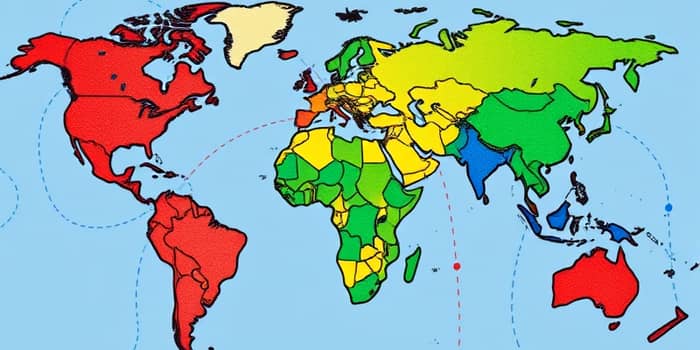
As global trade trends evolve under geopolitical pressures, investors must adapt their approaches to capture new opportunities.
Macro Context: Trade is Fragmenting, Not Collapsing
In 2025, global trade in goods and services is set to exceed $35 trillion, marking a record high. This represents a 7% increase year-on-year, driven by $1.5 trillion in goods and $750 billion in services growth.
Monthly global goods trade volumes grew at an average 4.7% through August 2025, compared to 2.7% in 2024 and a 0.7% contraction in 2023. This shift from price-driven to volume-driven expansion signals stable demand despite easing inflationary pressures.
UNCTAD reports that trade growth has consistently outpaced global GDP growth, highlighting a re-wiring of trade relationships rather than a retreat from globalization.
Trade Blocs and Fragmentation: Understanding the New Landscape
Globalization is not collapsing but evolving into distinct trade blocs. Formal agreements like the EU, USMCA, RCEP, and AfCFTA coexist with de facto alignments centered on the U.S. and China.
Mechanisms such as friendshoring and nearshoring demonstrate how companies and governments prioritize politically aligned and geographically proximate partners. Indicators for these trends have returned to 2021 averages, indicating a renewed focus on nearshoring and friendshoring trends across regions.
This process, often termed “bloc-alization,” creates networks crystallizing around major hubs, reshaping global trade flows and altering risk-return profiles for investors.
Regional Winners, Losers, and Patterns
Not all regions are affected equally. Understanding which areas lead or lag provides investors with crucial insights.
East Asia
East Asia has witnessed the strongest export growth over the past year, with a 9% increase overall and 10% in intra-regional trade. Electronics exports surged by 14%, fueled by AI-related demand.
China and South Korea drive this momentum, leveraging both Western markets and South–South integration. This highlights the region’s ability to adapt and thrive within multiple blocs.
Africa
Africa’s imports grew 10% and exports 6% over the last four quarters. The AfCFTA is deepening intra-African trade, positioning the continent as a key beneficiary of resource flows and demographic dividends.
Despite infrastructure and governance challenges, improved connectivity and greater South–South engagement are transforming Africa into a strategic trade hub.
South America and South–South Trade
South–South trade expanded by 8%, outpacing global averages. Intra-regional trade in South America grew 7% over four quarters, led by Brazil’s diverse export portfolio.
These trends underscore the growing importance of developing economies as both suppliers and markets within emerging trade blocs.
North America and Europe
North American exports fell 3% in Q3 2025 but rose 2% annually, while imports climbed 6%. The USMCA corridor now accounts for nearly 29% of U.S. goods trade, dwarfing trade with China at 6.9%.
Europe saw export growth of 6% annually and import growth of 8%, benefiting from the EU single market and strong ties with neighboring countries. This reinforces the bloc-alization dynamic in mature economies.
Sectoral Shifts That Matter
Sector dynamics within trade blocs are critical for portfolio allocation:
- manufacturing and technology supply chains—trade grew 10% annually, with electronics up 14%, highlighting core battlegrounds between blocs.
- Agriculture and Food Security: Trade rose 6% over four quarters, driven by cereals (+11%) and fruits (+11%). Diversifying food supply across regions is a strategic and foreign-policy tool.
- Automotive and Energy Transition: Hybrid vehicles trade surged 22%, while EV trade declined 5%, reflecting policy shifts and infrastructure gaps.
- Commodities and Resources: Iron and steel trade jumped 40%, though overall resource flows are muted by lower fuel prices.
Investment Strategies for a Divided World
In a fragmented trade environment, investors should consider the following approaches:
- Diversify across blocs: spread risk across U.S., China, and regional hubs to capture varied growth drivers.
- Focus on resilient sectors: Target manufacturing, technology, and critical infrastructure that benefit from policy support.
- Leverage data-driven insights: Use trade flow data to identify emerging patterns and re-wiring of supply chains.
- Engage thematic funds: Seek exposure to friendshoring trends through specialized equity and bond strategies.
- Balance short and long durations: Combine liquid positions in developed-market assets with selective emerging-market credits.
Navigating Risks and Returns
While bloc-oriented investments can offer enhanced returns through targeted exposure, they also carry unique risks:
Geopolitical tensions may lead to sudden policy shifts or trade barriers. Currency volatility can amplify returns but also increase drawdowns. Supply chain disruptions, whether due to climate events or infrastructure delays, affect sector performance.
Investors should implement robust risk management frameworks, including stress testing scenarios and dynamic hedging strategies. Collaboration with local partners and leveraging on-the-ground expertise can mitigate execution risks in less familiar markets.
Conclusion: Embracing Bloc-Aligned Opportunities
In 2025 and beyond, the global economy will remain interconnected, but through evolving networks of trade blocs. Successful investors will recognize that growth is not uniform, and the era of one-size-fits-all globalization has given way to targeted, bloc-specific strategies.
By understanding regional dynamics, sectoral shifts, and the underlying geopolitical drivers, investors can position portfolios to harness the benefits of a divided yet deeply interconnected global economy.
Embrace this new paradigm with agility and insight, and transform the challenges of fragmentation into pathways for sustainable, diversified growth.
References
- https://unctad.org/news/global-trade-hit-record-35-trillion-despite-slowing-momentum
- https://unctad.org/publication/global-trade-update-december-2025-global-trade-poised-record-breaking-2025-flows
- https://www.census.gov/foreign-trade/statistics/highlights/topcm.html
- https://blogs.worldbank.org/en/developmenttalk/global-trade-s-rollercoaster-ride
- https://www.hinrichfoundation.com/research/how-to-use-it/global-trade-outlook-and-statistics-update-october-2025
- https://www.visualcapitalist.com/sp/hf07-trade-agreements/
- https://www.federalreserve.gov/econres/notes/feds-notes/understanding-trade-fragmentation-20251212.html