Global economic divides persist at unprecedented scales, driving debates over fairness, efficiency, and morality. By examining who truly benefits from these gaps, we adopt a contrarian lens on wealth flows across borders and sectors.
Mapping Global Disparities
Understanding income and wealth disparities requires standardized metrics. The global median income of $3,400 (international dollars) equips analysts to compare living standards across nations and time.
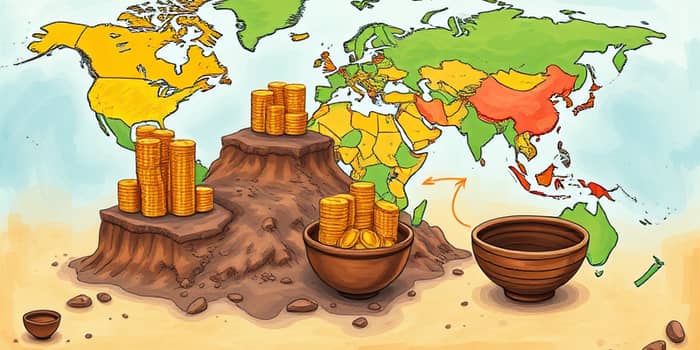
To appreciate extremes, note that the richest 10 percent command 54 percent of global income and 74 percent of total wealth, while over one-third of humanity survives on $2.15 to $6.85 per day.
This table highlights the stark differences in within-country inequality, revealing where the wealth divide is most pronounced. While globalization has narrowed gaps between nations, inequality within societies escalates.
Drivers of Inequality
Multiple forces propel the widening chasm between rich and poor. Globalization’s dual nature has lifted millions above poverty lines yet fueled concentration of gains among elites.
- Labor arbitrage and lower production costs in emerging markets
- Regulatory and tax haven migration by multinational corporations
- Capital accumulation in financial centers with minimal redistribution
- Technological change favoring high-skilled, high-income workers
Political influence further skewers outcomes. Surveys show 60 percent of adults believe the affluent hold excessive political power, stifling reforms that address economic inclusion.
Who Profits from Disparities?
At the apex, we find top global percentiles and country-level elites. Their strategies exploit cost differences across labor, resources, and regulations to maximize returns. Examples include:
- Multinational corporations sourcing inputs from low-wage regions
- Private equity firms optimizing tax burdens and regulatory arbitrage
- High-frequency traders capitalizing on cross-border financial inefficiencies
- Real estate investors acquiring undervalued land in developing economies
Such actors tap into systemic structural gaps, turning inequality into profit engines. Even philanthropic vehicles may inadvertently reinforce disparities through debt instruments and conditional funding.
Impact and Perception
Public sentiment underscores urgency: 54 percent across 36 countries view the rich-poor gap as a major national crisis. Distrust in government peaks where inequality rises fastest, eroding social cohesion.
The post-pandemic shock magnified fractures. The World Bank recorded the largest surge in income inequality in three decades, as job losses hit lower-income groups hardest. Recovery remains uneven, with disadvantaged segments trailing behind.
Contrarian Strategies and Moral Debate
The contrarian perspective does not condone exploitation but probes the logic behind profit from disparities. Efficiency arguments claim cost differentials drive global competitiveness and consumer benefits. Critics counter that unfettered arbitrage undermines labor rights and environmental standards.
Key moral tensions include:
- Economic efficiency versus human dignity
- Short-term profit against long-term stability
- Global competitiveness versus domestic inequality
Proponents of minimal redistribution argue incentives matter for growth, while advocates for reform highlight the risks of social backlash and political instability if disparities remain unchecked.
Historical Context and Shocks
Major crises reshape disparity dynamics. The COVID-19 pandemic induced unprecedented job losses in informal sectors, rolling back poverty reduction by years. Climate-related events now threaten agrarian livelihoods, triggering migration and resource competition.
Shifts in economic power centers also play a role. Emerging economies, once growth engines narrowing between-country gaps, now face domestic inequality spikes as capital concentrates in urban hubs and resource industries.
The Path Forward
Addressing global imbalances calls for multifaceted action. Higher growth in poorer nations can narrow gaps between societies, but without targeted redistribution, within-country divides worsen.
Policymakers and investors should consider:
- Progressive taxation paired with transparent public spending
- Conditional infrastructure investment in underserved regions
- Strengthening labor standards in global supply chains
- Incentivizing sustainable practices to mitigate climate vulnerabilities
International coordination, through platforms like the G20 and UN frameworks, remains crucial. By aligning incentives and sharing best practices, stakeholders can create a more inclusive growth paradigm.
Ultimately, profiting from global disparities without heed to fairness carries systemic risks. The potential for social upheaval, regulatory crackdowns, and ecological collapse underscores the need for a balanced approach that respects both economic efficiency and human well-being.
References
- https://ourworldindata.org/global-inequality-opportunity-to-give
- https://www.un.org/en/desa/6-takeaways-world-social-report-2025
- https://worldpopulationreview.com/country-rankings/wealth-inequality-by-country
- https://openknowledge.worldbank.org/entities/publication/2683322d-068d-4300-b0dc-532ca49c8c13
- https://www.pewresearch.org/global/2025/01/09/economic-inequality-seen-as-major-challenge-around-the-world/
- https://www.imf.org/en/publications/weo/issues/2025/10/14/world-economic-outlook-october-2025
- https://www.visualcapitalist.com/visualizing-global-wealth-inequality/
- https://wid.world