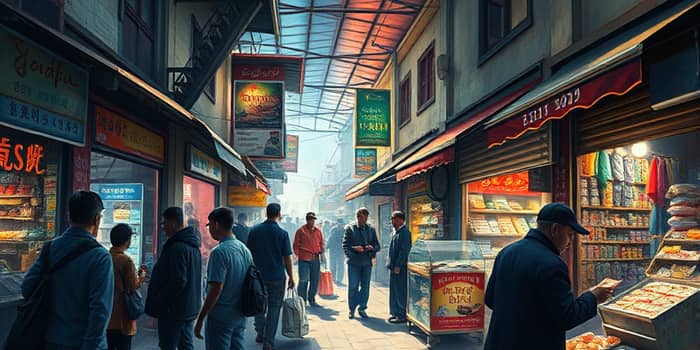
From corner stalls in bustling cities to hidden networks running beneath official channels, shadow economies permeate every society.
These informal, often untaxed exchanges shape livelihoods, policy, and the future of global development.
Understanding the Shadow Economy
The shadow economy comprises all economic activities that go unreported, untaxed, or unregulated.
It includes legal informal work like street vending and cash-based services, alongside illicit operations such as smuggling and money laundering.
By blending legitimate and criminal enterprises, these markets thrive on anonymity and opportunity, operating beyond government oversight.
At its core lies the tension between formal regulation and untaxed or unregulated economic activities that persist in every corner of the globe.
Global Size and Evolving Trends
- 1991–2015 average: 31.9% of global GDP, declining to 27.8% by 2015.
- 2011–2025 forecast: projected drop from 23% to 21% of GDP.
- 2000–2023 decline: average 6.7% reduction, 119 of 131 countries saw decreases.
- 2023 weighted estimate: 11.8% of global GDP generated outside official channels.
Despite the downward trajectory, trillions of dollars remain entrenched in shadow markets, fueling informal livelihoods while depriving public coffers.
Occasional surges occur during crises, as seen when pandemic disruptions prompted temporary rises in low- and middle-income regions.
Regional Variations and Realities
In nations with limited social safety nets and high poverty, informal labor fills critical gaps but also perpetuates vulnerability.
Conversely, high-income countries maintain smaller shadows, though high-tech evasion and specialized illicit trades still thrive in pockets.
Drivers Behind the Shadows
- Economic Development: Lower GDP per capita correlates with larger informal sectors.
- Tax Burden: Excessive direct or indirect taxes incentivize underground transactions.
- Regulatory Complexity: Costly labor and business rules push firms off the books.
- Public Service Quality: Weak provision erodes trust in official institutions.
- Official Economy Strain: Recessions and unemployment spur informal work.
- Social Factors: Poverty, inequality, corruption, and limited financial access.
These six factors interweave, creating environments where illicit trade flourishes and formal enterprises struggle to compete on equal footing.
By addressing root causes, governments and communities can begin enabling fair competition and growth across all sectors.
Impacts: Costs and Unseen Risks
The shadow economy’s toll extends far beyond lost tax revenue.
Without registration, businesses lack legal protection, workers miss out on social benefits, and markets operate on unequal terms.
Institutional integrity suffers when widespread evasion undermines public trust, leading to weaker governance and higher corruption.
Security threats also emerge as clandestine funds fuel organized crime, human trafficking, and even terrorism.
Yet informal markets can provide short-term relief for vulnerable populations, offering flexible jobs during downturns when formal roles vanish.
Measuring the Unmeasurable
Quantifying hidden economic activity remains a complex challenge.
Researchers rely on indirect indicators such as currency demand, electricity consumption, and tax–labor gaps to estimate informal trade.
Surveys of households and firms supplement models, while novel techniques—like satellite night lights analysis—provide fresh insights.
Data inconsistencies persist across studies, underlining the need for standardized methodologies and improved transparency.
Turning the Tide: Policy and Practical Steps
A multipronged approach offers the best chance to reduce shadow activity while supporting inclusive growth.
Key strategies include:
- Simplifying regulations and reducing administrative burdens for small businesses.
- Enhancing financial inclusion through microcredit, mobile banking, and digital wallets.
- Investing in public services—healthcare, education, infrastructure—to build trust.
- Leveraging technology (blockchain, AI) for transparent transactions and efficient tax collection.
- Encouraging formalization through incentives, training programs, and accessible registration.
For entrepreneurs and workers, practical steps can ease the transition to formal markets:
Seek out digital payment platforms that offer low fees and easy registration processes.
Join cooperatives or trade associations that provide training, bulk purchasing power, and advocacy support.
Access free or subsidized accounting software to maintain transparent records and build credibility with regulators and lenders.
Engage in community networks that foster peer learning and share strategies for compliance and growth.
By equipping participants with tools and knowledge, informal operators gain confidence to operate within legal frameworks.
Looking Ahead: A Future Beyond the Shadows
As economies evolve, so too must our approaches to informality and illicit trade.
Innovations in digital identity, real-time reporting, and automated enforcement can make hidden transactions visible and accountable.
Empowering citizens through education, technology, and civic engagement fosters transparent and inclusive economic systems that benefit all.
Ultimately, reducing the shadow economy unlocks new tax revenue for public goods, levels the playing field for entrepreneurs, and strengthens social cohesion.
By working together—governments, businesses, and communities—societies can harness the power of innovation to illuminate the unseen, transform challenges into opportunity, and build a more equitable world.
References
- https://www.accaglobal.com/us/en/technical-activities/technical-resources-search/2017/june/emerging-from-the-shadows-the-shadow-economy-to-2025.html
- https://openknowledge.worldbank.org/entities/publication/256e1cbc-c288-591f-a6ac-91d8338196b3
- https://www.bcg.com/publications/2023/unveiling-the-shadow-economy
- https://www.voronoiapp.com/crime/Visualizing-the-Worlds-Shadow-Economies--5018
- https://hbr.org/2018/05/what-45-years-of-data-tells-us-about-globalizations-influence-on-the-shadow-economy
- https://www.visualcapitalist.com/size-of-the-shadow-economy-by-country/
- https://www.integrin.dk/2025/05/21/shadow-economy-in-europe-and-the-world/
- https://www.marketplace.org/story/2024/05/31/how-large-is-the-shadow-economy
- https://www.nature.com/articles/s41599-025-05995-2