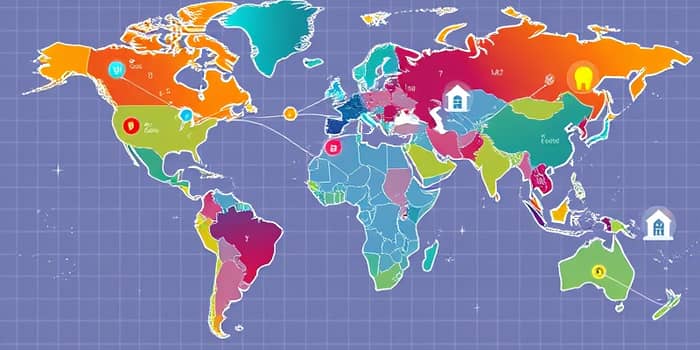
In today’s interconnected financial landscape, mastering the art of global asset allocation is both a science and a craft. With Global assets under management reached $147 trillion by mid-2025, investors must navigate complex trends, regional dynamics, and emerging opportunities.
This comprehensive guide explores how to build resilient, growth-oriented portfolios by diversifying across continents, asset classes, and strategies.
Global Landscape in 2025
The benchmark “World Portfolio” tracks nearly $250 trillion of investable assets—about 200% of global GDP. While this passive approach offers broad exposure, it can amplify home country bias and miss strategic tilts that drive superior risk-adjusted returns.
Recent research shows that money in motion across borders could range from $6 trillion to $10.5 trillion over the next five years as investors adjust to shifting macro conditions, policy uncertainty, and currency risks.
Structural Shifts Shaping Diversification
Three disruptive trends are redefining asset management:
- Convergence of public and private investing through evergreen funds and semi-liquid vehicles.
- Reassertion of home country bias as policy divergence prompts local and cross-border reallocations.
- Mainstream adoption of active ETFs, expanding access and distribution channels.
These forces are driving institutional interest in private equity and real estate outside the US, particularly in Europe, where regulatory frameworks and valuation disciplines are evolving rapidly.
Geographic Opportunities and Risks
While US assets remain prominent, many investors are underweight US equities and bonds. A weaker dollar and cyclical recovery favor allocations to Europe and emerging markets in 2026.
Key regional tilts include:
- Overweight: China equities, Japan REITs, European bank loans, industrial commodities.
- Underweight: US equities, UK assets, EM investment-grade bonds.
Quantitative models from leading asset managers suggest raising China equities from 2% to 4%, Europe ex-UK from 1% to 2%, and Emerging Markets from 5% to 9%, while reducing US exposure to 0%.
Meanwhile, US inflation pressures—driven by tariffs and supply-chain adjustments—may peak near 3.8% core CPI before receding by late 2026.
Asset Classes and Allocation Techniques
Strategic tilting challenges the passive World Portfolio approach. Historically, a simple 60% stocks/40% bonds blend has yielded higher Sharpe ratios than global market-cap benchmarks. But in 2025, layering in alternatives and credit is critical to capture value and manage volatility.
Consider these allocation enhancements:
- Alternatives and secondaries exposure to access private markets and offset public fundraising shortfalls.
- Active management strategies to navigate geopolitical events and valuation extremes.
- Fixed income beyond the US, focusing on Italian BTPs and UK Gilts for attractive yields.
Portfolio Construction and Risk Management
Relying solely on market-value weighted benchmarks may lead to overconcentration in the US and missed diversification benefits. Instead:
• Balance market-cap allocations with strategic tilts toward under-owned regions. • Manage currency risk by partially hedging a weaker dollar into the Japanese yen. • Employ dynamic risk budgeting tools driven by AI and machine learning for adaptive positioning.
Resilient economic data, stable credit spreads, and AI-driven momentum signals support risk assets in the near term—provided portfolios are constructed with robust stress tests and scenario analyses.
The Rise of Alternatives and Private Markets
Alternatives now command over $700 billion in secondaries AUM, with $130 billion raised in 2024 alone. Public–private strategies, evergreen vehicles, and model portfolios are increasing private market exposure in both defined contribution plans and wealth channels.
Non-affluent investors are also gaining access to alternatives through digital platforms and evolving regulations, fueling broader participation and longer accumulation horizons.
Policy, Regulation, and Macro-economic Outlook
Central bank policies, particularly from the US Federal Reserve, will continue to influence yield curves and lending conditions. Protectionist trade measures and tariff developments remain key drivers of supply-chain fragmentation and regional investment flows.
Geopolitical uncertainties—US-China relations, European elections, and tensions stemming from the war in Ukraine—underscore the need for diligent scenario planning and active monitoring of macro variables.
Practical Strategies and Model Allocation Table
Below is a sample global portfolio, reflecting best-in-class allocations and regional overweight positions for 2026, based on leading insights.
This model emphasizes diverse regional exposures and dynamic adjustments to exploit cyclical recoveries and valuation gaps.
Key Takeaways for Investors
• Geographic diversification is essential to mitigate home bias and unlock long-term outperformance. • Structural trends, like the convergence of public and private strategies, are reshaping portfolio construction. • Strategic tilts, active ETFs, and AI-driven risk management enhance adaptability in volatile markets. • Alternatives, dynamic hedging, and tactical region-sector adjustments provide multiple levers for optimized returns.
By embracing these principles and leveraging data-driven insights, investors can master the art of allocation and build resilient portfolios that thrive across continents.
References
- https://www.mckinsey.com/industries/financial-services/our-insights/asset-management-2025-the-great-convergence
- https://am.jpmorgan.com/dk/en/asset-management/per/insights/portfolio-insights/asset-class-views/asset-allocation-views/
- https://www.goldmansachs.com/insights/articles/how-to-build-a-global-investment-portfolio-for-the-next-decade
- https://www.ishares.com/us/insights/investment-directions-fall-2025
- https://www.sageadvisory.com/commentaries/global-asset-allocation-strategy-october-2025/
- https://am.gs.com/en-us/advisors/insights/article/market-know-how
- https://www.blackrock.com/us/individual/insights/blackrock-investment-institute/outlook
- https://www.fieracapital.com/en/insights/global-asset-allocation-team-market-update-november-2025/
- https://www.morganstanley.com/im/fr-fr/intermediary-investor/strategies/solutions-and-multi-asset/global-tactical-asset-allocation.html