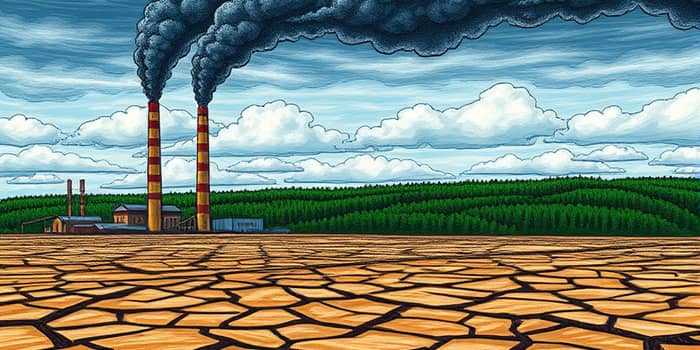
In an era defined by rapid economic expansion, we often overlook the hidden toll paid by our planet. This article delves into the roots of environmental externalities and the pressing need for sustainable progress.
Understanding Environmental Externalities
At its core, an environmental externality is an unintended consequence of economic actions that impacts third parties without compensation. When a factory emits pollutants into the air or discharges waste into a river, the company avoids reflecting the full cost of those emissions in its prices. As a result, communities downstream or downwind bear the brunt of these harmful effects.
Externalities break down into two broad categories:
- Negative externalities: Costs forced upon society, such as respiratory illnesses from air pollution, deforestation leading to habitat loss, and noise pollution disturbing urban neighborhoods.
- Positive externalities: Benefits for third parties, like pollination services provided by beekeeping or restoration of ecosystems through green technologies.
Economic Growth and Environmental Degradation
Economic growth often correlates with rising pollution, although not always at the same pace. Historical data in the United States shows that a 1% increase in economic activity led to only a 0.4% rise in CO2 emissions between 1990 and 2014, while GDP per capita grew at 1.4% annually. This discrepancy hints at the potential for decoupling but also underscores the persistent pressure growth places on natural systems.
One prominent framework, the Environmental Kuznets Curve (EKC), proposes an inverted U-shaped relationship: pollution intensifies in early stages of development, peaks at mid-level incomes, and declines as societies invest in cleaner technologies and stronger regulations. Yet this pattern is far from universal, and many countries remain on the steep upward trajectory without ever reaching the turning point.
Empirical analysis reveals a bidirectional interaction between growth and emissions. Not only does increased output generate more pollutants, but rising pollution feeds back into the economy by impairing health, eroding productivity, and inflating medical costs. In China, for example, SO2 emissions exhibited inertia relative to GDP growth: medium-growth regimes saw a strong positive correlation, whereas high-growth and low-growth periods experienced declining emission rates as regulatory measures stiffened.
Despite promising signs, decoupling remains challenging. Many emerging economies still rely heavily on coal and deforestation to fuel growth, while wealthier nations outsource their pollution through complex global supply chains. International trade can shift the burden onto lower-income countries, where environmental regulations are weaker and enforcement is lax. This relocation of harmful activities underscores the need for a globally coordinated regulatory framework that holds all actors accountable.
Sectoral Impacts: A Closer Look
Different industries contribute to externalities in distinct ways, highlighting where intervention can be most effective. Consider the following overview:
This cross-sectoral lens demonstrates that tackling externalities demands tailor-made solutions, as one-size-fits-all approaches often fall short of addressing specific environmental challenges.
Real-World Examples and Mechanisms
Historical and contemporary cases illustrate how externalities emerge and persist:
- Industrial Revolution: A surge in coal-driven productivity overshadowed by unchecked emissions, leading to the infamous smogs and polluted waterways that plagued major cities.
- Deforestation in the Amazon: Timber extraction generates profits for logging enterprises but triggers massive carbon release and biodiversity collapse, with long-term climate repercussions.
- Tragedy of the commons: Shared fisheries struggle under unregulated harvesting, depleting stocks and undermining community livelihoods.
Such mechanisms share a common root: poorly defined property rights over shared resources. When air, water, or wildlife belongs to no single owner, the incentive to conserve diminishes, and the race to the bottom accelerates resource degradation.
Health, Social, and Global Impacts
The ripple effects of environmental externalities extend far beyond damaged ecosystems. Communities near pollution hotspots face elevated rates of asthma, cardiovascular disease, and premature death, burdening healthcare systems and straining social services. Children growing up in contaminated neighborhoods often suffer lifelong health challenges that impair educational attainment and workforce participation.
On a global scale, greenhouse gas emissions ignore national borders. Rising sea levels, extreme weather events, and shifting agricultural zones jeopardize food security and displace vulnerable populations. These transboundary impacts necessitate coordinated international action as no single nation can manage the climate crisis in isolation.
Social inequalities amplify the burden of externalities. Marginalized populations often reside in areas with lower land values but higher pollution levels, compounding pre-existing disparities. Access to clean resources becomes a matter of environmental justice, with communities demanding equitable distribution of both the benefits and costs of development.
Policy Responses and Sustainable Paths
A range of economic and regulatory instruments aim to realign private incentives with social welfare:
- Carbon pricing and emission taxes: Internalize the cost of carbon releases, making polluting activities less attractive financially.
- Cap-and-trade systems: Set limits on total emissions and allow firms to buy and sell permits, fostering market-driven reductions.
- Subsidies and incentives: Support renewable energy, sustainable agriculture, and research in clean technologies to generate positive environmental spillover effects.
Beyond these instruments lies a broader imperative: redefining growth itself. Concepts like "green growth" or "degrowth" challenge the notion that rising GDP must entail greater resource use. By prioritizing well-being, social equity, and ecological resilience, societies can forge a new development path that respects planetary boundaries.
Ultimately, confronting the dark side of growth demands collective will, innovative policies, and a shared vision for the future. By acknowledging the true costs of our economic choices and embracing sustainable alternatives, we can transform externalities into opportunities for regeneration and long-term prosperity.
References
- https://energy.sustainability-directory.com/term/environmental-externalities/
- https://pmc.ncbi.nlm.nih.gov/articles/PMC9684716/
- https://fiveable.me/public-economics/unit-8/environmental-externalities-market-failure/study-guide/jXHgOXUIoR7hebdW
- https://www.tandfonline.com/doi/full/10.1080/27658511.2024.2345445
- https://corporatefinanceinstitute.com/resources/economics/externality/
- https://www.stlouisfed.org/on-the-economy/2017/september/effects-economic-growth-pollution
- https://conceptually.org/concepts/externalities
- https://www.epa.gov/clean-air-act-overview/clean-air-act-and-economy
- https://www.imf.org/en/publications/fandd/issues/series/back-to-basics/externalities
- https://earth.org/gdp-climate-change/
- https://accesspartnership.com/opinion/why-we-should-price-environmental-externalities/
- https://www.eea.europa.eu/en/analysis/publications/growth-without-economic-growth
- https://greenly.earth/en-us/blog/ecology-news/what-was-the-industrial-revolutions-environmental-impact