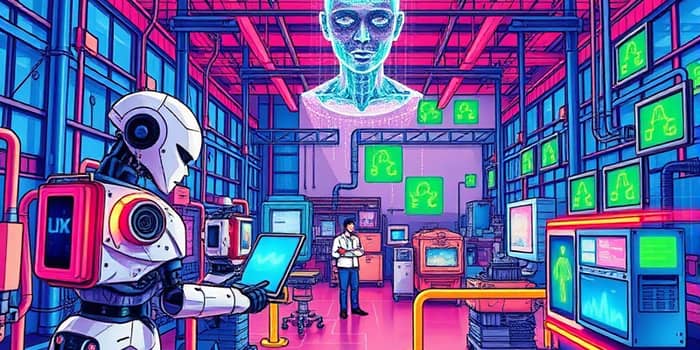
As we step into 2025 and beyond, manufacturing is undergoing a seismic transformation driven by cutting-edge technologies. From intelligent analytics to autonomous robots, factories are becoming smarter, safer, and more efficient than ever.
Transforming Production with AI Integration
Artificial intelligence has moved from pilot projects to the heart of modern factories. By 2025, 89% of manufacturers plan to integrate AI into their production networks, enabling a host of new capabilities.
Key advantages include:
- Real-time defect detection via computer vision, catching flaws before they escalate.
- Predictive maintenance reducing downtime and costs, by anticipating machine failures.
- Optimization of supply chain logistics and inventory, ensuring parts arrive exactly when needed.
- Enhanced workplace safety through AI-powered surveillance, detecting hazards faster than human eyes.
By embedding AI-driven analytics and decision-making are central to operations, manufacturers can adjust parameters on the fly, maintain quality standards, and allocate resources dynamically. Deloitte reports that 22% of firms plan to deploy autonomous robots by 2026, underlining the shift toward agentic AI—machines that can act independently to accomplish tasks.
Robots and the Rise of Collaborative Automation
While traditional automation has excelled at repetitive tasks, collaborative robots, or cobots, are redefining human–machine partnerships. Designed to work safely beside operators, cobots boost precision, consistency, and safety.
Small and mid-sized U.S. manufacturers are at the forefront: 93.4% of firms under 100 employees have adopted cobots for assembly, quality inspection, and machinery tending.
Cobots can:
- Take on hazardous welding and painting in shipyards.
- Perform palletizing and packaging with millimeter accuracy.
- Assist human workers on complex assembly lines.
As these robots become more intuitive, production floors transform into hybrid environments where interconnected production systems optimizing workflows deliver unprecedented throughput and reliability.
Connecting the Factory Floor with IIoT and Edge Computing
The Industrial Internet of Things (IIoT) weaves together machines, sensors, and analytics engines. Smart sensors monitor temperature, vibration, flow, and energy usage in real time, feeding streams of data into analytics platforms.
Edge computing brings intelligence closer to physical assets, reducing latency and enabling instant decision-making without constant reliance on cloud servers. As Rockwell Automation notes, distributed intelligence at or near processes is key to maintaining seamless operations.
Digital twins—virtual replicas of physical equipment—are now robust enough to simulate entire production lines. Managers can run “what if” scenarios, test process changes, and visualize outcomes before touching a single machine. The emergence of fully automated facilities with minimal human intervention, dubbed “dark factories,” showcases the power of these innovations.
Sustainability and Resilient Supply Chains
Green manufacturing has moved from a moral choice to a strategic imperative. Companies are deploying AI-powered energy management systems and adopting circular models that emphasize reuse and recyclability.
Meanwhile, supply chain strategies are shifting toward localization. Reshoring and nearshoring reduce shipping costs, enhance quality control, and shorten lead times. Technology plays a pivotal role:
- Blockchain for supply chain visibility and adaptability, ensuring traceability and trust.
- IIoT-enabled asset tracking, monitoring goods in transit in real time.
- AI-driven demand forecasting, aligning production with actual market needs.
These measures foster resilience against disruptions—from pandemics to geopolitical tensions—while delivering environmental benefits.
Key Statistics at a Glance
This table highlights the rapid pace of change and the scale of investment pouring into modern manufacturing.
Securing Tomorrow’s Smart Factories
As connectivity expands, cybersecurity becomes paramount. Industrial networks face an uptick in sophisticated attacks targeting operational technology (OT) systems.
Manufacturers are adopting zero-trust frameworks, AI-driven threat detection, and advanced encryption to safeguard data and processes. Some even leverage blockchain to secure transactional records and prevent tampering.
Proactive security measures are crucial for maintaining stakeholder trust and avoiding costly downtime or reputational damage.
The Human Element: Workforce Transformation and Safety
Automation and AI are not replacing workers; they are elevating roles and responsibilities. Routine and hazardous tasks are handled by machines, while humans focus on creativity, oversight, and complex problem-solving.
Wearable devices analyze worker health metrics and movement patterns to predict injury risks. AI-powered surveillance systems detect unsafe conditions before incidents occur. Training programs emphasize digital skills and collaboration with advanced equipment, ensuring employees remain at the heart of innovation.
Looking Ahead: Innovation, Investment, and Growth
The convergence of AI, robotics, IIoT, digital twins, and sustainability initiatives defines the next era of manufacturing. Companies that embrace these trends will deliver higher quality products at lower costs, respond swiftly to market shifts, and reduce environmental footprints.
As expert voices remind us, the factories of 2025—and beyond—will be faster, safer, and more intelligent. The future is not only automated; it is human-centric, resilient, and sustainable. By investing strategically in technology and people, manufacturers can navigate uncertainties and drive long-term growth.
References
- https://archerpoint.com/smart-manufacturing-trends-for-2025/
- https://www.hanwha.com/newsroom/news/feature-stories/manufacturing-trends-for-2025-ai-automation-supply-chains-and-energy.do
- https://www.advancedtech.com/blog/manufacturing-trends/
- https://www.autodesk.com/blogs/design-and-manufacturing/industrial-automation/
- https://www.leecontracting.com/future-of-industrial-automation-trends/
- https://www.rockwellautomation.com/en-us/company/news/the-journal/8-key-industrial-automation-trends-in-2025.html
- https://www.deloitte.com/us/en/insights/industry/manufacturing-industrial-products/manufacturing-industry-outlook.html
- https://www.mckinsey.com/capabilities/tech-and-ai/our-insights/the-top-trends-in-tech
- https://www.designnews.com/automation/seven-automation-trends-mark-2025-from-ai-enhanced-systems-to-workforce-transformation