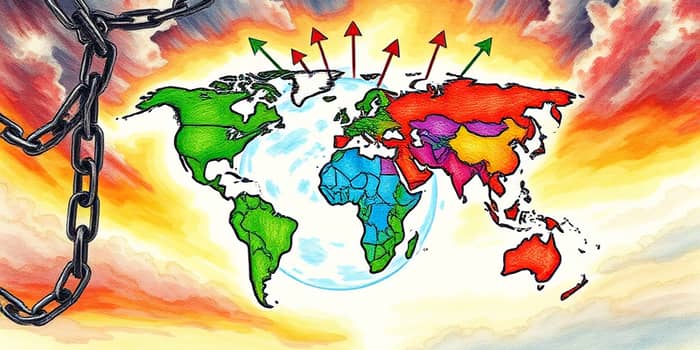
In an era defined by mounting obligations and shifting economic landscapes, the world's balance sheets have become pivotal narrative drivers. Stakeholders across the globe must navigate this complex terrain with insight and agility.
Understanding the Debt Landscape
Since the onset of COVID-19, global debt dynamics have swung dramatically. Public and private borrowing surged to unprecedented heights before showing tentative signs of stabilization.
total debt reached $251 trillion in 2024, marking a subtle decline from its 2020 peak of 258% of GDP yet still outpacing pre-pandemic levels. This stabilization conceals significant regional and sectoral divergences that demand close attention.
Regional Variations and Key Drivers
Debt profiles vary widely across advanced economies, emerging markets, and low-income nations, each shaped by unique fiscal, monetary, and social pressures.
- Advanced economies saw overall debt ratios ease slightly, driven by private sector deleveraging and steady public borrowing needs.
- Emerging markets and developing economies experienced rising public debt and cautious private credit expansions, reflecting stimulus legacies and interest rate pressures.
- Low- and middle-income countries face persistent external financing gaps and record debt outflows, straining budgets for vital services.
Interest costs, demographic shifts, and de-globalization trends combine to shape this multifaceted picture.
Country-Specific Highlights
Examining individual nations reveals both acute stresses and latent opportunities in the global debt environment.
This snapshot underscores how policy settings, growth prospects, and financial market structures influence each country's debt trajectory.
Risks on the Horizon
Elevated borrowing levels amplify vulnerabilities across financial systems and public budgets.
- Unprecedented levels pose risks amid slowing growth, tightening liquidity, and rising interest burdens.
- Fiscal space limits constrain future stimulus and investments in critical transitions like energy and health care.
- Debt-at-Risk scenarios point to public debt exceeding 120% of GDP by 2027 under adverse shocks.
For low-income nations, steep debt service increases threaten social spending and nutrition programs, heightening development challenges.
Policy Responses and Fiscal Strategies
Governments and international bodies are exploring diverse pathways to restore debt sustainability and support growth.
Key measures include:
- Targeted fiscal adjustments, such as VAT introductions and pension reforms to shore up revenues.
- Enhanced debt transparency and rigorous sustainability assessments by institutions like the IMF and World Bank.
- Experimentation with monetary frameworks to balance inflation control and growth support.
While no single blueprint exists, adaptive policymaking and credible reform agendas can ease long-term pressures.
Opportunities in a High-Debt World
Despite the challenges, elevated debt levels also create fertile terrain for innovation and investment.
- Global fixed-income markets offer attractive relative yields, prompting portfolio diversification beyond traditional U.S. Treasuries.
- Private debt instruments are expanding via fintech and ESG-aligned financing, unlocking new capital pools.
- Strategic asset allocations can benefit from policy experimentation, inflation hedges, and sustainable growth themes.
Investors and policymakers who anticipate shifts in borrowing costs and liquidity conditions can position themselves for resilience and upside.
Charting a Path Forward
The global debt dilemma demands a balanced blend of pragmatic reforms, forward-looking investments, and international cooperation. Policymakers must reconcile the imperative for fiscal discipline with the need to foster inclusive growth.
At the same time, private sector actors can leverage high-yield debt markets and emerging credit solutions to support real-economy recovery. By prioritizing transparency, sustainability, and innovation, stakeholders can transform the debt burden into a springboard for opportunity.
Proactive policies foster stability and growth, while collaborative financing mechanisms can alleviate strains on the most vulnerable economies. Through shared commitments and strategic vision, the world can navigate today’s debt challenges and unlock a more resilient and prosperous future.
Ultimately, understanding the intricacies of public and private debt, anticipating risks, and capitalizing on emerging opportunities will define the next chapter of global economic progress.
References
- https://www.imf.org/en/blogs/articles/2025/09/17/global-debt-remains-above-235-of-world-gdp
- https://institutional.fidelity.com/institutions/insights/topics/market-commentary/unsustainable-global-debt
- https://policy.desa.un.org/news/high-global-debt-a-risk-to-the-economic-outlook
- https://blogs.worldbank.org/en/opendata/international-debt-report-2025--when-relief-isn-t-enough---lmics
- https://cepr.org/voxeu/columns/quantifying-global-debt-risks-amid-high-and-rising-public-debt
- https://www.visualcapitalist.com/state-of-world-debt-in-2025/
- https://www.pimco.com/us/en/insights/developed-market-public-debt-risks-and-realities
- https://www.worldbank.org/en/programs/debt-statistics
- https://www.imf.org/en/publications/wp/issues/2025/05/05/debt-at-risk-566595
- https://www.oecd.org/en/publications/2025/03/global-debt-report-2025_bab6b51e.html
- https://research-center.amundi.com/article/private-debt-turning-point-risks-and-opportunities-industry-scales
- https://unctad.org/publication/world-of-debt
- https://www.weforum.org/stories/2024/09/global-debt-crisis-development-chief-economy/
- https://www.visualcapitalist.com/111-trillion-of-global-debt-in-2025/
- https://www.youtube.com/watch?v=yab69j8mnOc
- https://www.worldbank.org/en/programs/debt-toolkit/dsa
- https://www.brettonwoodsproject.org/2025/12/as-jubilee-year-draws-to-a-close-debt-crisis-remains-unresolved/