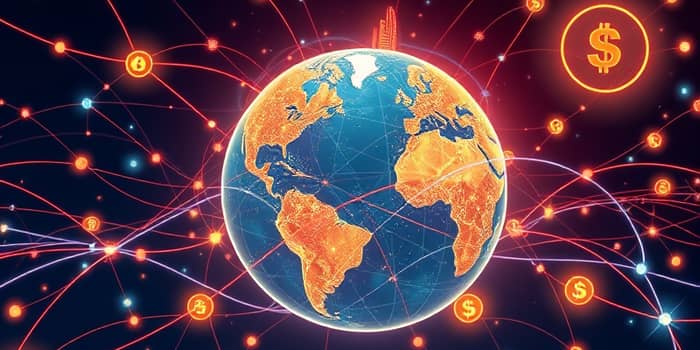
The modern economy thrives on a tapestry of institutions, technologies, and regulations that link every continent in a single, intricate structure. Understanding this network is essential to grasp how we allocate resources, manage risks, and foster innovation across borders.
Definition and Core Components of the Global Financial System
The global financial system is built on a interconnected network of financial institutions, payment mechanisms, and oversight bodies that facilitate the flow of capital and liquidity. Among its vital pillars are central banks, commercial banks, nonbank financial intermediaries, securities markets, and the infrastructure that binds them.
Key payment systems such as SWIFT process over $3 trillion in US dollar transactions daily, while alternative messaging platforms like China’s CIPS and Russia’s SPFS are growing in prominence. Regulatory agencies coordinate to ensure stability, enforce compliance, and protect consumer interests across jurisdictions.
In essence, this architecture enables efficient resource allocation, risk management, and the provision of liquidity to markets worldwide. Its resilience depends on seamless information flows, trust in counterparties, and robust legal frameworks that adapt to new challenges.
Historical Evolution and Integration
Since the mid-20th century, the global financial system has undergone transformative change. The Bretton Woods agreement initially tied currencies to gold and fixed exchange rates to the US dollar. By the early 1970s, the collapse of this system ushered in floating exchange rates post-1970s, allowing markets to determine currency values dynamically.
Over the following decades, trade liberalization and capital market integration fueled unprecedented growth. Barriers to cross-border flows were lowered, enabling efficient capital allocation and boosting prosperity. By 2024, global financial assets reached over 350% of nominal GDP, reflecting the depth of integration and innovation in banking, insurance, and investment sectors.
Structural Shifts and New Actors
The 2008 Great Financial Crisis marked a pivotal turning point. Two major structural changes reshaped the landscape:
- Shift from private sector claims to sovereign bonds: Governments assumed larger roles as principal borrowers, expanding their balance sheets to stabilize economies.
- Rise of nonbank financial intermediaries in global finance: Asset managers, hedge funds, and investment vehicles now rival traditional banks for capital allocation and risk-bearing.
By 2024, global banks reported record net income of $1.2 trillion, underscoring the scale and profitability of private capital flows alongside sovereign financing.
Technological Disruption and Innovation
Advances in technology are rewriting the rules of finance. Innovations in settlement processes, asset representation, and digital currencies are accelerating transaction speeds and reducing costs.
- Blockchain-based settlement systems cut cross-border transaction times from days to minutes, thanks to tokenization of financial assets.
- Central Bank Digital Currencies (CBDCs) are being piloted globally, promising real-time, interoperable cross-border payments and challenging the US dollar’s dominance.
- Quantum computing presents both opportunities for massive processing power and threats to existing cryptographic security, spurring the development of quantum-resistant cryptography.
These digital strides open doors for more inclusive financial products while demanding vigilant regulatory frameworks to manage new risks.
Geopolitical Shifts, Fragmentation, and De-Dollarization
Geopolitical tensions are testing the unity of the financial web. Tariffs, sanctions, and regulatory divergences are driving a shift toward regional blocs and alternative payment systems. The US average effective tariff reached 17.9% in 2025—the highest level since 1934.
The expanded BRICS+ alliance, now including Saudi Arabia, Egypt, the UAE, Iran, and Ethiopia, accounts for 28% of global GDP and over 45% of the world’s population. These nations seek to reduce reliance on the US dollar by forging new trade agreements and reserve strategies, highlighting an ongoing trend of trade and regulatory divergence.
Risks, Instabilities, and Fragmentation Costs
While diversification can enhance resilience, excessive fragmentation threatens global growth and stability. The World Economic Forum estimates that a significant breakdown of the system could shave $5.7 trillion off global GDP and push inflation above 5%.
- Elevated asset valuations risk sharp corrections, especially in sovereign bond markets under heavy upward pressure.
- Nonbank financial intermediaries’ expanded role may amplify systemic shocks without traditional bank buffers.
- Incomplete post-crisis regulatory reforms leave gaps in oversight, increasing vulnerability to market stress.
Proactive coordination among regulators and institutions is essential to mitigate these threats.
Future Financial Architecture and the Path Ahead
Experts call for a revamped global financial safety net and stronger multilateral frameworks to align with sustainable development goals. Over the next decade, the system is expected to evolve through phased integration of digital innovations and traditional structures.
Each stage demands collaboration among central banks, private institutions, and technology developers to ensure a smooth transition and resilient architecture.
Conclusion
The global financial system stands at a crossroads between integration and fragmentation, innovation and security. Its evolution will be shaped by how effectively stakeholders navigate technological disruption, geopolitical tensions, and systemic risks.
By fostering adaptability, reinforcing multilateral cooperation, and embracing sustainable finance, we can weave a stronger, more inclusive web that supports prosperity and stability for all participants in the decades ahead.
References
- https://www.weforum.org/stories/2025/11/understanding-fragmented-global-financial-system-safeguarding-its-integrity/
- https://www.bis.org/speeches/sp250519.htm
- https://www.mckinsey.com/industries/financial-services/our-insights/global-banking-annual-review
- https://www.imf.org/en/publications/gfsr/issues/2025/10/14/global-financial-stability-report-october-2025
- https://www.bu.edu/gdp/2025/03/24/the-international-financial-architecture-and-sustainable-prosperity/
- https://www.fsb.org/2025/10/incomplete-reform-implementation-leaves-financial-system-vulnerable-to-shocks-warns-fsb-chair/
- https://www.federalreserve.gov/publications/April-2025-financial-stability-report-Overview.htm
- https://www.deloitte.com/us/en/insights/industry/financial-services/financial-services-industry-outlooks/banking-industry-outlook.html