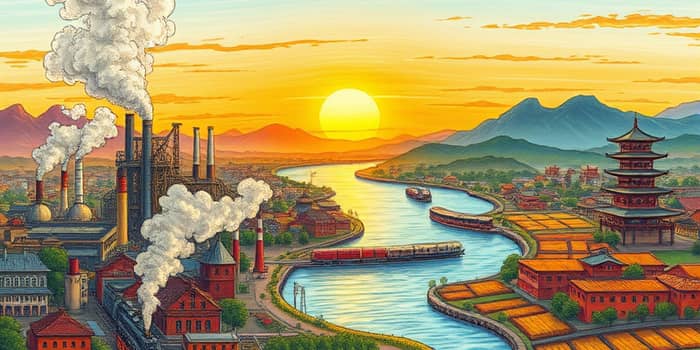
The story of the Great Divergence is one of ambition, innovation, and profound global change. It describes how Western Europe and its offshoots surged ahead in wealth and power, leaving advanced Asian civilizations behind. Understanding this monumental shift offers insights into our modern world and guidance for future development.
Origins and Early Developments
Before the 1500s, economies in the Yangzi Delta, Mughal India, and the Ottoman Empire rivaled or even surpassed those of Europe. Complex cities, thriving trade networks, and sophisticated technologies characterized Asia, while Europe remained relatively underdeveloped.
The so-called “Little Divergence” emerged between 1300 and 1800 within Europe itself. The Black Death of 1348 reduced labor supplies, driving wages up in England and the Netherlands. This rise of high real wages and labor scarcity eroded feudal bonds. Meanwhile, southern Europe experienced slower recovery, setting the stage for northern prosperity.
Major Explanatory Theories
Scholars attribute the Great Divergence to a mix of geography, institutions, innovation, and global interactions. No single factor explains everything, but together they paint a compelling picture.
- Geography and Resources: Access to coal, Americas land
- Institutions and Culture: Rule of law, joint-stock companies
- Innovation and Productivity: Labor-saving technologies, TFP growth
- Trade and Colonialism: New World profits, colonial markets
- Markets and Policy: Protectionism, efficient financial systems
Geographical advantages played a crucial role. Britain’s access to abundant coal deposits powered early factories, while China’s deposits were remote. The Americas provided raw materials and room for agricultural expansion, freeing European resources for industry.
Institutional frameworks in Europe fostered innovation. The emergence of corporations—monasteries, universities, and joint-stock firms like the East India Companies—created deep and liquid financial markets. Legal protections for property rights and commercial contracts empowered entrepreneurs to invest and experiment, accelerating growth.
By contrast, China’s economy remained rooted in clan-based networks and household production. While highly efficient for local needs, these structures lacked incentives for large-scale, impersonal trade. Imperial autocracy also stifled some entrepreneurial ventures.
Innovation surged in northwest Europe as high wages incentivized labor-saving machinery. Britain’s textile mills, powered by steam engines, rapidly outpaced traditional handloom producers in India. Total factor productivity in Europe turned sharply positive after 1700, while it stagnated or declined in many Asian regions.
Economic Metrics and Their Impacts
Quantitative measures illustrate the scale of divergence and its human impact.
- Per capita GDP: Europe ~1,200 vs. China ~600 (1820); by 1870 West was 5× richer.
- Wages: English workers earned several times more than Mughal counterparts by 1800.
- TFP Trends: Positive in Europe after 1700, negative or flat in China.
- Population growth: Europe’s output rose with population; China’s land constraints limited gains.
- Industrial output: Steam engines, railways, and mechanized factories exploded growth.
These shifts translated into vastly improved living standards for Europeans—urbanization, better diets, and rising educational levels—while many Asian societies faced deindustrialization and stagnation under colonial policies.
Contemporary Relevance and Debates
Understanding the Great Divergence sheds light on persistent global inequalities and informs policy choices today.
- Explains North-South income gaps and modern economic hierarchies.
- Highlights the role of institutions in sustaining growth.
- Challenges simplistic cultural or racial explanations.
- Emphasizes the contingent nature of development paths.
- Offers lessons for emerging economies on resource use and legal frameworks.
Recent debates focus on when divergence truly began—some argue for the post-1750 Industrial Revolution, while others trace roots to the 1500s maritime expansion. There is growing consensus that multiple, interlocking factors drove the shift, rather than a single cause.
Conclusion: Lessons for Today
The Great Divergence reminds us that economic success depends on more than natural endowments. Legal rights, inclusive institutions, access to energy, and openness to innovation are equally vital. Emerging nations can draw on these lessons to craft policies that foster sustained growth and equitable development.
As global dynamics evolve, the spirit of inquiry that drove Europe’s breakthrough—coupled with prudent stewardship of resources and robust institutions—remains a beacon for any society seeking to improve the lives of its citizens. The past offers both cautionary tales and inspiring examples, guiding us toward a more balanced and prosperous future.
References
- https://kids.kiddle.co/Great_Divergence
- https://cepr.org/voxeu/columns/great-divergence-and-great-reversal-new-approach-global-economic-history
- https://www.hbs.edu/faculty/Pages/item.aspx?num=49113
- https://worldcommercereview.com/from-the-great-divergence-to-south-south-divergence/
- https://worldhistoryconnected.press.uillinois.edu/2.1/br_hubbell.html