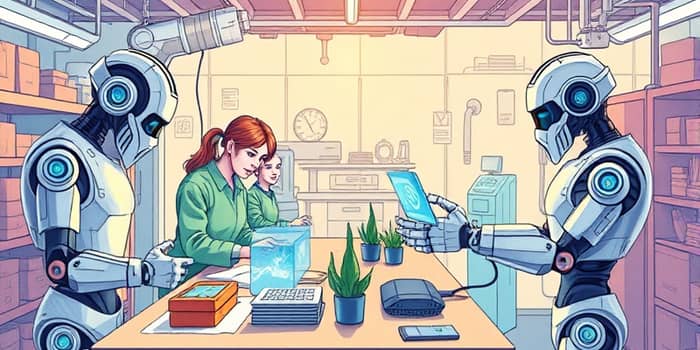
As artificial intelligence and automation continue to reshape industries, the global workforce stands at a crossroads. The promise of innovation clashes with the reality of job displacement, creating a landscape filled with both peril and possibility. Understanding these forces is crucial for employees, employers, and policymakers aiming to navigate the coming decade.
Dual Forces of Displacement and Creation
Technology’s march forward is neither inherently good nor bad—it is transformative. On one hand, estimates suggest 300 million jobs at risk globally as AI and automation streamline repetitive tasks. By 2030, as many as 92 million positions could disappear, yet 170 million new roles are projected to emerge in fields unimagined today.
This dynamic reflects a fundamental shift: automation often replaces routine tasks, but it also spawns industries centered on data, digital platforms, and advanced machinery. The result is a workforce that must constantly evolve or risk obsolescence.
Fastest-Growing and Declining Occupations
Certain roles stand out for rapid expansion, while others face steep declines. According to U.S. Bureau of Labor Statistics projections (2023–2033):
- Software Developers: +17.9% growth, adding 303,700 jobs.
- Personal Financial Advisors: +17.1%, adding 55,000 roles.
- Computer Occupations overall: +11.7%, adding 586,800 positions.
- Database Architects: +10.8%, adding 6,600 jobs.
Conversely, sectors relying on manual assessment or routine analysis shrink:
- Insurance Appraisers: –9.2%
- Claims Adjusters: –4.4%
- Credit Analysts: –3.9%
These trends spotlight the divide between roles fueled by creativity, human judgment, and technical expertise, versus those dominated by repetitive processes.
Who Is Most Vulnerable?
Workers in routine cognitive and manual jobs face the highest automation risk. Globally, nearly 47% of U.S. employees could see their roles altered or eliminated within the next decade. Manufacturing alone could lose 20 million jobs by 2030 to robotics and computer-controlled systems.
Entry-level white-collar positions—such as claims adjusters and junior analysts—also come under fire. Recent college graduates in tech-centric fields report unemployment rising by three percentage points in jobs exposed to AI. Meanwhile, low-skilled roles in retail, warehousing, and data entry are increasingly managed by algorithms.
Skills, Retraining, and the Future Workforce
Amid displacement fears, there lies an opportunity to cultivate talent. Companies and educational institutions are racing to fill the gap in technology-related skills like AI, cybersecurity, big data, and cloud computing. The fastest-growing roles include AI and machine learning specialists, big data analysts, and fintech engineers.
Yet, a significant mismatch between lost skills and new roles challenges workers. To thrive, individuals must embrace lifelong learning and adaptability. Governments and corporations are launching reskilling initiatives—from coding bootcamps to on-the-job training programs—to ease the transition.
- Invest in digital literacy and advanced technical courses.
- Partner with industry to align curricula with market needs.
- Offer flexible, modular training for working adults.
Productivity, Wages, and Work Transformation
Productivity often accelerates alongside automation. Industries adopting AI have seen revenue per employee grow three times faster than peers. In sectors heavily exposed to AI, wages are rising twice as fast, indicating that augmentation can uplift workers rather than simply replace them.
However, nearly 40% of companies focus on full automation instead of complementary augmentation. Platforms like ride-sharing apps illustrate both sides: improved efficiency and broader access, paired with wage stagnation or decline for individual workers.
Overall, the picture is one of net positive job creation overall, but the benefits are unevenly distributed. Some roles vanish, while others multiply; some regions boom, others lag behind.
Geographic and Social Mismatches
Job displacement and creation rarely occur in the same locales. Manufacturing automation hits regions reliant on factories, while tech hubs absorb new positions in data science and software engineering. This divergence deepens economic inequality and demands targeted policy interventions.
Demographic impacts also vary. Young tech workers in their 20s face rising unemployment, while older employees may lack the flexibility to retrain quickly. On average, men experience slightly higher automation risk, though outcomes differ by occupation and country.
Policy Responses and the Path Forward
Addressing this multifaceted challenge requires collaboration:
- Governments must expand social safety nets and incentivize regional development.
- Businesses should adopt responsible automation strategies that prioritize skills-first workforce planning.
- Educational systems need to integrate digital and soft skills from an early age.
Some countries lead the way with public–private partnerships, funding reskilling programs that have retrained millions. Others offer tax credits to companies hiring displaced workers. Yet, many regions still lack coherent strategies, leaving workers vulnerable.
Ultimately, the future of work will be defined by our ability to balance innovation with inclusivity. By proactively managing displacement, investing in education, and fostering collaboration, societies can turn technology-driven upheaval into an engine for shared prosperity.
As we move forward, remembering that technological progress and human potential are not opposing forces but allies will be key to shaping a workforce that benefits everyone.
References
- https://www.comptia.org/en-us/resources/research/state-of-the-tech-workforce-2025/
- https://explodingtopics.com/blog/ai-replacing-jobs
- https://www.jpmorgan.com/insights/global-research/artificial-intelligence/ai-impact-job-growth
- https://www.weforum.org/stories/2025/08/ai-jobs-replacement-data-careers/
- https://www.goldmansachs.com/insights/articles/how-will-ai-affect-the-global-workforce
- https://hai.stanford.edu/news/assessing-the-real-impact-of-automation-on-jobs
- https://www.bls.gov/opub/ted/2025/ai-impacts-in-bls-employment-projections.htm
- https://www.shrm.org/executive-network/insights/people-strategy/automation-displacement-us-workforce-whos-at-risk
- https://www.weforum.org/publications/the-future-of-jobs-report-2025/digest/
- https://www.nexford.edu/insights/how-will-ai-affect-jobs
- https://www.census.gov/library/stories/2025/09/technology-impact.html
- https://www.pwc.com/gx/en/services/ai/ai-jobs-barometer.html
- https://budgetlab.yale.edu/research/evaluating-impact-ai-labor-market-current-state-affairs
- https://www.nu.edu/blog/ai-job-statistics/
- https://archieapp.co/blog/technology-in-the-workplace-statistics/