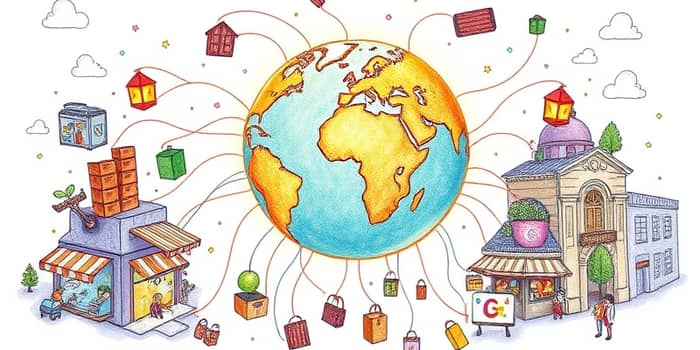
In our rapidly evolving world, no marketplace exists in isolation. A tremor in Beijing’s factories can echo through a Tuscan vineyard, while a policy shift in Washington can reshape the menus of Southeast Asian restaurants. Grasping this complex global tapestry of trade empowers local businesses to not only survive but thrive.
Globalization and Local Interconnectedness
Globalization often feels abstract until it alters the price of your groceries, disrupts the flow of components to your workshop, or shifts consumer expectations overnight. Every international crisis—be it a geopolitical conflict, a public health emergency, or a regulatory change—sends ripples across continents.
These ripple effects, akin to the butterfly effect in economics, travel along four key channels: supply chains, financial markets, technology, and consumer behavior. Modern connectivity—from e-commerce platforms to instant financial trading—amplifies both opportunity and vulnerability.
How International Events Transmit to Local Markets
When energy prices surged after the 2022 Russia-Ukraine conflict, local gas stations in Europe and Asia raised rates within days, illustrating real-time market reactions. Similarly, the 2020 COVID-19 pandemic triggered:
- A global supply shock that cost an estimated $10 trillion in lost economic output.
- U.S. unemployment spiking to nearly 15% in Q2 2020.
- Over 90% of Fortune 1000 companies reporting supply chain disruptions.
Such episodes highlight how deeply local businesses are entwined with distant events.
Sector-Specific Impacts
Different industries feel global tremors in unique ways:
Adaptation Strategies for Local Businesses
Resilience lies in combining agility with foresight. Local enterprises can adopt several practical measures to navigate global uncertainty:
- Digital transformation and automation: E-commerce platforms, CRM and ERP systems, and AI tools.
- Source diversification: Balancing suppliers across regions to reduce single-country risk.
- Flexible pricing and financial hedges: Protecting against currency and commodity swings.
- Collaborative partnerships: Forming alliances with overseas peers and tapping international talent.
Governments can bolster these efforts through subsidies, innovation grants, and streamlined trade policies. Communities that champion continuous learning and strategic innovation often outperform in the long run.
Challenges and Risks in the Interconnected Economy
Yet, the same global ties that unlock new horizons also bring intensified competition and complexity. Smaller players may face:
- Strained resources to comply with multilayered regulations and tariffs.
- Heightened exposure to external shocks beyond their control.
- A sense of urgency to innovate or risk falling behind corporate giants.
Moreover, navigating political turbulence—like Brexit’s trade upheaval—demands robust scenario planning and adaptable logistics networks.
Unearthing Opportunities Amidst Global Shifts
For every disruption, there lies an opening. Local artisans can sell specialty foods and crafts to customers worldwide. Businesses embracing sustainability cater to rising global eco-consciousness. Startups leveraging AI and digital logistics can punch above their weight.
Consider a corner shop in Lisbon that sources organic olive oil directly from small groves in Andalusia, marketed globally via online platforms. Or a cafe in Seoul introducing matcha-infused pastries inspired by Japanese tea traditions, quickly becoming a viral sensation.
Building a Resilient Future
The global-local dance is a dynamic push-pull. Policy must bridge these realms, offering support without stifling innovation. Communities thrive when they cultivate local strengths—culture, craftsmanship, unique value propositions—while embracing the world’s vast digital marketplace.
Strategic foresight and collaborative spirit become the compass guiding local markets through the turbulence of global events. By weaving flexibility into every process and nurturing a mindset of continuous learning, businesses can transform shocks into drivers of growth.
Ultimately, the story of today’s markets is not one of helplessness in the face of distant crises, but of empowered adaptation—an interconnected web where each node, no matter how small, contributes to the strength and resilience of the whole.
References
- https://rauva.com/blog/impact-of-global-trends-local-businesses
- https://www.youtube.com/watch?v=-I-TyWroAt8
- https://wautier.co.uk/business-globalization/
- https://enomics.in/how-economics-impacts-global-and-local-markets/
- https://vocal.media/education/the-impact-of-global-events-on-financial-markets
- https://www.gwi.com/blog/10-localized-marketing-examples
- https://emc3.com/the-impact-of-events-on-local-economies/
- https://www.getmarvia.com/blog/12-examples-of-brands-with-great-local-marketing-campaigns