Money shapes lives, societies, and futures beyond simple arithmetic. Every choice to spend, save, or invest is influenced by hidden forces in our minds and hearts. In today’s complex world, understanding those forces is essential for building stronger financial habits and more resilient economies.
This article explores how emotions, cognition, social context, and policy design interact to guide our economic actions. By combining narrative insights with empirical research, we aim to inspire more mindful decisions and practical strategies for everyday financial wellbeing.
Understanding Behavioral Economics
Classical economic theory treats humans as perfectly rational agents making optimal choices. Behavioral economics, however, reveals that economic decision-making is not always rational. Instead, choices are often influenced by mental shortcuts, deeply held beliefs, and social pressures. This emerging discipline integrates psychology into traditional models to explain why people sometimes make seemingly irrational financial moves.
By acknowledging biases and emotional drivers, behavioral economics offers a more dominant but incomplete framework for predicting consumer behavior and designing effective policies. As a result, governments, businesses, and individuals worldwide are adopting these insights to foster better financial outcomes.
Key Psychological Factors Impacting Financial Choices
Several cognitive and emotional influences shape our relationship with money. Recognizing these forces can help us guard against unhelpful patterns and leverage adaptive strategies.
- Heuristics: Quick mental shortcuts that simplify decisions but may lead to costly errors.
- Loss aversion: A tendency to experience losses more intensely than equivalent gains.
- Status quo bias: A preference for maintaining current financial arrangements, often hindering beneficial changes.
- Framing effect: Decisions vary depending on how options are presented, even when outcomes are identical.
Emotions like fear, excitement, and regret can overpower rational analysis. During market downturns, panic selling becomes common, while in booms, overconfidence may drive excessive risk-taking. Unconscious mental shortcuts can mislead investors and consumers alike.
Social and environmental factors also play a critical role. Peer behaviors, cultural norms, and family attitudes towards money can reinforce thrift or encourage overspending. Research shows individuals act more cautiously with others’ money than their own—a phenomenon rooted in social accountability and perceived responsibility.
Components of Money Attitudes
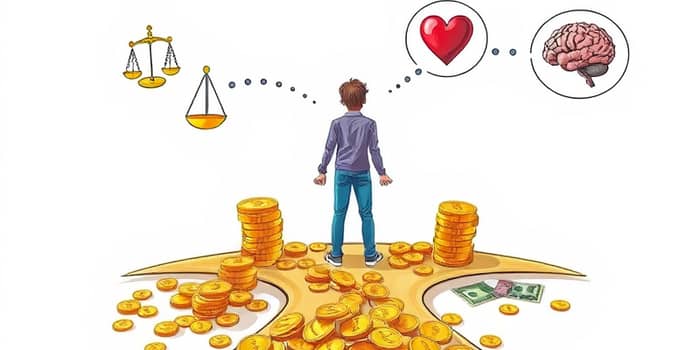
People’s relationships with money involve three interconnected dimensions that guide feelings and actions:
- Affective component: Emotional associations, such as security or anxiety.
- Cognitive component: Beliefs about money’s role in achievement, power, and freedom.
- Behavioral component: Habits of saving, spending, budgeting, or hoarding.
Popular scales measure these dimensions through questions about money’s personal meaning, understanding of financial principles, and actual management behaviors. This tripartite framework helps diagnose potential barriers and strengths in financial planning.
Major Behavioral Economics Concepts in Practice
Behavioral research has uncovered powerful effects that shape real-world money decisions. Loss aversion explains why people often cling to underperforming investments rather than realizing small losses early. The default effect reveals that simply changing the default option—for instance, making retirement savings automatic—can dramatically increase participation rates without restricting freedom of choice.
The framing effect demonstrates that describing a loan as having a 95% chance of payback rather than a 5% default risk leads to more favorable reception, despite identical statistical realities. Meanwhile, the so-called “free” effect shows that zero-cost offers can distort perceived value, pulling consumers toward suboptimal deals purely because of the allure of “free.”
Scarcity and Choice Architecture
Financial scarcity does not always result in poor decision-making. Contrary to simplistic views, those under tight budgets often make strategic, context-appropriate choices. Researchers argue that impatience in such cases is strategic, not simply irrational, prioritizing immediate needs to maintain stability.
Choice architecture—the design of environments in which people make decisions—leverages this insight. By presenting options in an intuitive order, setting beneficial defaults, or reducing friction for positive actions, policymakers can guide behavior subtly yet effectively. Examples include arranging healthier foods at eye level or enabling one-click savings transfers.
Individual Differences and Financial Outcomes
Financial decisions also vary by personality, demographics, and situational context. Conscientious individuals are more likely to stick to budgets and long-term plans, while high impulsivity can predict financial instability. Age, gender, cultural background, and past economic experiences further color money attitudes and risk tolerance.
Emotional and financial intelligence—abilities to regulate feelings and understand complex monetary concepts—are strong predictors of financial health. Those with higher self-control and greater awareness of cognitive biases tend to build more robust saving and investment portfolios over time.
Numbers, Data, and Example Policies
Empirical findings provide compelling evidence for behavioral interventions:
Consider the impact of a simple nudge: automatic enrollment in workplace savings plans boosts participation dramatically while preserving individual choice. Such policies demonstrate how small changes in choice architecture can yield substantial societal benefits.
Behavioral Interventions and Policy Implications
Governments and organizations deploy several evidence-based tools to improve financial wellbeing. Below are examples of interventions that have shown positive results:
- Automatic enrollment and opt-out defaults for retirement contributions.
- Prompted reminders for bill payments and savings deposits.
- Targeted financial education highlighting common biases.
While educational programs can raise awareness, their impact is often modest. Pairing knowledge with thoughtfully designed choice environments tends to produce more robust and lasting change.
Conclusion and Future Directions
Understanding the psychology of money attunes us to the hidden drivers of our financial behavior. By integrating cognitive science with economics, we gain a richer, more humane perspective on spending, saving, and investing.
Future research should explore the long-term effects of digital finance tools, the heterogeneity of behavioral responses, and how emerging technologies can customize nudges for individual needs. As we deepen our grasp of these dynamics, we move closer to a world where wise financial decisions are within everyone’s reach—empowering individuals and strengthening global economies.
References
- https://pmc.ncbi.nlm.nih.gov/articles/PMC5812171/
- https://journal.ppipbr.com/index.php/demand/article/view/148
- https://online.ucpress.edu/collabra/article/9/1/77305/196372/Understanding-Individual-Attitude-to-Money-A
- https://pmc.ncbi.nlm.nih.gov/articles/PMC6115210/
- https://www.apa.org/news/press/releases/2023/09/financial-scarcity-decision-making
- https://www.ssa.gov/policy/docs/ssb/v70n4/v70n4p1.html
- https://tcgservices.com/2023/07/17/the-psychology-of-money/
- https://thedecisionlab.com/reference-guide/economics/behavioral-economics
- https://www.stlouisfed.org/publications/page-one-economics/2025/apr/psychology-of-free-how-price-of-zero-influences-decisionmaking
- https://courses.business.columbia.edu/B8619
- https://ideas.darden.virginia.edu/financial-decision-making
- https://news.uchicago.edu/explainer/what-is-behavioral-economics
- https://www.neuroscienceof.com/branding-blog/behavioral-economics-consumer-behavior-merle-van-den-aaker-interview
- https://onlinelibrary.wiley.com/doi/abs/10.1002/9781118926352.ch22