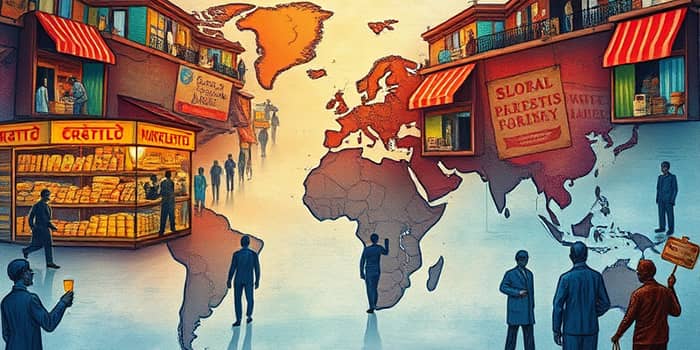
The shadow economy permeates every corner of the globe, operating beyond official oversight and record-keeping. It thrives on cash transactions, barter exchanges, and clandestine trades that evade taxation and regulation.
While often linked to illicit activities such as trafficking or money laundering, much of its volume arises from legal services and goods exchanged without formal reporting. These unreported transactions and taxes unpaid create a parallel marketplace that interacts with, yet distorts, the official economy.
Understanding the Shadow Economy
At its core, the shadow economy encompasses economic activities deliberately concealed from authorities worldwide. From informal street vendors and home-based services to large-scale tax evasion schemes, these hidden transactions collectively account for nearly 12% of global GDP in 2023, making it arguably the third-largest economy behind the US and China.
Estimating its true size poses challenges. Researchers rely on currency demand methods, MIMIC models, and other indirect measures to approximate an underground output that often rivals formal markets in emerging economies. Despite a gradual decline over recent decades, persistent pockets of informal markets remain deeply rooted in regions burdened by poverty, unemployment, and weak institutions.
Key Drivers Behind Hidden Markets
The roots of the shadow economy lie in a complex interplay of fiscal, regulatory, and social factors. High taxation and cumbersome regulations often push individuals and businesses to seek relief through off-the-books transactions. Similarly, labor market rigidities and strict employment protections can incentivize employers to hire workers informally.
- Excessive tax and social security burdens
- Poor institutional quality and pervasive corruption
- Strict labor regulations and enforcement gaps
- Low trust in government and public services
In many developing countries, limited access to banking, credit, and digital platforms further entrenches informal trade. Meanwhile, in advanced economies, high compliance costs and intense competition drive segments of businesses underground. Addressing these drivers requires a nuanced understanding of each nation’s legal framework and economic culture.
Impacts on Society and Economy
The consequences of unchecked shadow activity ripple across societies. Governments lose vital revenue needed for healthcare, education, and infrastructure. Formal businesses face unfair competition from counterparts that dodge taxes and regulations, undermining growth and innovation.
Beyond fiscal losses, informal work often lacks social protections, exposing workers to exploitation and unsafe conditions. At a macro level, distorted statistics hinder policymakers from crafting evidence-based strategies. In extreme cases, proceeds from illegal trades fund organized crime and undermine governance, further eroding public trust.
Charting a Path to Formalization
Eradicating the shadow economy entirely is neither feasible nor desirable in the short term, as it supports livelihoods for millions. Instead, a balanced approach promotes gradual formalization, strengthens institutions, and reduces the incentives for hidden activity. Success demands a comprehensive policy response tailored to each nation’s needs.
- Enhance detection through data analytics and digital reporting
- Streamline tax regimes and simplify compliance procedures
- Leverage digitalization and mobile banking for wider access
- Support small enterprises with training and incentives
Key long-term measures include improving governance, reducing corruption, and fostering public trust by demonstrating that tax revenues yield tangible benefits. Pilot programs offering temporary tax breaks for informal businesses can encourage registration, while social campaigns can bolster tax morale and civic responsibility.
Emerging technologies such as blockchain and AI hold promise for greater transparency and real-time monitoring, though they must be deployed thoughtfully to avoid new avenues for concealment. International cooperation to share best practices and harmonize regulations can further limit tax avoidance and money laundering across borders.
Ultimately, addressing the shadow economy is a collective endeavor. Governments, businesses, and civil society must collaborate to build an environment where formal trade flourishes, citizens trust public institutions, and economic growth becomes inclusive and sustainable.
By recognizing the drivers of hidden markets and implementing targeted reforms, each country can reclaim lost revenues, protect vulnerable workers, and foster a fairer, more resilient economy for all.
References
- https://www.bcg.com/publications/2023/unveiling-the-shadow-economy
- https://openknowledge.worldbank.org/entities/publication/256e1cbc-c288-591f-a6ac-91d8338196b3
- https://www.cedar-rose.com/blog/exploring-the-shadow-economy-a-dive-into-its-causes-and-countermeasures
- https://www.ey.com/en_gl/insights/tax/why-the-shadow-economy-persists-and-how-governments-are-responding
- https://www.imf.org/external/pubs/ft/issues/issues30/
- https://hbr.org/2018/05/what-45-years-of-data-tells-us-about-globalizations-influence-on-the-shadow-economy
- https://www.marketplace.org/story/2024/05/31/how-large-is-the-shadow-economy
- https://www.abacademies.org/articles/a-brief-note-on-shadow-economy-10582.html