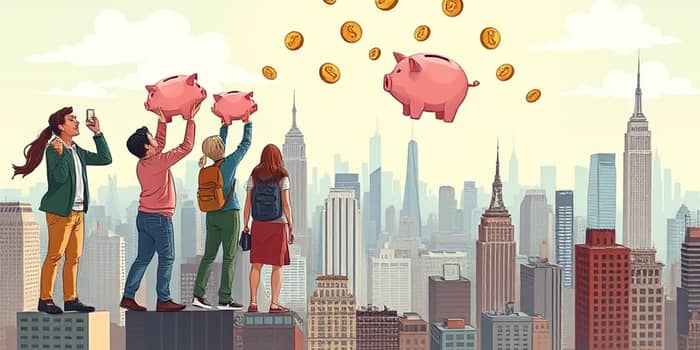
When economic uncertainty strikes, our first instinct is often to tighten our belts and squirrel away every penny. We believe that accumulating savings will protect us from future shocks and secure our personal well-being.
Yet, when that instinct permeates society at large, it can trigger a chain reaction that harms the very stability we seek. This tension between individual prudence and collective well-being lies at the heart of the paradox of thrift in economics.
Origins and Historical Perspectives
Long before John Maynard Keynes popularized the paradox of thrift in 1936, thinkers from ancient Greece to the early Enlightenment pondered similar dilemmas. The 1714 poem The Fable of the Bees hinted at how private virtues could yield public vice.
Keynes crystallized these ideas in The General Theory of Employment, Interest, and Money. He argued that during a downturn, widespread saving reduces consumption, erodes business revenues, and deepens recessions through what he called the profound Keynesian multiplier effect.
Modern economists recognize this as an example of the fallacy of composition in action, where what is rational for one individual becomes detrimental when practiced by all.
The Mechanics Behind the Paradox
In a simplified closed economy, total output equals total income. Every dollar saved is a dollar not spent, representing a “leakage” from the circular flow of income. If households collectively boost saving, aggregate demand falls, prompting firms to cut production and lay off workers.
At the original equilibrium income level, planned saving exceeds planned investment. The economy adjusts by shifting to a lower output level until saving and investment realign. Ironically, this new equilibrium often features the same total saving as before—but at a smaller pie of national income.
This model assumes fixed investment and stable prices. Real-world complexities such as liquidity preferences, international capital flows, and inflation expectations can alter outcomes.
Real-World Manifestations
History offers sobering case studies of how collective thrift can exacerbate crises.
- Great Depression (1930s): Households cut consumption drastically, deepening the downturn.
- Great Recession (2007–2009): Fears of collapse spurred saving, slowing recovery despite low interest rates.
- COVID-19 Pandemic: Precautionary saving rose globally, reducing consumer spending and pressuring GDP.
In the United States, the household saving rate climbed from around 2.9% pre–2007 to over 5% by 2011, illustrating the paradox in action: higher saving yields lower aggregate income and diminished total saving.
Critiques and Counterarguments
While powerful, the paradox of thrift is not without its critics. Neo-classical economists argue that:
- Banking systems channel savings into investment, mitigating demand shortfalls.
- Flexible prices and wages adjust to restore equilibrium without policy intervention.
- Long-run capital accumulation from saving fosters innovation and productivity growth.
Moreover, in open economies, higher saving can translate into trade surpluses, boosting exports and sustaining output despite weaker domestic demand.
Policy Responses and Modern Relevance
Keynesians recommend countercyclical measures to offset the drag of collective saving:
- Fiscal stimulus and deficit spending: Government borrowing funds projects that inject demand.
- Low interest rate policies: Cheap credit encourages businesses and consumers to spend rather than save.
- Targeted transfer payments and unemployment benefits cushion incomes and sustain consumption.
International coordination can amplify these effects. When major economies simultaneously pursue expansionary policies, global demand strengthens and trade flows recover more rapidly.
For individuals, the lesson is nuanced: maintain an emergency fund for security, but recognize that excessive hoarding during a downturn can prolong economic pain for everyone.
Conclusion: Striking the Right Balance
The paradox of thrift reminds us that one person’s spending is another’s income. In times of crisis, collective action is as crucial as individual prudence.
By balancing personal savings goals with an awareness of our shared economic fabric, we can protect our own futures without inadvertently deepening recessions. Thoughtful policies and informed choices together forge a path toward sustainable recovery and long-term prosperity.
References
- https://en.wikipedia.org/wiki/Paradox_of_thrift
- https://fiveable.me/key-terms/principles-econ/paradox-thrift
- https://corporatefinanceinstitute.com/resources/economics/paradox-of-thrift/
- https://www.economicsonline.co.uk/all/paradox-of-thrift.html/
- https://www.stlouisfed.org/publications/page-one-economics/2012/05/01/wait-is-saving-good-or-bad-the-paradox-of-thrift
- https://www.britannica.com/money/paradox-of-thrift
- https://www.youtube.com/watch?v=qrHyDztQlBY