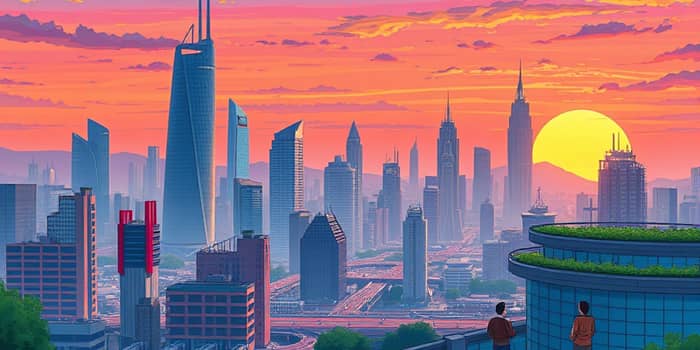
Urbanization is transforming societies on an unprecedented scale, reshaping economies and driving capital flows across continents.
Global Urbanization Overview
By 2025, the world population reaches approximately 8.2 billion, with nearly 4.8 billion people living in towns or cities, roughly 58% of humanity. According to the UN World Urbanization Prospects 2025, 45% reside in cities, 36% in towns, and 19% in rural areas.
Projections show that by 2050, about 67% of the global population will be urban dwellers, marking one of the most significant demographic transitions in human history. Two-thirds of global population growth will occur in cities, while the rural population peaks in the 2040s and then declines.
Regional Urbanization Patterns
Urbanization varies widely by continent. North America and Latin America exceed 80% urban share, while Europe approaches three-quarters. Asia’s urban share is lower but growing rapidly, driven by China, India and other emerging markets. Sub-Saharan Africa has the fastest growth rates, despite currently having the lowest urban share.
In 104 countries, cities host more people than towns or rural areas. Towns remain predominant in 71 countries, including India, Germany, Uganda, and the United States, reflecting the varied pace of urban transition across regions.
Countries Driving Future Urban Growth
Of the 986 million additional urban residents projected by 2050, more than half will be in seven countries:
- India
- Nigeria
- Pakistan
- Democratic Republic of the Congo
- Egypt
- Bangladesh
- Ethiopia
Together, these nations are expected to add over 500 million urban dwellers, underscoring the critical need for sustainable planning frameworks in high-growth markets.
Megacities: Expansion and Dynamics
The number of megacities—urban agglomerations exceeding 10 million inhabitants—grew from eight in 1975 to an expected 33 by 2025, with projections reaching 37 by 2050. Asia will host 19 of these megacities, reflecting the continent’s rapid urban expansion.
Jakarta leads with about 42 million residents, followed by Dhaka at 37 million and Tokyo at 33 million. Dhaka is projected to become the world’s largest city around mid-century, while Tokyo’s population declines, dropping its rank to seventh place by 2050.
This dual reality—soaring growth in some cities and decline in many smaller urban centers—presents diverse policy and investment challenges globally.
Urban Land-Use Change and Spatial Form
Between 1975 and 2025, urban land expanded almost twice as fast as the global population, raising the average built-up area per person from 43 m² to 63 m². Expansion patterns vary widely: Europe, North America, Australia and New Zealand have the highest per-capita land footprints, while Central and South Asia remain the most compact.
Unchecked sprawl impacts infrastructure costs, transport efficiency and environmental footprints. Proactive policies such as densification and transit-oriented development can balance growth, preserve green spaces and curb emissions.
Infrastructure and Development Challenges
Cities already house over 4 billion people and generate a major share of global GDP, energy use and CO₂ emissions. Rapid, unplanned urban growth can lead to congestion, pollution, housing shortages and infrastructure gaps. Conversely, well-managed urbanization fosters productivity, innovation and higher living standards.
Meeting infrastructure needs is critical for sustainable development and the achievement of Sustainable Development Goals (SDGs). Key service demands include:
- Housing and affordable housing solutions
- Transport and mobility networks
- Utilities: water, sanitation, electricity, and digital connectivity
- Social infrastructure: schools, hospitals, public spaces
Investment Themes Shaping the Future
Urbanization is a powerful investment driver. By 2050, nearly 70% of the global population may reside in urban areas, prompting increased spending on transportation, shelter, and utilities. Investors are actively targeting innovative development plans and resilient infrastructure, recognizing innovative city development plans as core growth engines.
Core opportunity areas include:
- Transportation & mobility: mass transit, metro systems, EV charging networks
- Housing & real estate: mixed-use developments, urban regeneration, affordable housing
- Utilities & digital infrastructure: power grids, water systems, broadband/fiber networks, data centers
- Sustainable and green buildings: energy-efficient designs, retrofits, ESG-aligned strategies
Positioning for Sustainable Urban Growth
Leading investors emphasize ESG integration, prioritizing resilient designs and community engagement. Transit-oriented development and mixed-use neighborhoods reduce commuting times and enhance quality of life.
Data-driven planning, smart-city technologies, and public-private partnerships are unlocking value and distributing benefits across social and economic strata. By aligning investments with local priorities, stakeholders can mitigate risks and foster inclusive growth.
Conclusion: Embracing Urban Futures
Urbanization will remain one of the defining forces of the 21st century, presenting both challenges and opportunities. As cities expand, strategic investments in infrastructure, real estate, and sustainable solutions will be pivotal.
By anticipating trends and adopting holistic planning approaches, investors, policymakers, and communities can harness urban growth to drive prosperity, equity, and resilience in an increasingly urban world.
References
- https://www.jircas.go.jp/en/program/proc/blog/20251209
- https://www.investmentbankingcouncil.org/blog/trends-driving-2025-investment-themes-and-market-shifts
- https://www.youtube.com/watch?v=Dme14SnW2RA
- https://www.pwc.com/gx/en/industries/financial-services/real-estate/emerging-trends-real-estate/etre-global-outlook.html
- https://www.statista.com/statistics/270860/urbanization-by-continent/
- https://www.londonpropertyalliance.com/global-cities-survey-march-2025/
- https://www.destatis.de/EN/Themes/Countries-Regions/International-Statistics/Data-Topic/Population-Labour-Social-Issues/DemographyMigration/UrbanPopulation.html
- https://www.prnewswire.com/news-releases/kearney-2025-global-cities-report-302604981.html
- https://ourworldindata.org/urbanization
- https://www.kearney.com/service/national-transformations-institute/gcr/2025-full-report
- https://www.un.org/development/desa/pd/world-urbanization-prospects-2025
- https://www.jll.com/en-us/insights/market-perspectives/global
- https://unctad.org/publication/world-investment-report-2025
- https://www.worldbank.org/en/topic/urbandevelopment/overview
- https://www.capgemini.com/insights/research-library/investment-trends-2025/
- https://www.henleyglobal.com/publications/wealthiest-cities-2025