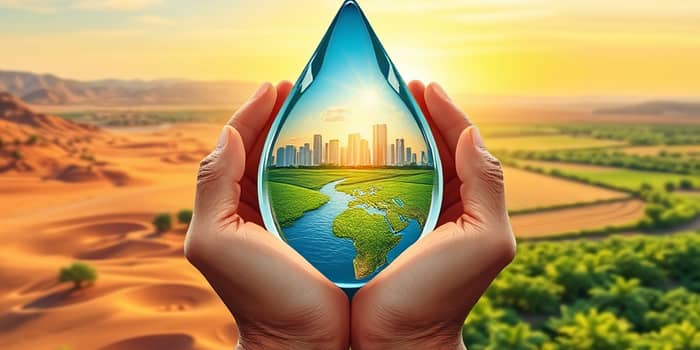
Water is life, yet today our planet stands on the brink of a crisis. Across continents, communities face dwindling supplies, and economies tremble under the weight of scarcity. In this article, we explore how strategic investments in water can transform the future, ignite hope, and empower individuals, businesses, and governments to build a sustainable world.
Understanding the Crisis
Water scarcity arises when demand outstrips supply, or when infrastructure fails to deliver clean water. It manifests in two forms: physical scarcity—simply not enough water in rivers, lakes, and aquifers—and economic scarcity, where funding and systems lag behind need. By 2025, over 2.2 billion people lack properly managed drinking water; 4.5 billion remain without safely managed sanitation.
Demand is projected to exceed supply by 40% by 2030, driven by population growth, urban expansion, and agricultural pressure. Renewable water per person has declined 7% in the past decade. Regions such as Northern Africa and Western Asia have seen withdrawal rises of 16% and skyrocketing stress in megacities from Karachi to Cape Town.
Why This Matters to You
Beyond global metrics, water scarcity shapes everyday lives. From the price of food on supermarket shelves to the availability of clean drinking water in your home, everyone feels the impact. Consider these realities:
- Health risks: Every two minutes, a child dies from waterborne diseases.
- Economic strain: Productivity losses reach $8.6 billion per year in the US alone.
- Social upheaval: Migration and conflict are fueled by resource competition.
- Environmental stress: Ecosystems collapse when rivers, lakes, and wetlands dry up.
Investment Opportunities and Strategies
Water scarcity is not just a challenge; it is a powerful resource investment theme for growth. Investors, businesses, and policymakers can seize opportunities to drive innovation and resilience. Consider these strategic areas:
- Infrastructure upgrades: Modernizing pipelines, reservoirs, and treatment plants to reduce waste and boost capacity.
- Advanced irrigation: Deploying drip and precision irrigation to cut agricultural water use by up to 50%.
- Water recycling and reuse: Treating wastewater for industrial, agricultural, and even potable uses.
- Desalination technologies: Harnessing renewable energy to produce freshwater from seawater.
Practical Steps to Make a Difference
No action is too small. Individuals, communities, and corporations can adopt measures that conserve water and catalyze broader change. Here are actionable steps you can take today:
- At home: Install low-flow fixtures, fix leaks promptly, and capture rainwater for gardening.
- At work: Audit water usage, implement reuse systems, and incentivize efficient practices.
- In your community: Support local watershed protection groups and advocate for updated infrastructure.
- As an investor: Allocate capital toward water-efficient technologies and resilient agricultural systems.
Case Studies of Success
Across the globe, innovative projects showcase how focused investment can yield profound benefits. The following table highlights three examples demonstrating impact, scale, and replicability:
Looking Ahead: A Shared Responsibility
By 2050, global water demand could surge 55%. Three in four people may face drought conditions, and displacement due to scarcity could affect 700 million. Yet these projections are not destiny—they are a call to action. Through collaborative investment and policy, we can steer toward a future where water sustains life, economies, and ecosystems.
Governments must embed water resilience into national plans; businesses must view water efficiency as a core strategy; individuals must embrace conservation as a daily habit. By aligning financial tools with sustainable practices, we can unlock the $58 trillion annual value that freshwater ecosystems contribute to global GDP.
Together, we have the power to turn scarcity into abundance. Each investment, each policy decision, each drop saved brings us closer to a world where clean water flows freely for all. Let us forge this path with vision, empathy, and determination—because the future we build today will shape generations to come.
References
- https://humannecessityfoundation.com/water-scarcity-in-2025/
- https://www.bis.org/publ/work1314.htm
- https://www.fao.org/newsroom/detail/renewable-water-availability-per-person-plunges-7-percent-in-a-decade-as-global-scarcity-deepens--fao-data-shows/en
- https://www.publicfirst.co.uk/the-impact-of-water-scarcity-on-the-economy.html
- https://seametrics.com/global-water-crisis-facts/
- https://www.worldbank.org/en/topic/water/publication/high-and-dry-climate-change-water-and-the-economy
- https://news.un.org/en/story/2025/12/1166582
- https://www.weforum.org/stories/2024/11/7-facts-about-the-global-water-crisis-that-cop29-leaders-should-know/
- https://worldpopulationreview.com/country-rankings/countries-with-water-scarcity
- https://www.cdcfoundation.org/blog/addressing-growing-water-crisis-us
- https://www.unwater.org/publications/un-world-water-development-report-2025
- https://www.dni.gov/index.php/gt2040-home/gt2040-deeper-looks/future-of-water
- https://www.who.int/news/item/26-08-2025-1-in-4-people-globally-still-lack-access-to-safe-drinking-water---who--unicef
- https://www.worldwildlife.org/news/press-releases/water-crisis-threatens-58-trillion-in-economic-value-food-security-and-sustainability/
- https://www.worldwildlife.org/our-work/freshwater/water-scarcity/
- https://www.wri.org/insights/growing-water-risks-food-crops
- https://www.unwater.org/water-facts/water-scarcity