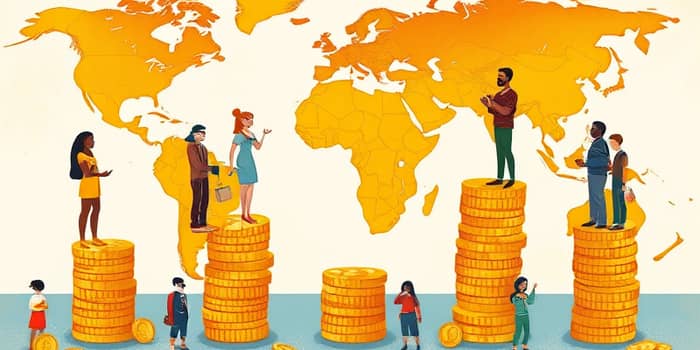
Wealth inequality—the gap between those who control vast assets and those who struggle to accumulate basic savings—has become one of the defining challenges of our era. As economies expand, the distribution of financial capital has remained stubbornly uneven, concentrating power and opportunity in the hands of a few. This article explores the historical trends, structural drivers, societal consequences, and practical policy solutions that can help bridge the growing economic divide.
By examining the data, listening to impacted communities, and outlining actionable strategies, we aim to inspire meaningful progress toward a fairer and more inclusive global economy.
Global Overview and Historical Context
Since the year 2000, global wealth has climbed at a 3.4% annual rate, yet wealth inequality has increased by 0.4% in the same period. While the total personal wealth worldwide rose by 4.6% in 2024 alone, the fruits of this expansion were not shared equally. Regions like North America spearheaded almost all of that growth, leaving many countries in Africa, Latin America, and parts of Asia lagging behind.
Today, millionaires own nearly half of the world’s personal wealth. Over the next two decades, more than $83 trillion is expected to transfer across generations, with the United States, Brazil, and China accounting for the lion’s share. These staggering figures underscore how historical accumulation patterns, inheritance laws, and regional growth disparities have fueled a widening gap between the asset-rich and the asset-poor.
Defining and Measuring Wealth Inequality
To quantify the economic divide, economists rely on the Gini coefficient—a number ranging from 0 (perfect equality) to 100 (perfect inequality). A higher Gini value indicates that a large portion of wealth is held by a small fraction of the population.
These numbers reveal dramatic contrasts: while Slovakia, Slovenia, and Belgium rank among the most equal societies, countries like South Africa and Brazil struggle with deep wealth divides that perpetuate poverty and limit mobility.
Current State by Country and Region
On a national level, Brazil, Russia, and South Africa are among the most unequal economies. In contrast, smaller European nations and some wealthy Gulf states boast relatively balanced distributions. Globalization has played a dual role: it has reduced average wealth gaps between countries but often widened disparities within nations.
Today’s developing economies face a paradox: international trade and foreign direct investment can fuel overall growth, yet benefits frequently accrue to urban elites with access to capital and education, leaving rural and marginalized populations behind.
Drivers of Wealth Inequality
- Wage stagnation among lower-income groups despite rising labor productivity.
- Accumulation of financial assets and intergenerational inheritance, which favor established families.
- Tax policies favoring the wealthy through deductions and lower capital gains rates.
- Unequal access to quality education and homeownership, reinforcing entrenched advantages.
Between 1980 and 2023, the bottom half of earners saw their pre-tax income rise by only $358, while the top 1% experienced gains of $191,000. Discriminatory labor markets, barriers to affordable housing, and skewed financial regulations further amplify these trends. In many countries, systemic racism and gender bias add yet another layer, creating persistent racial and gender wealth gaps that undermine social cohesion.
Consequences of Wealth Disparity
- Restricted economic mobility for millions who cannot accumulate savings or access credit.
- Increased social unrest and political polarization fueled by perceptions of unfairness.
- Persistent poverty even as national wealth rises, because gains concentrate at the top.
- Billionaires increased their wealth by $2 trillion in a single year, highlighting runaway accumulation.
High inequality erodes trust in institutions, undermines democratic norms, and can spark civil unrest. Families stuck in poverty struggle to invest in health, education, and entrepreneurship, perpetuating cycles of disadvantage.
Policy Solutions and Approaches
Addressing such a complex challenge requires an integrated policy framework focused on taxation, labor rights, education, and asset-building:
- Progressive tax reforms and wealth taxes that target large estates, cap deductions, and rebalance responsibilities.
- Universal basic income or targeted cash transfers to ensure a safety net for the most vulnerable households.
- Raising minimum wages and expanding earned income tax credits to lift the earnings of low-wage workers.
- Investment in universal early education and sector-based job training to close skill gaps and unlock opportunity.
- Automatic enrollment in retirement and early-life savings accounts so that every generation builds financial resilience.
Additional measures such as reforming safety net asset tests, exploring national reparations to address historical injustices, and investing in affordable housing and healthcare can create a multilayered defense against disenfranchisement.
International Cooperation and Development
Global solutions must complement national reforms. Fairer trade agreements, debt relief for low-income countries, and robust support for social programs can help emerging economies build more equitable foundations. International development banks and donor nations should prioritize initiatives that reduce gender and racial wealth gaps, promote smallholder agriculture, and expand financial inclusion.
By coordinating policy design and sharing best practices, nations can accelerate progress toward narrowing the economic divide worldwide.
Future Outlook
Without bold intervention, the next generation may witness even more concentrated wealth, as trillions transfer to heirs and technological innovation amplifies winner-take-all markets. Climate change and automation risk leaving vulnerable communities further behind, unless policymakers anticipate and mitigate their impacts.
Yet there is reason for optimism: a growing global consensus recognizes that unchecked inequality undermines social stability and economic growth. Thoughtful combinations of tax reform, labor protections, targeted investments, and asset-building policies have the potential to reverse current trajectories.
Conclusion
Wealth inequality is more than an economic statistic—it is a force that shapes life chances, health outcomes, and the fabric of society. By championing comprehensive policy solutions and fostering international solidarity, we can work toward an era where prosperity is shared, opportunity is universal, and future generations inherit a fairer world. The journey demands vision, collaboration, and unwavering commitment to justice. Together, we can close the economic divide and rebuild trust in our shared future.
References
- https://www.voronoiapp.com/economy/Wealth-Inequality-by-Country-in-2025-6910
- https://apps.urban.org/features/wealth-inequality-charts/
- https://www.ubs.com/global/en/media/display-page-ndp/en-20250618-gwr-2025.html
- https://belonging.berkeley.edu/six-policies-reduce-economic-inequality
- https://worldpopulationreview.com/country-rankings/wealth-inequality-by-country
- https://siepr.stanford.edu/publications/policy-brief/policy-cocktails-attacking-roots-persistent-inequality
- https://www.visualcapitalist.com/visualizing-global-wealth-inequality/
- https://www.changelabsolutions.org/driver-income-inequality-poverty
- https://wid.world
- https://www.hks.harvard.edu/centers/mrcbg/programs/growthpolicy/racial-wealth-inequality-social-problems-and-solutions
- https://www.pewresearch.org/social-trends/2020/01/09/views-on-reducing-economic-inequality/
- https://www.oxfamamerica.org/explore/issues/economic-justice/extreme-inequality-and-poverty/
- https://www.oxfamamerica.org/explore/issues/economic-justice/income-and-wealth-inequality/
- https://ourworldindata.org/economic-inequality
- https://nonprofitquarterly.org/from-precarity-to-promise-how-public-policy-can-reverse-the-wealth-gap/
- https://www.nasdaq.com/articles/millionaires-now-own-nearly-half-worlds-personal-wealth-heres-what-it-means
- https://www.weforum.org/stories/2024/02/inequality-developing-countries-women-oxfam/