In today’s interconnected world, unexpected shifts in the cost of living resonate deeply with households and businesses alike. By exploring the roots of inflation, we can make more informed financial decisions and protect our lifestyles from unpredictable price swings.
Defining Inflation and Its Impact
At its core, inflation describes how the general level of prices for goods and services steadily rises, diminishing the value of money over time. If a simple market basket of everyday items cost $100 last year and $103 today, that 3% increase illustrates how each dollar now buys less than before. This mathematical perspective anchors the concept in real-world experiences that all consumers share.
Conversely, deflation signifies an economy-wide fall in prices, boosting purchasing power but risking stagnation, while disinflation denotes a slowdown in the inflation rate, with prices still rising but more moderately. As inflation climbs, it functions like a hidden levy on cash and percentage change per year measures quantifying its pace, which shapes financial planning for everyone from wage earners to pensioners.
Measuring the Shifts in Price Levels
Economic authorities rely on indices like the Consumer Price Index (CPI) to gauge inflation. The CPI monitors the cost of a basket of goods and services—including housing, food, transportation, and healthcare—tracking how that bundle’s price evolves month after month. Detailed subindices, such as shelter, used vehicles, and medical care, allow analysts to discern which components drive overall changes.
- Consumer Price Index (CPI) and detailed subindices
- Core inflation excluding volatile food and energy
- Harmonized Index of Consumer Prices (HICP) in Europe
- Global datasets: World Bank, IMF, Trading Economics
Because individual spending patterns vary widely, official inflation figures can differ from perceived costs. For instance, a household heavily spending on rising healthcare or rent may feel inflation more acutely than one focused on electronics or travel. Recognizing personal expenditure priorities helps tailor budgeting strategies and avoid surprises.
Types of Inflation: Forces at Work
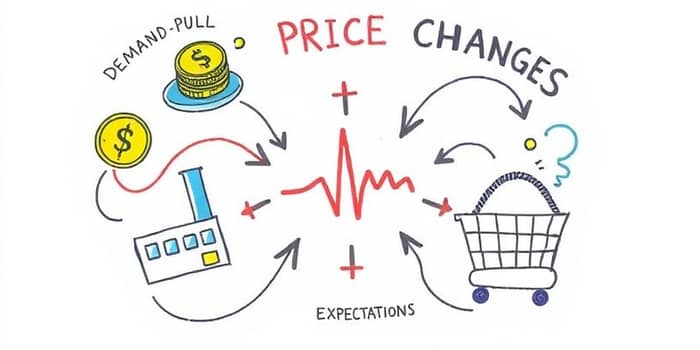
Inflation manifests in several forms, each driven by distinct economic triggers. The four primary types—demand-pull, cost-push, built-in, and monetary—often overlap, creating complex dynamics. By isolating these categories, policymakers and individuals can better diagnose price pressures and deploy appropriate remedies.
Demand-pull inflation arises when aggregate demand exceeds productive capacity of an economy, meaning consumer and business spending outpaces what companies can supply. Simply put, too many dollars chase too few goods. Historical spikes followed massive stimulus after economic downturns, where rapid demand recovery overwhelmed still-constrained production lines, leading to higher prices across sectors.
Cost-push inflation occurs when production expenses rise—be it wages, energy, or raw materials—and businesses transfer those costs to consumers. Supply shocks such as natural disasters, pandemics, or geopolitical tensions can cripple supply chains, from semiconductors to shipping, creating cascading price jumps that spread from industry to industry.
Built-in inflation evolves from shifting expectations, embedding price increases into economic behavior. A self-reinforcing wage-price spiral emerges when employees anticipate rising costs and request higher salaries, prompting firms to increase prices to cover elevated wage bills. If unchecked, this cycle cements a norm where future contracts automatically adjust for past inflation.
Monetary inflation reflects the relationship between money supply and real output. According to classical theory, excessive growth in money supply without matching expansion in goods and services leads directly to price escalation. Central banks that pursue aggressive quantitative easing or prolonged low interest rates can inadvertently inflate asset prices and consumer goods when liquidity outstrips productive investment.
How Forces Intersect: A Complex Causal Web
Real-world inflation rarely stems from a single cause; instead, multiple factors interplay. For example, after the 2020 pandemic, unprecedented fiscal stimulus fueled demand-pull pressures simultaneously as global supply disruptions inflicted cost-push shocks. These combined to produce one of the steepest inflation surges in decades. Additionally, as households observed rising costs, their expectations influenced wage negotiations, layering in built-in dynamics.
International comparisons underscore how local factors—like energy dependence, central bank credibility, and labor market flexibility—shape inflation trajectories. Emerging markets with high exchange rate volatility often grapple with imported inflation, where currency depreciation directly inflates the cost of vital imports, adding another layer to the causal web.
Practical Takeaways: Navigating Inflation’s Waves
While inflation can feel like a relentless tide, understanding its root causes turns uncertainty into actionable intelligence. Whether you’re safeguarding savings or planning major purchases, these strategies can help preserve financial stability and even capitalize on inflationary trends.
- Track expenses and adjust personal budgets regularly
- Invest in inflation-linked assets and real estate
- Seek income streams with built-in cost adjustments
- Keep an emergency fund diversified across currencies
Maintaining a precise spending log reveals which categories erode your budget fastest, enabling early course corrections. Assets like Treasury Inflation-Protected Securities (TIPS), real estate, or commodity-linked funds offer hedges against rising prices. Moreover, negotiating wage or rental contracts tied to inflation can secure real purchasing power.
Ultimately, unmasking the forces behind inflation equips individuals and businesses to act confidently in volatile environments. By dissecting demand dynamics, cost shocks, monetary flows, and expectation-driven cycles, you transform an intimidating economic phenomenon into a navigable landscape—laying the foundation for resilient financial decisions under any price regime.
References
- https://www.ruleoneinvesting.com/blog/investing-news-and-tips/us-inflation
- https://www.ifo.de/en/press-release/2025-04-09/experts-expect-inflation-rates-rise-worldwide
- https://www.rosenbergresearch.com/2025/05/26/understanding-inflation-causes-effects-and-solutions/
- https://www.oecd.org/en/data/insights/statistical-releases/2025/08/consumer-prices-oecd-updated-5-august-2025.html
- https://www.independent.org/article/inflation-causes/
- https://www.statista.com/statistics/256598/global-inflation-rate-compared-to-previous-year/
- https://www.imf.org/en/publications/fandd/issues/series/back-to-basics/inflation
- https://www.imf.org/en/publications/weo/issues/2025/10/14/world-economic-outlook-october-2025
- https://www.pgpf.org/article/what-is-inflation-and-why-does-it-matter/
- https://www.bls.gov/news.release/cpi.nr0.htm
- https://www.congress.gov/crs-product/IF10477
- https://www.imf.org/external/datamapper/PCPIPCH@WEO/CIS
- https://www.meetbreeze.com/blog/what-is-inflation/
- https://tradingeconomics.com/country-list/inflation-rate-
- https://www.blackrock.com/us/individual/education/inflation
- https://www.visualcapitalist.com/global-inflation-by-country-2020-2025/
- https://www.bankrate.com/banking/federal-reserve/what-is-inflation/
- https://www.worldbank.org/en/research/brief/inflation-database