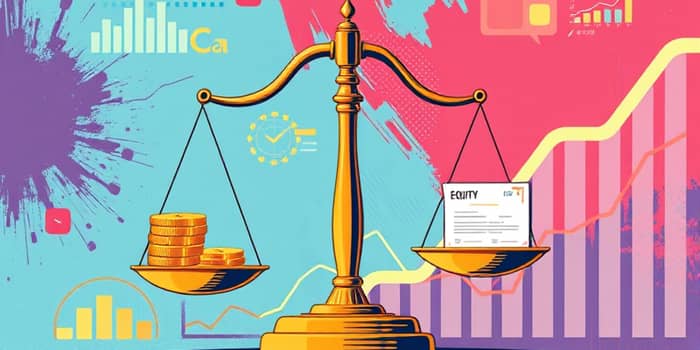
Every successful enterprise faces a delicate challenge: how to fund growth while safeguarding its financial health. Capital structure optimization is the art of designing the ideal blend of financing instruments so that a firm minimizes the firm’s weighted average cost and sustains strategic flexibility. By understanding the interplay between debt, equity, and hybrid securities, leaders can make informed choices that drive value and resilience.
Understanding Capital Structure Fundamentals
At its core, capital structure reflects a company’s mix of debt and equity financing. Debt capital—loans, bonds, credit facilities—offers tax advantages through interest deductibility but carries mandatory payments and covenant constraints. Equity capital, by contrast, dilutes ownership and commands higher returns, yet provides a cushion against default and enhances flexibility.
Hybrid instruments, such as convertible bonds and preferred stock, blend features of both debt and equity. They can be powerful tools for companies seeking tailored financing solutions, offering investors fixed-income characteristics with upside participation in equity appreciation.
- Debt: bank loans, corporate bonds, leasing obligations
- Equity: common shares, preferred stock, retained earnings
- Hybrids: convertibles, mezzanine debt with equity kickers
- Alternative sources: private equity, project finance
The Risk-Reward Trade-Off in Leverage
Leverage is a double-edged sword. On one hand, debt reduces capital costs and can incremental value created by higher leverage when returns on invested capital exceed borrowing costs. On the other, excessive debt elevates bankruptcy probabilities, restricts operational flexibility, and erodes stakeholder confidence.
By framing financing choices through a risk–reward lens—akin to investment portfolios—firms can strike a prudent balance. As debt increases, the equity beta rises, demanding higher returns from shareholders and amplifying earnings volatility. Conversely, an all-equity stance offers maximum resilience but at the expense of higher potential reward requires accepting higher risk for investors.
- Pros of higher debt: tax shields, lower overall WACC, enhanced ROE
- Cons of higher debt: covenant restrictions, refinancing risk, distress costs
- Pros of equity: no fixed payments, improved credit ratings, strategic freedom
- Cons of equity: dilution, higher required return, potential ownership shifts
Quantitative Tools and Benchmarks
Effective optimization relies on concrete metrics. Firms monitor leverage and coverage ratios to align with credit rating objectives and stakeholder expectations. A clear grasp of the following benchmarks is essential for rigorous analysis:
To calculate the overall financing cost, the weighted average cost of capital (WACC) blends the cost of equity (Re) from CAPM and the after-tax cost of debt (Rd):
WACC = (E⁄(D+E))·Re + (D⁄(D+E))·Rd·(1–T).
Practical Steps to Optimize Your Capital Structure
Bringing theory into action involves a structured process. Begin with a comprehensive diagnostic of your current financing mix and stress-test forecasts under various market scenarios. Use sensitivity analysis to identify leverage levels that align financing decisions with strategic objectives.
- Assess current capital costs and covenant limits
- Define target ranges for key ratios
- Model scenarios under stress and growth cases
- Implement debt refinancings or equity injections
- Establish monitoring dashboards for real-time tracking
Industry dynamics play a pivotal role. High-growth technology firms may favor equity to preserve operational agility, while stable utilities can safely shoulder more debt to capture tax efficiencies. Striking the right balance demands an in-depth understanding of sector norms and cyclicality.
Monitoring and Adapting Over Time
Capital structure optimization is not a one-off exercise. Market conditions, interest rates, and strategic priorities evolve continuously. Companies should conduct periodic reviews, stress-testing the balance sheet against economic downturns and regulatory changes, while maintaining financial risk at a level consistent with corporate goals.
Building in flexibility through undrawn credit lines, covenant headroom, and liquidity reserves can buffer shocks. Regular communication with rating agencies and lenders ensures that financing strategies remain credible and execution-ready.
Building a Long-Term Framework
Ultimately, the goal is building a resilient capital framework over time that supports sustainable growth. By integrating quantitative benchmarks with strategic insights, firms can pursue optimizing tax efficiency and shareholder returns without compromising stability.
Leaders who master capital structure optimization empower their organizations to navigate volatility, seize investment opportunities, and deliver enduring value to stakeholders.
Conclusion
Effective capital structure management lies at the heart of financial strategy. By balancing debt and equity thoughtfully, companies can lower probability of financial distress while unlocking value. The journey involves rigorous analysis, proactive monitoring, and a clear alignment with strategic imperatives. Embrace the challenge, and you’ll position your enterprise for long–term success in any market environment.
References
- https://eoxs.com/new_blog/capital-structure-optimization-10-key-strategies/
- https://capital.com/en-int/learn/essentials/risk-reward-ratio-key-differences
- https://www.kayekendrick.com/blog/optimizing-your-capital-structure-for-sustainable-growth
- https://capitalgains.thediff.co/p/capital-asset-pricing-model-risk-reward-reasons
- https://www.treasurers.org/hub/treasurer-magazine/how-pin-down-optimal-capital-structure
- https://guild.capital/the-basics-of-structured-products-risk-vs-reward/
- https://www.vareto.com/post/best-practices-for-optimizing-capital-structure
- https://www.capitalgroup.com/institutional/resources/risk-vs-reward.html
- https://www.wallstreetprep.com/knowledge/optimal-capital-structure/
- https://www.pimco.com/us/en/resources/education/understanding-the-risk-reward-spectrum
- https://www.phoenix.edu/articles/business/what-is-optimal-capital-structure.html
- https://www.personalinvesting.jpmorgan.com/guides/investing-principles/risk-and-reward
- https://financialmodelslab.com/blogs/blog/risk-reward-venture-capital-deals
- https://www.khanacademy.org/economics-finance-domain/core-finance/investment-vehicles-tutorial/investment-consumption/v/risk-and-reward-introduction