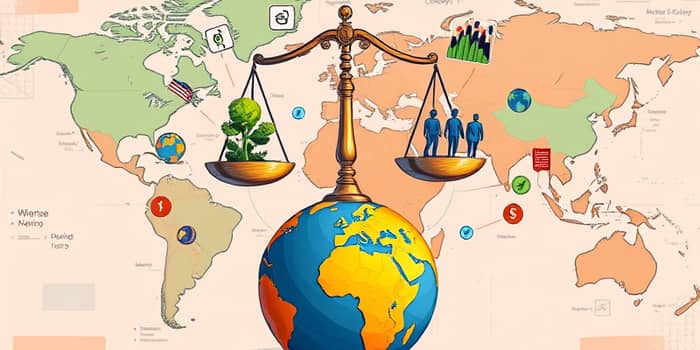
In an era of flux, the global economy is undergoing a profound transformation. A blend of slower growth, rising imbalances, policy realignments and structural transitions is reshaping how nations interact, compete and collaborate.
The Uneven Tides of Global Growth
The outlook for global expansion through 2027 is marked by divergence across regions and institutions. Forecasts range from a modest 2.4–3.3% projected growth, underscoring the debate between resilience and deceleration.
Major agencies present a spectrum of scenarios: the IMF anticipates around 3.1–3.3% growth in 2026–27, while the UNCTAD estimate is closer to 2.7–2.9%. S&P Global warns of the weakest pace since 2009 (excluding 2020), with Goldman Sachs offering a slightly brighter 2.8% projection. These variations hinge on assumptions about Middle East conflicts, policy support, AI-driven investment and financial conditions.
Inflation trends add nuance: headline rates may rise modestly in 2026 before resuming a downward trajectory in 2027, yet emerging markets face a more pronounced cost-of-living squeeze driven by food, energy and housing pressures.
Widening Imbalances and the Dollar’s Dominance
Global imbalances are back at scale not seen since the financial crisis. Current account surpluses and deficits have increased by 25–35% since 2018, reflecting a return to fragmented capital flows and uneven regional performance.
The US and China form the core of these disparities. The United States continues to run persistent current account deficits, driven by low savings and high consumption. China, in contrast, maintains large surpluses through elevated savings and export-led investment. Tariffs alone cannot rectify this fundamental misalignment; enduring rebalancing demands coordinated fiscal, monetary and trade policies.
Policy-Driven Rebalancing: From Tariffs to Coordination
A new era of policy coordination is needed to address imbalances effectively. Higher tariffs, in a world of floating exchange rates, often provoke offsetting currency moves and uncertainty without closing savings-investment gaps.
Experts advocate for a broader G3 accord spanning fiscal, monetary and development measures among the US, euro area and China. Only such a multipronged framework can synchronize demand restraint in deficit economies and stimulus in surplus regions.
- United States: Fiscal retrenchment to boost national savings; a targeted tax on foreign investment to reduce the dollar’s dominance.
- China: Reflation of domestic demand through stronger social safety nets, pension reforms and consumer incentives to lower precautionary savings.
- Multilateral: Enhanced coordination on infrastructure finance, green transition funding and cross-border investment standards.
From Dollar Hegemony to Twin Financial Hubs
Oxford Economics envisions a shift from a unipolar system to a fragmented yet diversified financial system anchored by both the US and China. Under this scenario, US government debt surpasses 180% of GDP by the 2030s, while political interference weakens Fed credibility. Gradual capital flow reversals could see the dollar weaken by 20%, eroding its dominant-currency privileges.
Concurrently, China’s structural reforms—looser capital controls, transparent institutions and a revamped pension framework—could drive domestic consumption 14% above baseline by 2060. Emerging markets might benefit through broader access to renminbi-denominated debt and reduced reliance on dollar financing.
Structural Shifts: Technology, Climate and Demographics
Beyond macro and policy, deep structural forces are reshaping growth trajectories and competitive landscapes.
- Technology-driven productivity surge: AI and automation promise efficiency gains, but also threaten job displacement and uneven income distribution.
- Climate risk and demographic shifts: Aging populations in advanced economies strain pension systems, while climate shocks impose high adjustment costs on vulnerable regions.
- Urbanization and labor transitions: Rapid urban growth in emerging markets demands investment in infrastructure, education and social services to harness demographic dividends.
Policymakers must align investment in digital skills, green infrastructure and social protection to bridge these long-term trends with near-term macro stability.
Distributional and Sectoral Impacts
Rebalancing is not just a macro concern—it has profound distributional consequences across households, industries and countries.
Consumers in deficit economies may face tighter budgets as governments prioritize savings. Workers in automation-prone sectors require reskilling to remain competitive. Exporters in surplus countries must cultivate domestic markets to sustain growth.
Financial markets will adjust: higher risk premia on US assets may spur capital flows into alternative currencies and assets, benefiting regions with stronger balance sheets. Commodity exporters could see renewed demand from green transition investments, but must manage price volatility and ensure inclusive proceeds.
Charting a Path Forward
The global economy stands at a crossroads. A rebalancing agenda that combines prudent fiscal policies, coordinated multilateral action and targeted structural reforms offers the best chance to navigate slower growth and rising fragmentation.
Leaders must embrace humility and cooperation, recognizing that tariffs and unilateral measures alone cannot deliver sustainable equilibrium. By fostering resilient consumption patterns, investing in human capital and adapting to technological and environmental shifts, the international community can transform this rebalancing challenge into an opportunity for inclusive, stable and shared prosperity.
References
- https://www.imf.org/en/publications/weo/issues/2026/04/14/world-economic-outlook-april-2026
- https://www.capitaleconomics.com/blog/path-solving-global-imbalances-doesnt-run-through-mar-lago
- https://www.goldmansachs.com/insights/outlooks/2026-outlooks
- https://www.oxfordeconomics.com/resource/shifting-economic-gravity-in-a-global-rebalance/
- https://unctad.org/publication/world-economic-situation-and-prospects-2026
- https://www.nber.org/papers/w33554
- https://www.spglobal.com/market-intelligence/en/news-insights/research/2026/04/global-economic-outlook-april-2026
- https://cepr.org/voxeu/columns/why-global-imbalances-matter-again-and-what-do-about-them
- https://www.goldmansachs.com/insights/videos/global-gdp-outlook-in-2026-sturdy-growth-and-stable-prices
- https://www.brookings.edu/articles/rebalancing-the-world-economy-right-idea-but-wrong-approach/
- https://www.imf.org/en/publications/weo/issues/2026/01/19/world-economic-outlook-update-january-2026
- https://www.alliancebernstein.com/apac/en/institutions/insights/economic-perspectives/world-economy-to-continue-rebalancing-in-2025.html
- https://www.youtube.com/watch?v=vLfUrJ7Iebc
- https://openknowledge.worldbank.org/entities/publication/bb904ec6-730f-4dd9-b1af-ad3153ee1616