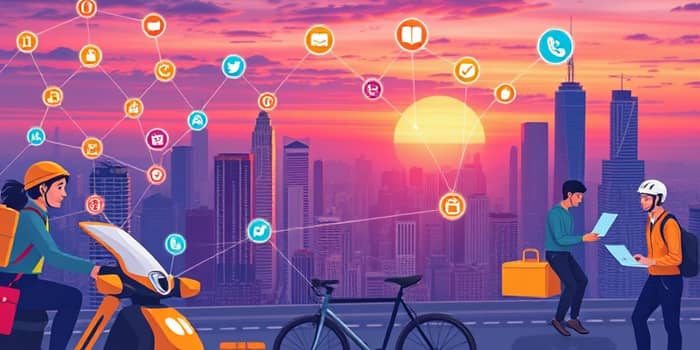
In recent years, the world of work has undergone a profound transformation. The centuries-old model of a single employer, fixed hours, and a predictable career path is giving way to a more fluid landscape, where tasks are assigned on demand and workers navigate multiple projects simultaneously. This new reality, often heralded as the gig economy, is redefining how labor markets function and how individuals shape their careers.
Understanding this shift is essential for workers seeking opportunity, for businesses aiming to adapt, and for policymakers striving to balance innovation with protection. By examining the gig economy’s definitions, history, scale, and future, we gain insight into both its promise and its perils.
Definitions and Scope
At its core, the gig economy is a labor market characterized by short-term, flexible, or freelance jobs paid per task or project rather than through traditional, long-term employment contracts. These roles are mediated by digital platforms that match supply and demand, manage payments, and often adjudicate ratings and reviews.
- Digital labor platforms: Online services connecting buyers and sellers of labor or services, handling transactions and feedback loops.
- Types of gig workers: Include freelancers (designers, developers, writers), independent contractors (legal, accounting consultants), rideshare and delivery drivers, micro-task workers (data labeling, content moderation), and on-call shift workers.
- Platform economy: The broader ecosystem of non-standard employment, encompassing self-employment, part-time, temporary, and app-mediated work.
Historical Evolution
While casual and piecework labor have existed for centuries, the internet and smartphones revolutionized how tasks are sourced and completed. In pre-digital times, day laborers gathered at jobbers’ yards and temp agencies placed workers for short-term assignments. The advent of digital platforms drastically lowered transaction costs, enabling seamless, global matching.
The first wave glimpsed this potential in the mid-2000s: eBay and Craigslist pioneered peer-to-peer marketplaces, and by 2009, Uber and TaskRabbit were reshaping transport and local services. In this era, platforms online platforms created a new mode of search between clients and workers, but still classified labor as independent contracting.
The second wave brought professional freelancing platforms like Upwork, Fiverr, and Toptal, connecting corporations with software developers, translators, and consultants around the world. Employers tapped global expertise, while workers in lower-wage regions accessed higher-paying projects, blurring national labor boundaries.
During the COVID-19 pandemic, lockdowns accelerated demand for delivery and digital services, as millions turned to gig work to offset furloughs and layoffs. By 2022, the gig economy had become central to understanding structural labor shifts worldwide.
Today, gig work is fully integrated into workforce strategies. Individuals craft “hybrid careers,” combining stable roles with side gigs, while employers treat on-demand talent as a regular part of their staffing mix.
Global Scale and Key Numbers
The gig economy’s reach is vast and growing. In 2024, an estimated 1.5 billion people engaged in some form of gig or freelance work, contributing to a platform economy projected to be worth $21.45 trillion by 2033. Revenues from digital gig platforms alone exceeded $556 billion in 2024 and are expected to more than triple by 2032.
These figures illustrate the gig economy’s economic weight and its critical role in shaping tomorrow’s labor markets.
Transforming Employment Relationships
Gig platforms offer workers unprecedented autonomy: choose hours, select tasks, and operate from anywhere. Yet this flexibility often comes at the expense of security. Classified as independent contractors, gig workers typically lack benefits such as health insurance, paid leave, and unemployment coverage.
This classification removes eligibility for critical worker protections, eroding social safety nets established over decades. As a result, a two-tier labor market has emerged: a secure core of standard employees and a peripheral layer of gig workers facing income volatility and limited legal recourse.
Worker Experience: Benefits and Challenges
Many individuals embrace gig work for its ability to fit around life’s demands. Students, parents, and retirees find opportunities to earn without long commutes or strict schedules. For professionals, freelancing can offer higher hourly rates and diverse project portfolios.
- Flexibility to tailor schedules and tasks
- Access to global clients and diverse projects
- Potentially higher hourly earnings than traditional roles
- Income unpredictability and gaps between gigs
- Lack of employer-sponsored benefits and protections
- Intense competition driving rates downward
Balancing these trade-offs requires strategic planning. Building a strong reputation, diversifying platforms, and setting clear financial cushions can help individuals thrive.
Business Models and Technology
Digital platforms operate on asset-light models: they own the technology and brand but rely on independent workers to supply vehicles, tools, or expertise. Revenue comes from commissions, subscription fees, and sometimes dynamic pricing formulas.
Algorithms govern task assignment, vetting, and compensation. Platforms leverage algorithm-driven task assignment and pricing to optimize match rates and customer satisfaction while controlling labor costs. In parallel, integration of AI in labor platforms is powering new efficiencies: predictive demand modeling, automated dispute resolution, and skill-based job recommendations.
Policy, Regulation, and Inclusion
Legislators grapple with how to classify gig workers—employee or contractor—and how to extend social protections without stifling innovation. Laws like California’s AB5 exemplify these tensions, with ongoing legal challenges shaping future norms.
Internationally, regulatory approaches vary widely. In Europe, several countries are exploring hybrid employment categories, granting basic benefits while preserving flexibility. In developing nations, gig platforms often fill gaps in formal employment, even as they expose workers to unregulated risks.
Equity concerns are mounting. Gig workers in the U.S. are disproportionately Black and Latinx in sectors like delivery and driving, while gender pay gaps in gig work often exceed those in traditional employment. Addressing wage gaps and systemic inequities in gig markets demands targeted training programs, transparent algorithms, and inclusive policy frameworks.
Future Scenarios
Looking ahead, the gig economy will continue to evolve. Potential futures include more integrated talent marketplaces, portable benefits decoupled from employers, and advanced AI mediating worker–client interactions.
Some envision a universal basic income complementing gig work’s volatility; others foresee credentialing systems where reputation scores translate into access to higher-value projects. Regardless of the path, collaboration among workers, platforms, policymakers, and businesses will determine whether gig work becomes a sustainable livelihood or perpetuates precarious labor.
By understanding the dynamics at play and taking proactive steps—building skills, advocating for fair policies, and designing ethical platforms—we can ensure the gig economy remains a source of opportunity rather than dislocation. To shape a future that benefits all, stakeholders must engage proactively in shaping policies and practices that foster both innovation and security.
References
- https://economiclens.org/gig-economy-2025-how-flexible-work-is-reshaping-the-global-labor-market/
- https://www.weforum.org/stories/2025/06/the-gig-economy-ilo-labour-platforms/
- https://www.talentneuron.com/blog/navigating-the-rising-gig-economy-and-its-impact-on-work
- https://www.park.edu/blog/the-gig-economy-shaping-the-future-of-work-and-business/
- https://dl.acm.org/doi/full/10.1145/3726122.3726196
- https://search.proquest.com/openview/fef48b71597c2094a0c0664b9315fa96/1?pq-origsite=gscholar&cbl=2045096
- https://nativeteams.com/blog/future-of-gig-economy
- https://www.economicsobservatory.com/ongoing-research/how-online-gig-economy-reshapes-the-international-labour-market-amid-covid-19
- https://www.adpresearch.com/research/the-gig-economy-a-tale-of-two-labor-markets