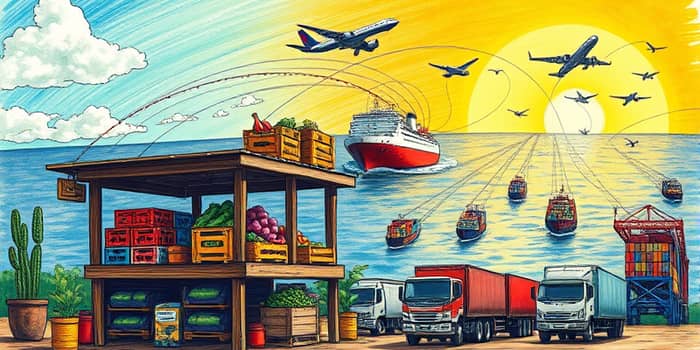
Every decision about what to grow, purchase or regulate at the local level can send ripples across the world. Whether it’s a family farmer in rural Asia choosing a new seed variety, a city council investing in storage facilities, or a government imposing tariffs, these acts shape global markets, incomes, and resilience. By tracing how choices travel through trade, logistics, policy, and social systems, we can unlock new ways to build a fairer and more sustainable world.
Interconnected Food Systems and Market Ripples
Local food and commodity networks no longer operate in isolation. Thanks to global value chains, a single harvest shortfall in one region can drive price hikes thousands of miles away. Traders, processors, and retailers link farmers to end consumers through a web of contracts, storage facilities, and shipping lanes.
Processing decisions—such as when to mill wheat or can tomatoes—determine when and where goods reach consumers, affecting availability and affordability. Every time a distributor chooses a port or a warehouse, they influence the final price tag on supermarket shelves worldwide.
Comparative Advantage and Specialization
At the heart of international trade lies the principle of produce relatively efficiently. Comparative advantage explains why regions focus on crops or goods they can grow or manufacture at lower opportunity costs. By specializing, countries tap into global demand and secure better prices for their exports.
- Specialization fosters mutual interdependence—no economy stands alone.
- Trade incentives reshape local planting or manufacturing patterns.
- Underlying cost differences and trade frictions create price differentials across borders.
Transportation Costs, Storage, and Price Volatility
Geography and infrastructure profoundly shape economic outcomes. High shipping rates and poor roads translate into higher consumer prices and widen gaps between producer and consumer markets. In contrast, efficient logistics networks lower markups and improve welfare.
Storage capacity smooths seasonal swings in supply and demand. When granaries sit empty or cold-storage is scarce, markets face spikes in volatility. Investing in warehouses and ports is thus an economic decision with global consequences, dampening shocks and stabilizing incomes.
Policy Levers: Tariffs, Quotas, and Income Distribution
Tariffs and quotas are powerful tools that countries wield to protect domestic producers or raise revenue. Yet they also redistribute income within society. While a tariff may boost farmgate prices for growers, it simultaneously elevates costs for consumers and downstream industries.
- Domestic producers can gain from restricted competition.
- Consumers often pay higher retail prices.
- Downstream firms face increased input costs.
Political leaders frequently succumb to pressure from concentrated interest groups, even when broader consumer losses outweigh the benefits to a few. Understanding these incentives is key to crafting fairer trade policies.
Value Chains, Integration, and Governance
Firms navigate global markets through strategic arrangements. Some pursue horizontal integration, expanding their footprint across regions or continents, while others opt for vertical control—from input supply to marketing and distribution.
- Horizontal integration enhances market reach but may raise antitrust concerns.
- Vertical integration secures quality assurance but can concentrate power.
- Specialization paired with market exchange offers a flexible alternative.
Effective governance of transactions—through contracts, standards, and dispute-resolution mechanisms—reduces risks of market failure and safeguards small producers and consumers alike.
Social and Environmental Externalities
Economics alone cannot capture the full impact of production and trade. The costs of environmental damage, labor rights violations, and health hazards often remain hidden in the final price.
By adopting full-cost accounting, businesses and policymakers can ensure that local purchasing decisions support sustainability and ethical production across borders. Recognizing these externalities is essential for building supply chains that protect workers, ecosystems, and public health.
Resilience Amid Uncertainty: Charting the Path Forward
Despite geopolitical tensions, trade frictions, and tighter finance conditions, the global economy demonstrates remarkable resilience. According to UNCTAD, global output grew by 2.8% in 2025 and is projected at 2.7% for 2026—though still below the pre-pandemic average of 3.2%.
The world’s interconnected systems can withstand shocks, but below-trend growth and policy uncertainty threaten inclusive progress. To reinforce resilience, local actors must recognize their role in global markets:
- Invest in infrastructure—roads, ports, and storage—to lower costs and volatility.
- Promote transparency and social accounting to align prices with real costs.
- Advocate for balanced policies that protect both producers and consumers.
Ultimately, every community, firm, and individual holds the power to shape a more equitable global economy. By making informed, responsible choices, we can ensure that local actions carry weight far beyond our borders.
References
- https://ideas.repec.org/h/pal/psachp/978-3-031-53840-7_11.html
- https://unctad.org/news/mirage-global-economic-resilience
- https://www.plutobooks.com/product/from-the-local-to-the-global/
- https://joseplehndujowich.com/the-impact-of-economics-on-everyday-decisions/
- https://www.youtube.com/watch?v=B2YU6SVJfOI
- https://www.imf.org/en/publications/weo
- https://www.ibisworld.com/blog/from-local-to-global/99/5641/
- https://www.worldbank.org/en/publication/global-economic-prospects
- https://siepr.stanford.edu/av/Econ-To-Go-podcast-tariffs-trade-turning-point-globalization
- https://www.youtube.com/watch?v=tljHWn36370&vl=en
- https://www.abundance.global/from-local-to-global/
- https://clutch.co/resources/economy-impacts-business-decisions
- https://conversableeconomist.com
- https://www.youtube.com/watch?v=jYYGJPJtxmU
- https://www.onpointcu.com/blog/the-impact-of-global-economic-trends-on-personal-investments/