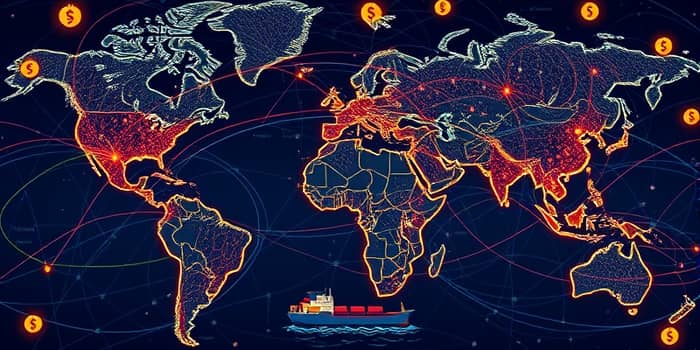
Global trade and finance form a vast, intertwined web where changes in one corner of the world can ripple instantly across continents. Understanding these dynamics is essential for businesses, policymakers, and citizens as they navigate the benefits and vulnerabilities of a shared economic ecosystem.
Foundations of Economic Interdependence
At its core, division of labour and comparative advantage drives nations and firms to specialize in what they do best. No country can efficiently produce every good or service it needs, so mutual exchange becomes inevitable.
- Mutual dependence among participants in an economic system
- Significant exit costs from breaking economic ties
- Opportunity costs shaping cross-border relations
This framework highlights how mutually reinforcing patterns of trade and finance emerge from basic economic principles, setting the stage for complex global linkages.
Historical Evolution of Global Integration
After World War II, technological breakthroughs such as containerization and computerization, along with reduced travel and communications costs, sparked a period of rapid integration. Governments negotiated lower tariffs under the GATT framework, eventually leading to the WTO’s establishment. Meanwhile, domestic reforms opened markets and invited foreign competition.
- Technological progress driving shipping and communications
- Trade liberalization under GATT and WTO
- Progressive financial opening since the 1970s
By the 2008–09 financial crisis, these interdependencies were both undeniable and underappreciated. A shock originating in one housing market cascaded through complex financial instruments, underscoring the magnitude of cross-border spillovers and the need for coordinated policy responses.
Trade Interdependence: Value Chains and Beyond
Today’s trade is dominated by intermediate goods embedded in global supply chains rather than simple exchanges of final products. Between 1995 and 2020, intermediate goods trade exceeded US$114 trillion in total value according to UN Comtrade data. Major economies each contribute significant shares:
Complex products like the Apple iPhone source components—from chips and batteries to lenses—from over 50 countries, while the Boeing 787 Dreamliner integrates more than two million parts from 75 countries. This web of cross-border inputs and technologies illustrates how production processes span continents.
Regional Dynamics and Relational Ties
No region stands entirely on its own. McKinsey analysis shows every part of the world relies on others for resources, manufactured goods, and advanced inputs. Recognizing this, companies are shifting from single-node supply lines to multi-node networks prioritizing resilience, often diversifying away from sole sourcing in any one country.
At the micro level, relational contracts between exporters and buyers foster reliability and shock resilience. In Bangladesh’s garment sector, firms with long-term ties can charge 11% higher prices to repeat buyers, generating about 30% of annual profits. Such relationships highlight how trust and commitment underpin trade patterns.
Financial Interdependence: Global Cycles and Risks
Global capital markets have been interconnected for centuries, with cyclical flows and asset price co-movements traceable back to at least 1815. The U.S. dollar, as the dominant reserve currency, wields outsized influence on global interest rates and liquidity conditions. Low real rates in major economies can fuel debt cycles that predict slower growth later, reflecting a rapid transmission of cross-border financial shocks worldwide.
Financial integration offers clear advantages but also exposes participants to new vulnerabilities:
- Diversification of investment risks
- More efficient global allocation of savings
- Exposure to sudden stops and contagion
Interconnected Financial Institutions and Markets
The modern financial system is an intricate network of banks, non-bank lenders, and markets linked by cross-holdings, derivatives, and lending activities. Even local disruptions can amplify through this network, causing systemic global impacts across multiple markets. Studies by the ECB and IMF highlight how bond, equity, and currency markets in over 60 economies co-move beyond fundamentals, driven by risk-on/risk-off sentiment.
The Trade–Finance Nexus
Trade and finance reinforce each other in a feedback loop. Exporters depend on trade finance to move goods, while cross-border investment supports factory expansions and technology transfers. Conversely, trade disruptions—from natural disasters or geopolitical tensions—can trigger financial stress through reduced earnings, lower collateral values, and tighter credit.
The 2008 crisis exemplified this nexus: collapsing asset values weakened banks, constraining trade finance and shrinking global commerce. Rebounding required synchronized monetary easing and trade policy coordination under G20 guidance, demonstrating the importance of a rules-based multilateral trading system and joint crisis management.
Managing Risks and Shaping Policies
Policymakers and business leaders are now debating how to balance efficiency with resilience in an interdependent world. Strategies include diversifying supply chains, building strategic reserves of critical inputs, and strengthening macroprudential frameworks. Financial regulators are enhancing stress tests that account for cross-border linkages, while international forums aim to improve transparency.
- Develop strategic resource and component reserves
- Enhance financial surveillance and stress testing
- Strengthen multilateral coordination forums
Ultimately, economic interdependence is not optional but a reflection of contemporary reality. Embracing it requires a mindset that views global integration as a global common social and economic good, demanding cooperation, innovation, and shared responsibility to harness its promise while mitigating its perils.
References
- https://www.goldmansachs.com/insights/articles/the-financial-times-strategic-interdependence-is-rewiring-the-global-economy
- https://www.imf.org/en/blogs/articles/2017/11/08/understanding-and-managing-financial-interdependence
- https://ucigcc.org/blog/how-economic-interdependence-shapes-international-security/
- https://www.cigionline.org/publications/understanding-global-interdependencies-contribution-economic-models/
- https://www.interdependence.org
- https://egc.yale.edu/research/importance-relationships-global-trade
- https://www.airo.co.in/display-publication/2484
- https://en.wikipedia.org/wiki/Economic_interdependence
- https://www.youtube.com/watch?v=hUv6UQciRbI
- https://ideas.repec.org/a/eee/jimfin/v110y2021ics0261560620302369.html
- https://www.mckinsey.com/mgi/our-research/global-trade-explorer-how-interdependent-are-two-economies