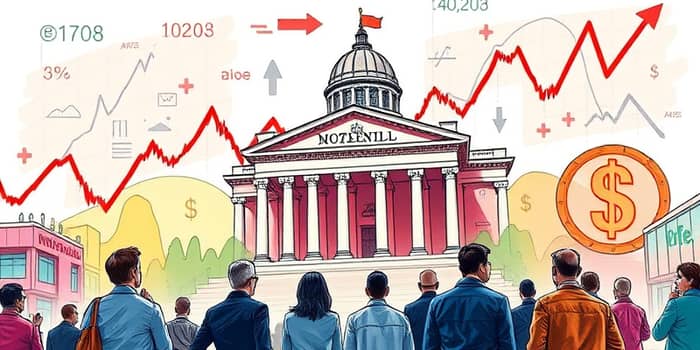
In today’s interconnected global economy, market dynamics extend beyond corporate balance sheets and quarterly profits. Investors monitor policy changes as diligently as earnings reports, recognizing that governments wield powerful tools to shape economic conditions. From central bank rate adjustments to sweeping regulatory reforms, policy shifts influence the fundamental drivers of asset prices. Understanding these forces can unlock strategic opportunities in volatile environments.
Why Government Actions Move Markets
At its core, public policy establishes the rules under which firms borrow, invest, and compete. Changes in taxation, spending, and regulatory frameworks alter cash flows and cost structures across sectors. Markets often react swiftly when changing interest rates and liquidity conditions reshape borrowing costs and investment incentives. Whether through fiscal stimulus or trade tariffs, policy can act as a catalyst for growth or a barrier to entry.
- Interest-rate channel impacting borrowing costs
- Asset-price channel shifting valuations
- Expectations channel via forward guidance
- Uncertainty channel elevating volatility
- Regulatory channel affecting corporate profitability
Monetary Policy: The Most Direct Lever
Central banks, led by the Federal Reserve in the United States, steer financial conditions through the policy rate, most notably the federal funds rate. A lower target range denotes easing, which typically lowers short-term rates and increases market liquidity. Conversely, tightening raises rates, dampens credit availability, and cools demand. Investors watch for shifts in the Fed’s goals of maximum employment, stable prices, and moderate long-term rates to anticipate market movements.
Beyond the policy rate, the Fed employs several tools to manage conditions. Forward guidance shapes market expectations, moving asset prices ahead of actual rate changes. Quantitative easing or asset purchase programs flood the financial system with reserves, pushing yields lower across the yield curve. Interest on reserve balances and the overnight reverse repurchase facility rate further fine-tune liquidity.
- Target federal funds rate adjustments
- Large-scale asset purchases (quantitative easing)
- Interest on reserve balances
- Overnight reverse repurchase facility
- Forward guidance and communications
Fiscal and Regulatory Policy: Broad but Uneven Effects
While monetary policy is the most nimble lever, fiscal actions and regulations exert pervasive, if slower, influence. Changes in tax rates reshape corporate profits and consumer disposable income. Government spending programs support sectors from infrastructure to healthcare, lifting demand in targeted areas. Meanwhile, environmental regulations, labor laws, and industry-specific mandates adjust compliance costs and investment priorities.
Sector responses vary: energy firms may face higher capital expenditure under stricter emission rules, while technology companies often benefit from research incentives. Healthcare, financials, and industrials also experience distinct tailwinds or headwinds based on legislation. The cumulative effect of these policies can ripple through supply chains and shift capital allocation across the economy.
Trade Policy, Geopolitics, and Sector Rotation
Tariff announcements, export restrictions, and trade agreements can quickly unsettle global supply chains. Companies with significant overseas operations face revised cost structures and revenue projections. When markets anticipate tariffs or diplomatic standoffs, they often undergo policy uncertainty can spike volatility.
Investors navigate these waters by rotating capital into more resilient sectors. Defense and domestic-focused industries may draw interest during geopolitical tension, while export-driven firms see valuations pressured. This continuous rotation underscores the importance of monitoring both policy developments and corporate fundamentals.
Political Events and Anticipation Effects
Elections, the annual State of the Union address, and major legislative milestones create event-driven market movements. Studies show that average returns around Election Day are about 50 basis points, while State of the Union days yield around 30 basis points compared to a daily average of just 3 basis points. Notably, markets often move in anticipation, pricing in expected outcomes before official announcements.
In the 12 months before presidential elections, equities average under 6% gains versus over 8% in non-election years. Bonds deliver roughly 6.5% returns compared to 7.5% in normal periods. Post-election dynamics shift further depending on whether a new party takes office or an incumbent stays, illustrating how political cycles drive volatility and opportunity.
Government Intervention and Market Structure
Beyond headline stimulus and rate cuts, government entities participate in market operations, altering structure and behavior. Through direct trading or strategic asset purchases, authorities can enhance market liquidity and price stability, or inadvertently distort price discovery. In markets characterized by asymmetric information or incompleteness, targeted intervention can government intervention can improve investor welfare, provided policy design aligns with broader economic goals.
However, intervention outcomes hinge on context. Measures intended to stabilize may crowd out private investors or signal deeper imbalances. As a result, policymakers must calibrate actions carefully, balancing objectives such as informational efficiency, liquidity, and price stability to avoid unintended consequences.
Investor Takeaways: Interpreting Policy Signals
For market participants, distinguishing between noise and meaningful policy shifts is paramount. Not every central bank statement or regulatory proposal warrants a portfolio overhaul. Instead, focus on changes that materially affect discount rates, corporate costs, or macroeconomic growth trajectories. Incorporating policy analysis into investment frameworks can improve decision-making under uncertainty.
- Monitor central bank communications for forward guidance cues
- Track legislative timelines and fiscal stimulus plans
- Assess sector exposure to regulatory and trade changes
- Evaluate election cycle patterns and event risk premiums
- Balance portfolio duration and credit risk based on rate forecasts
By integrating policy insights with traditional economic and financial analysis, investors can position themselves to navigate both volatility and opportunity. While policy shifts are not deterministic market signals, they create environments where risk and reward profiles adjust rapidly. Embracing a policy-aware investment approach allows for more robust portfolio resilience and enhanced potential returns.
References
- https://sc.edu/about/offices_and_divisions/research/news_and_pubs/caravel/archive/2015/2015-caravel-stock-market.php
- https://www.nber.org/papers/w33827
- https://finalto.com/blogs/how-do-politics-affect-stock-market-performance/
- https://www.newyorkfed.org/markets/domestic-market-operations/monetary-policy-implementation
- https://journeys.dartmouth.edu/digital/2024/02/20/public-policy-changes-and-their-impact-on-businesses/
- https://www.federalreserve.gov/aboutthefed/fedexplained/monetary-policy.htm
- https://www.capstone-advisors.com/capstoneconnections/navigating-market-volatility-amid-government-policy-shifts
- https://www.americancentury.com/insights/government-policy-markets/
- https://www.blackrock.com/us/individual/insights/us-policy-investing
- https://www.imf.org/en/publications/fandd/issues/series/back-to-basics/monetary-policy
- https://pmc.ncbi.nlm.nih.gov/articles/PMC8120790/
- https://www.brookings.edu/articles/the-impact-of-federal-reserve-policy-on-the-feds-financial-conditions-index/