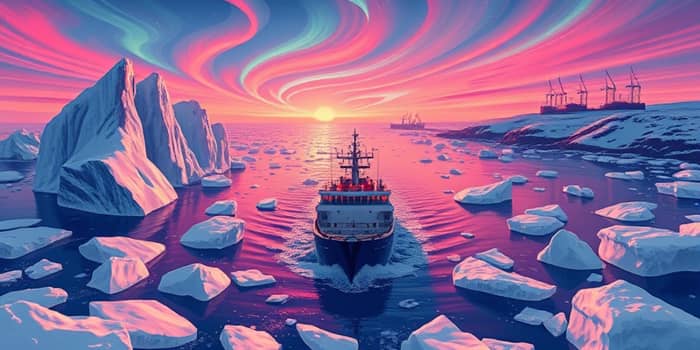
The Arctic region is undergoing a profound metamorphosis. Once locked in ice, its vast waterways are opening, its hidden riches are being mapped, and its strategic value is rising on the global stage.
From the shores of Greenland to the Siberian tundra, climate change, resource demand, and power dynamics are rewriting the rules of engagement for governments, companies, and communities alike.
The Strategic and Physical Awakening of the Arctic
Over the past half-century, the Arctic has warmed at a rate twice as fast as the global average, unleashing dramatic declines in sea ice, glaciers, and permafrost.
These changes are not merely environmental—they rewrite the geostrategic calculus for eight sovereign states vying for influence, resources, and new passageways.
- Canada
- Denmark (Greenland)
- Norway
- Russia
- United States (Alaska)
- Finland
- Sweden
- Iceland
In an era of prime real estate vs stubborn costs, Arctic capitals are balancing hopes of lucrative returns against the region’s notorious logistical challenges.
As navigable months lengthen, military planners, shipping consortia, and policymakers recognize the Arctic as the shortest distances between major continents, driving interest from Asia to Europe and North America.
Yet experts caution that many claims of a near-term bonanza are overstated; the Arctic’s boom may be locally significant but unlikely to reshape global markets overnight.
New Shipping Routes and Emerging Corridors
Sea ice retreat is unlocking three principal marine highways that could redraw trade maps:
- Northern Sea Route (NSR): Along Russia’s Arctic coast between the Barents Sea and Bering Strait, promising up to 40% distance savings between East Asia and Northern Europe.
- Northwest Passage (NWP): Through Canada’s archipelago, poised for regular summer transits pending legal and environmental hurdles.
- Trans-polar Routes: Direct central Arctic passages that may emerge as ice thins further by mid-century.
Shipping traffic has already surged: unique voyages in the Polar Code Area climbed 40% from 2013 to 2025, while total nautical miles sailed nearly doubled.
Fishing vessels remain the most common visitors, accounting for 40% of all transits, but liquid bulk carriers have driven much of the growth, especially on the Kara Sea route linked to the Yamal LNG project.
Even with these gains, independent analyses find Arctic passages will account for only about 3.5% of trade between East Asia, Europe, and North America over the next five years—underscoring their more political than commercial value today.
New Resources: Hydrocarbons, Minerals, Fisheries, and Renewables
Beneath the icy frontier lie vast deposits of oil, gas, minerals, and marine life—all coveted in an era of resource scarcity.
- Hydrocarbons: Barents Sea fields may hold up to 950 million m³, while the North and Norwegian Seas add more than 1.6 billion m³ of potential reserves.
- Critical Minerals: Nickel, cobalt, rare earths, and platinum-group metals essential for renewables and electronics.
- Fisheries: Expanding fish stocks drawn northward, with fishing vessels now constituting nearly half of regional traffic.
- Renewables: Strong wind corridors and tidal currents offer new clean energy opportunities.
Flagship ventures like Russia’s Yamal LNG and planned Shtokman developments illustrate the high stakes: multi-billion-dollar investments in remote waters require specialized vessels, year-round support infrastructure, and robust environmental safeguards.
Subsea fiber-optic cables, exemplified by Russia’s $889 million Polar Express link, aim to connect isolated communities and support data-intensive offshore operations by 2026.
Yet unlocking these riches hinges on overcoming cost overruns, extreme weather, and sensitive ecosystems—an embodiment of the climate-driven access and resources paradox.
Investment, Risk, and Environmental Limits
Global investors are drawn by the promise of high returns and new frontiers, but they must navigate a maze of legal uncertainties, geopolitical rivalries, and hidden costs.
Russia’s assertive build-out of ports, icebreakers, and military installations underscores the great-power competition and geopolitical stakes at play.
Environmental groups, backed by the Clean Arctic Alliance, urge stakeholders to embrace strict adherence to IMO Polar Code, phase out heavy fuel oil, and measure black carbon to protect fragile habitats.
Proposals for Arctic emission control areas, combined with rules on noise, spill response, and wildlife disturbance, reflect growing international consensus on sustainable development.
Financial institutions are increasingly applying climate risk criteria to Arctic projects, assessing potential regulatory shifts, stranded assets, and reputational exposure.
A Balanced Path Forward
The Arctic Awakening presents a tapestry of opportunity and obligation: an extension of the navigable season must be matched by rigorous standards and meaningful engagement with indigenous populations.
Success will demand partnerships that merge state ambition with corporate expertise and traditional ecological knowledge, ensuring benefits flow to local communities.
Innovation in ice-class vessels, satellite monitoring, and low-carbon technologies offers pathways to minimize impacts while sustaining economic momentum.
Ultimately, charting a course through this new frontier calls for bold vision tempered by caution—a commitment to forging prosperity without compromising the Arctic’s profound ecological and cultural heritage.
As ice retreats and horizons broaden, the decisions made today will shape the Arctic’s destiny for generations to come.
References
- https://www.heritage.org/global-politics/commentary/russia-invests-arctic-america-falls-behind
- https://maritime-executive.com/article/report-arctic-routes-to-remain-peripheral-especially-for-boxships
- https://arcticeconomiccouncil.com/news/arctic-investment-opportunities-that-show-you-the-numbers/
- https://arctic-council.org/news/increase-in-arctic-shipping/
- https://jsis.washington.edu/aic/2015/04/22/icelands-arctic-awakening/
- https://arcticportal.org/shipping-portlet/shipping-routes
- https://www.thearcticinstitute.org/questionable-arctic-bonanza/
- https://cleanarctic.org/campaigns/initiatives/regional-initiatives/arctic-shipping-routes-the-northern-sea-route-and-the-northwest-passage/
- https://open.substack.com/pub/sagrancarvalho/p/routes-of-the-future-and-the-arctic?r=3lm0ip
- https://arcticportal.org/shipping-portlet/about-shipping-portlet
- https://www.youtube.com/watch?v=sJ0684udigg
- https://www.thearcticinstitute.org/future-northern-sea-route-golden-waterway-niche/
- https://www.youtube.com/shorts/YkqKskP7mSU
- https://www.youtube.com/playlist?list=PLi8rTpm0dFlJoN0rl-j5f_MQngs0HjoJl