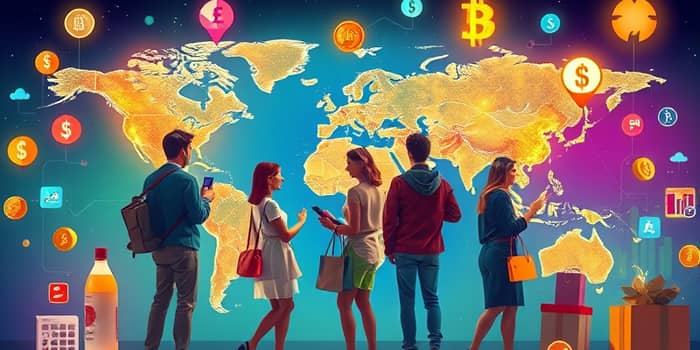
From bustling marketplaces in Mumbai to digital carts in New York, consumer spending powers economies and shapes societies. Examining who spends, where and why reveals the forces driving growth, innovation and resilience around the world.
The Big Picture
Global household consumption reached an estimated US$60.3 trillion in nominal terms and US$88.6 trillion on a purchasing-power-parity basis in 2023, representing roughly 58% of global GDP. This colossal figure underscores the central role of consumer demand in sustaining economic activity, driving nearly three-fifths of worldwide output.
We can conceptualize a three-pole consumer world: the United States, the European Union and China, with rapidly growing contributions from India and other emerging economies. While the US leads nominal spending at US$19.8 trillion (69% of GDP), the EU bloc follows with US$9.6 trillion (51%). China, the third-largest market at US$7.5 trillion nominal and US$12.5 trillion PPP, allocates only 38% of its GDP to household consumption—far below advanced Western economies.
India emerges as a high-growth powerhouse, with household consumption of US$2.4 trillion nominal (US$9.0 trillion PPP), representing 60% of its GDP. As incomes rise and urbanization accelerates, India’s consumer class is on track to redefine global demand patterns over the next decade.
Below are the world’s top ten consumer markets by nominal household final consumption expenditure (HFCE) and their share of GDP:
Forecasts indicate continued growth in global consumer spending from 2024 through 2029, driven by rising incomes, demographic shifts and technology adoption in both mature and emerging markets.
North America
The United States remains the undisputed leader, with household consumption of US$19.8 trillion—about 69% of GDP. Per-capita spending of roughly US$45,000 underscores its high-income, consumption-driven economy. Yet beneath these headline figures lie nuanced patterns in sentiment and budgeting.
According to recent surveys, only 34% of American adults expect their finances to improve in 2026, while 28% fear deterioration. Budgeting has gained traction: 53% of adults now maintain formal budgets, up from 46% a year earlier. Younger cohorts (18–34) are especially motivated to save, with 61% citing future security as their primary budgeting goal.
When Americans anticipate tighter budgets, they plan to cut back on nonessentials:
- Eating and drinking out: 66%
- Clothing and accessories: 54%
- Everyday conveniences (coffee, rideshares): 48%
- Subscriptions and streaming services: 48%
- Events and leisure outings: 48%
- Holidays and travel: 46%
Conversely, those expecting better finances will direct more spending toward:
- Groceries: 22%
- Holidays and leisure travel: 21%
- Wellness and fitness: 13%
- Health and beauty: 13%
- Dining out: 10%
The travel sector illustrates broader discretionary trends. Total US travel spending is projected to hit US$1.37 trillion in 2026 and US$1.42 trillion in 2027 (inflation-adjusted), with domestic leisure at US$909 billion. Memorial Day weekend travelers alone expect to spend nearly US$900 on transport, lodging and dining, highlighting the resilience of experiential consumption.
Canada and Mexico offer contrasting portraits within North America. Canada’s HFCE stands at US$1.18 trillion (56% of GDP), characterized by stable incomes and high per-capita outlays. Mexico, with US$1.30 trillion (69% of GDP nominal, US$1.83 trillion PPP), combines a large informal economy with rapidly rising living standards, creating unique opportunities in retail and digital finance.
Europe
The European Union, as a bloc, accounts for about US$9.6 trillion in household consumption, roughly 51% of GDP. Mature markets like Germany (US$2.26 trillion), the United Kingdom (US$2.06 trillion) and France (US$1.63 trillion) dominate the regional landscape.
Per-capita spending ranges from approximately US$15,700 in Spain to over US$29,000 in the UK, reflecting differences in income and social welfare systems. Post-pandemic rebounds in travel and dining have provided relief, but high energy costs and inflation continue to squeeze budgets.
European consumers have adapted their behavior. Inflation and energy pressures have driven heightened price sensitivity and caution and a shift toward discount channels and private labels. Meanwhile, the digital transformation—open banking, cross-border e-commerce and omnichannel retail—remains a focal point for brands seeking growth.
Asia and Emerging Markets
China’s consumer market, at US$7.5 trillion nominal spending (US$12.5 trillion PPP), ranks third globally but reflects only 38% of GDP. A heavy emphasis on infrastructure and exports has kept household consumption share relatively low, even as urban middle classes expand rapidly.
In India, by contrast, consumption is both a growth driver and social phenomenon. With US$2.4 trillion nominal spending accounting for 60% of GDP, India’s middle class is unleashing demand for automobiles, electronics, travel and premium foods. Digital payments via UPI, e-commerce platforms and mobile wallets have democratized access to goods and services.
Other emerging markets—from Brazil and Mexico to Indonesia and South Africa—are witnessing similar transitions. Rising incomes, urban migration and smartphone penetration are fuelling new spending patterns that prioritize convenience, experience and social sharing.
Why Patterns Are Shifting
Consumer behavior is in flux, driven by a confluence of economic, technological and social factors. Businesses that decode these shifts can seize competitive advantages and foster deeper connections with buyers.
- Inflation and cost pressures: Persistently high prices force strategic cutbacks and brand switching.
- Technological innovation: AI, mobile wallets and personalization elevate expectations for seamless experiences.
- Demographic change: Aging populations in developed regions contrast with youth bulges in emerging economies, shaping sectoral demand.
- Geopolitical dynamics: Trade tensions and supply chain diversification influence product availability and consumer confidence.
These drivers explain why consumers now spend more selectively, seeking value but also chasing experiences and convenience. From sustainability-driven brand loyalty to instant delivery services, today’s global buyer is empowered and discerning.
Looking ahead, consumer spending is poised for steady growth through 2029, underpinned by rising urbanization, income convergence and digital diffusion. Companies that invest in local insights, agile pricing and omnichannel engagement will capture a disproportionate share of this expanding market.
Ultimately, **the global consumer story** is about choices—how individuals channel their resources to reflect personal values, aspirations and constraints. Embracing this diversity and dynamism is critical for policymakers, businesses and communities aiming to harness the power of consumption for sustainable and inclusive growth.
References
- https://worldpopulationreview.com/country-rankings/consumer-spending-by-country
- https://www.upside.com/business/retailer-blog/consumer-spending-trends-2026
- https://tradingeconomics.com/country-list/consumer-spending
- https://yougov.com/en-us/articles/54197-us-consumer-spending-and-budgeting-trends-in-2026
- https://en.wikipedia.org/wiki/List_of_largest_consumer_markets
- https://www.deloitte.com/us/en/insights/topics/economy/consumer-pulse/state-of-the-us-consumer.html
- https://datatopics.worldbank.org/consumption/
- https://www.ustravel.org/research/travel-forecasts
- https://www.statista.com/forecasts/1160305/consumer-spending-forecast-in-the-world/
- https://www.pwc.com/us/en/industries/consumer-markets/library/summer-spending-trends-2026.html
- https://www.deloitte.com/us/en/insights/industry/retail-distribution/consumer-behavior-trends-state-of-the-consumer-tracker.html
- https://www.bls.gov/cex/
- https://ipn.ibotta.com/resource-hub/state-of-spend-2026
- https://www.intotheminds.com/blog/en/consumer-trends-2026/
- https://www.mckinsey.com/industries/consumer-packaged-goods/our-insights/the-state-of-the-us-consumer