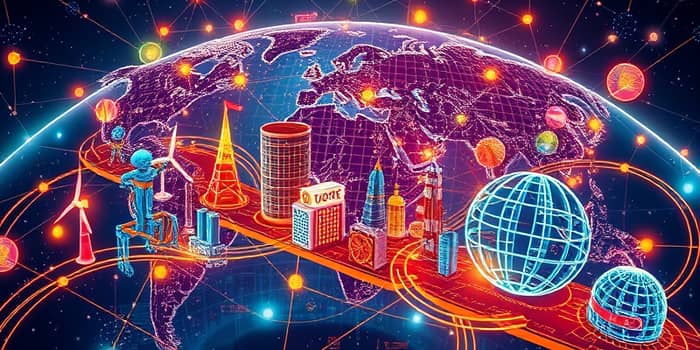
As global growth stabilizes and capital flows, the hunt for transformative industries intensifies. This article explores how macro megatrends, high-growth sectors, and next-generation arenas converge to reveal tomorrow’s market leaders.
Understanding the Macro Backdrop
Even amid inflationary pressures and geopolitical shocks, the global economy shows remarkable resilience. Forecasts predict Global GDP growth around 2.8% in 2026, slightly above consensus, with the US expected to expand ~2.6% versus a 2.0% baseline.
Such macroeconomic resilience fuels risk capital for emerging industries. Key drivers include:
- US-China AI and geopolitical race reshaping power dynamics
- Global energy supply waves fueling transition investments
- Stabilization of consumption, supply chains and investments
This context confirms that emerging industries do not grow in vacuum. They are propelled by policy, capital, and the ever-shifting geopolitical landscape.
Frameworks for Spotting the Next Big Thing
Navigating the complexity of emerging industries requires structured thinking. Two leading frameworks—EY’s megatrends and McKinsey’s global arenas—offer clarity.
EY identifies four root disruptors. We are entering a nonlinear, accelerated, volatile interconnected NAVI world where shocks propagate rapidly:
- Technology evolution in AI, robotics, and neurotechnology
- Geopolitical shifts altering trade and supply chains
- Sustainability imperatives driving green transitions
- Demographic changes reshaping consumer demand and labor
Under these forces, sectors like AI-powered healthcare and autonomous robotics emerge as tangible manifestations of broader megatrends. Indeed, human-machine partnerships unlock new potentials across industries.
McKinsey’s analysis of 18 high-potential arenas distills five category themes that outpace global revenue and market-cap growth:
- AI foundation: semiconductors, cloud services, AI software
- Digitization: e-commerce, streaming, cybersecurity, gaming
- Electrification & climate tech: electric vehicles, batteries, nuclear
- Hard tech & autonomy: robotics, space exploration, drones
- New bio frontiers: metabolic drugs, non-medical biotechnology
Between 2022 and 2025, these arenas added $18 trillion in market cap and could drive up to $48 trillion in revenues by 2040.
Fastest-Growing vs. Structurally Emerging Industries
Growth today can be cyclical. IBISWorld’s top five fastest-growing industries by 2026 highlight areas rebounding or driven by policy—yet not all are built on long-term structural change.
While coal mining’s surge reflects energy security concerns and aircraft manufacturing signals post-pandemic normalization, they may lack the decade-spanning tailwinds of AI or clean technologies. As such, fastest-growing does not guarantee future dominance.
By contrast, HubSpot and Market-Xcel highlight tech-centric sectors—AI, renewable energy, digital health, FinTech and cybersecurity—as structurally poised for growth through 2030.
Case Study: US-Centric Emerging Sectors
The US market offers a microcosm of global transformation, with high-growth clusters spanning CleanTech / low-carbon infrastructure, digital health, FinTech, artificial intelligence, biotech, cybersecurity and e-commerce.
Investment in low-carbon infrastructure reached $2.1 trillion in 2024, while the digital health market may surge from $199.1 billion in 2025 to $573.5 billion by 2030. Global AI revenues, estimated at $1.55 trillion in 2023, could approach $3.88 trillion by 2030, and cybersecurity may expand from $193.3 billion in 2022 to $478.9 billion by 2030.
Five Key Sectors Shaping Global Growth by 2026
Across geographies and analyses, five sectors consistently emerge as growth engines:
1. Artificial Intelligence & Digital Tech
Projected global AI investment of $500 billion by 2026 could lift GDP by up to 15% by 2035. Generative AI, predictive analytics and hyperautomation are transforming business models in finance, logistics and healthcare.
2. Renewable Energy
Driven by net-zero targets and supportive policies, investments in solar, wind, green hydrogen, energy storage and grid modernization position renewables as a central economic pillar.
3. Biotech & Healthtech
Novel therapies for metabolic disorders and agricultural biotech innovations promise to reshape health and food systems. AI-enabled diagnostics and telemedicine platforms will enhance patient outcomes.
4. CleanTech & Low-Carbon Infrastructure
With low-carbon spending surpassing $2 trillion, upgrades to smart grids, electric vehicle charging networks and sustainable construction are redefining infrastructure investment.
5. Cybersecurity & Digital Services
As digital ecosystems expand, protecting data and networks is paramount. The cybersecurity market, driven by escalating threats, underscores the necessity of resilient digital architectures.
Navigating Opportunities in Emerging Industries
Success in these dynamic fields hinges on disciplined strategy. To navigate these industries successfully, stakeholders should map megatrend alignment, focus on sectors with multi-decade structural tailwinds, leverage partnerships in high-innovation ecosystems and anticipate regulatory and geopolitical shifts.
Conclusion
Amid persistent global growth and transformative megatrends, a new generation of industries is taking shape. While some sectors ride short-term cycles, others stand on enduring, multi-decade foundations. Emerging global industries are where innovation meets impact. By applying rigorous frameworks, contrasting cyclical and structural growth, and aligning with macro drivers, investors and innovators can position themselves at the forefront of the next big thing.
References
- https://gedeth.com/es/blog/2025/12/10/the-5-sectors-that-will-shape-global-growth-in-2026/
- https://www.ibisworld.com/global/industry-trends/fastest-growing-industries/
- https://fortune.com/2026/05/06/mckinsey-18-industries-arenas-global-economy-us-china-ai/
- https://www.coursera.org/articles/business-trends
- https://www.market-xcel.com/us/blogs/fastest-growing-industries-usa
- https://www.hubspot.com/startups/reports/hypergrowth-startups/fastest-growing-industries
- https://insightglobal.com/blog/fast-growing-industries-jobs/
- https://www.youtube.com/watch?v=hd7bSlK0UHk
- https://www.ey.com/en_gl/megatrends
- https://explodingtopics.com/blog/business-trends
- https://www.goldmansachs.com/insights/outlooks/2026-outlooks
- https://www.mckinsey.com/mgi/our-research/the-race-takes-off-in-the-next-big-arenas-of-competition
- https://www.weforum.org/videos/5-trends-that-are-set-to-transform-factories-in-2026-88cd396965/