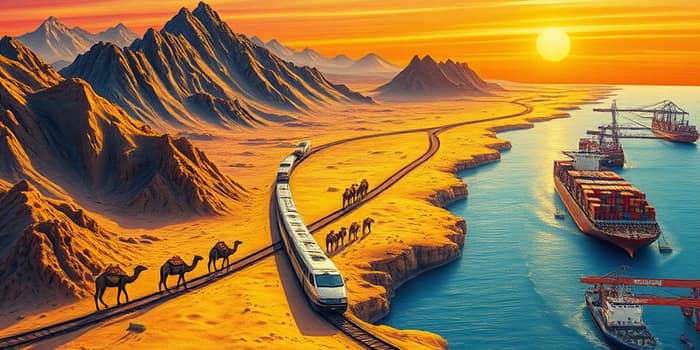
The ancient Silk Road is more than history—it is a living metaphor for the new trade corridors reshaping global commerce. Investors now face a chance to back strategic infrastructure that spans continents, weaves economies together, and mitigates geopolitical risk.
From Caravans to Containers: A Historical Legacy
The Silk Road began around 130 BCE during China’s Han Dynasty as a network of overland and maritime routes linking East and West. Far from a single path, it spanned deserts, mountains, and plains, shifting with politics, security, and climate challenges.
Merchants traded luxury goods and ideas across thousands of miles:
- Silk, spices, tea, precious metals, textiles, ceramics
- Religions, philosophies, scientific knowledge, artistic styles
This corridor-based globalization empowered intermediary hubs in Central Asia, the Middle East, and beyond, demonstrating how location and connectivity yield economic and cultural influence.
Geopolitical Shifts and Technological Advances
The era of frictionless globalization is giving way to deliberate “economic geometries”—clusters of politically aligned economies forging secure trade corridors. Data show that aligned trading blocs have boosted cross-border flows by nearly USD 1.9 trillion, reflecting a strategic shift toward reliability over lowest-cost sourcing.
At the same time, rising protectionism and trade tensions have tripled restrictions on roughly USD 2.7 trillion of merchandise, representing nearly 20% of global imports. Friendshoring, nearshoring, and regionalization efforts are diversifying supply chains away from singular dependencies.
Legacy sea routes still carry over half of global trade, but key chokepoints remain vulnerable to disruption:
When such routes are disrupted, container freight rates can temporarily double, underlining the importance of diversified corridors and resilient networks.
By 2030, trade diversification through new corridors could boost global GDP by up to 3% by reducing the economic drag of supply chain shocks and strengthening ties between emerging markets.
Modern Silk Roads: Corridors Redrawing Global Trade
China’s Belt and Road Initiative (BRI), launched in 2013 by President Xi Jinping, epitomizes today’s Silk Road revival. Combining overland “Belt” arteries and maritime “Road” lanes, it spans Central Asia, the Middle East, Europe, Southeast Asia, and Africa.
BRI’s financial scope is immense: initial estimates of USD 900 billion in planned investments have ballooned, with China Development Bank and policy banks setting aside nearly USD 900 billion for 900+ projects. Official statements suggest lending capacity could reach USD 8 trillion, covering around 68 countries and one-third of global GDP.
Complementary financing vehicles include a USD 40 billion Silk Road Fund, the Asian Infrastructure Investment Bank, and the New Development Bank, channeling capital into railways, ports, pipelines, and industrial parks.
Alongside BRI, two corridors are gaining traction:
China–Europe Rail Freight Network: An 11,000 km intermodal system linking cities like Chongqing, Chengdu, Zhengzhou, and Xi’an to European hubs in Duisburg, Hamburg, and Madrid. Transit times of 12–18 days versus 30–40 by sea, lower CO₂ emissions compared to air, and competitive costs for high-value goods make this corridor a strategic complement to maritime shipping.
Middle Corridor (Trans-Caspian International Transport Route): A 4,250 km multimodal route bypassing Russia and Iran by routing freight from Kazakhstan across the Caspian Sea through Azerbaijan and Georgia to Türkiye and Europe. Since the Russia–Ukraine war began in 2022, volume on this corridor has surged nearly tenfold as shippers seek alternatives to the Northern Corridor.
What This Means for Investors
For investors, new trade corridors offer opportunities across multiple asset classes, but also require careful risk management.
- Infrastructure spending: Funding port expansions, rail terminals, intermodal hubs, and energy pipelines can yield stable, long-term returns through user fees and tolls.
- Logistics innovation: Investments in digital freight platforms, real-time tracking, and green-shipping technologies enhance efficiency and reduce carbon footprints.
- Financial instruments: Project finance, public-private partnerships, multilateral development loans, and export-credit guarantees can diversify portfolio exposure and leverage public capital.
- Policy risk management: Conduct thorough due diligence on host-country governance, negotiate currency hedges, and develop scenario plans for geopolitical shifts and regulatory changes.
Infrastructure assets often serve as inflation hedges, while logistics and technology ventures can deliver high growth in corridor-enabled trade clusters. However, political risks—from expropriation to sudden sanctions—underscore the need for diversified exposure and active stakeholder engagement.
Strategic Takeaways
The revival of Silk Road–style networks is not merely a matter of nostalgia. It reflects a fundamental reordering of global trade underpinned by connectivity configuration, not just market size or cost minimization.
By aligning investments with corridor development—whether through equity stakes in ports, bond issuances for rail projects, or venture capital in logistics tech—investors can tap into a wave of growth driven by infrastructure modernization and geopolitical realignment.
The key is to balance ambition with prudence: identify projects backed by strong governance, secure diverse financing, and build partnerships with multilateral institutions. In doing so, capital allocators can help forge a more resilient, interconnected global economy.
As the ancient routes once did for caravans and merchants, today’s corridors promise to shape the flow of goods, ideas, and capital. For the forward-looking investor, this is a golden age of commerce, where strategic connectivity meets long-term value creation.
References
- https://www.chosun.com/english/world-en/2026/05/28/OF3WIVBTFJCLBMNYM7MIQ5UWZM/
- https://www.kenresearch.com/articles/global-trade-rewiring-new-corridors-opportunity
- https://escolaeuropea.eu/did-you-know/reviving-the-silk-road-how-china-europe-rail-freight-is-transforming-global-trade/
- https://www.allianz.com/en/economic_research/insights/publications/specials_fmo/251105-allianz-trade-report.html
- https://www.weforum.org/stories/2017/06/china-new-silk-road-explainer/
- https://gfmag.com/transaction-banking/shaping-new-trade-corridors/
- https://www.youtube.com/watch?v=uvKb1j9a4RE
- https://blogs.worldbank.org/en/developmenttalk/global-trade-s-rollercoaster-ride
- https://www.weforum.org/stories/2026/01/beyond-borders-new-trade-investment-corridors-reshaping-global-business/
- https://www.mckinsey.com/capabilities/geopolitics/our-insights/a-new-trade-paradigm-how-shifts-in-trade-corridors-could-affect-business
- https://www.tandfonline.com/doi/full/10.1080/24761028.2019.1580407
- https://www.youtube.com/watch?v=P9q1MRn_IQ0
- https://www.weforum.org/stories/2025/01/trade-corridors-resilient-future/