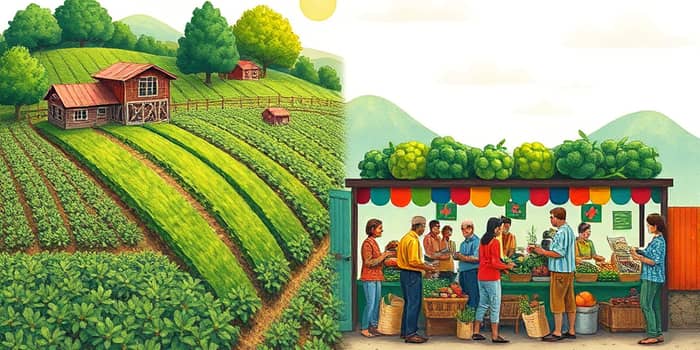
Global food security has emerged as a compelling narrative for investors seeking both financial returns and social impact. As the world grapples with conflict, climate shocks, and supply chain disruptions, strategic capital allocation across the agricultural value chain offers a pathway to resilient, inclusive growth.
Understanding the Pillars of Food Security
At its core, food security is defined by four interlinked dimensions: availability, access, utilization, and stability. Each pillar represents a critical node where targeted investment can drive measurable change.
- Availability – supply side resilience: ensuring sufficient production and stock levels.
- Access – economic and physical reach: improving incomes, market infrastructure, and affordability.
- Utilization – nutrition and health: enhancing diet quality, food safety, and care practices.
- Stability – long-term security: mitigating adverse shocks from weather, conflict, or price volatility.
For investors, these dimensions map directly to solution areas: cutting-edge input technologies, efficient storage and logistics, nutrition-sensitive processing, and risk-management tools that safeguard supply chains.
The Current Landscape: Challenges and Opportunities
In 2026, the World Bank reported that conflict and climate shocks are driving acute food insecurity. Over 87 million people in East and Southern Africa face hunger, and another 52 million in West and Central Africa are projected to suffer by mid-year. Political strife in the Middle East threatens fertilizer flows through the Strait of Hormuz, potentially pushing 45 million more into acute hunger.
Meanwhile, food price dynamics illustrate both challenges and entry points for investors:
- Agricultural price indices are down 7% since December 2025, even as cereal prices rose 7%.
- Food price inflation exceeded 5% in half of low-income countries and in nearly 44% of upper-middle-income economies.
- In 57% of 140 tracked countries, food inflation outpaced overall inflation, heightening social and political risks.
These trends underscore why food security is no longer a niche ESG concern but a macro-relevant investment theme that intersects with inflation, social stability, and geopolitical risk.
Policy and Public Capital: Foundations for Private Investment
Global policy frameworks provide a critical scaffold for private investors to de-risk opportunities and scale impact. SDG 2, Zero Hunger and sustainable agriculture, calls for doubling smallholder productivity, ending malnutrition, and building climate-resilient systems.
Historical commitments, such as the G8’s $22 billion pledge in 2009, paved the way for multilateral programs. The World Bank, through its Global Agriculture and Food Security Program (GAFSP), channels donor funds into cross-cutting themes like climate resilience, women’s empowerment, and fragility response.
The new Global Flagship Initiative for Food Security, launched in 2024, focuses on the Sahel and Horn of Africa, mobilizing governments, NGOs, and private financiers in three pillars:
- Collaborate broadly with diverse stakeholders.
- Mobilize private capital at scale.
- Deliver impact with agile interventions.
At the bilateral level, the US Millennium Challenge Corporation has deployed nearly $7 billion since 2005. Its metrics illustrate how public capital can build market pipelines:
These public interventions de-risk early projects and attract private impact capital, creating a virtuous cycle of innovation and scale.
From Data to Decision: The Investment Thesis
Empirical research underpins the investment case. A study on global agricultural investment shows a clear link between capital infusion and improved nutritional outcomes, measured by per-capita protein intake. This evidence affirms that strategic funding in agriculture directly translates to enhanced food security.
Investors can leverage data analytics to identify high-impact sub-sectors—from precision irrigation technologies that boost yields to cold-chain logistics that reduce post-harvest losses. By targeting opportunities with proven impact metrics, capital can unlock both financial return and social value.
Strategies for Investors: Practical Steps
To navigate this complex landscape, investors should consider the following:
- Focus on climate-resilient agriculture: support drought-tolerant seeds and smart water systems.
- Partner with local enterprises: leverage on-the-ground expertise and foster inclusive growth.
- Integrate risk-management tools: hedge against price volatility and supply disruptions.
- Measure impact rigorously: track nutrition, income, and environmental indicators.
- Engage in blended finance: combine public grants with private capital to scale projects.
These actions ensure that investments are not only profitable but also contribute to long-term stability of global food systems and community resilience.
Conclusion: Embracing Food Security for Profit and Purpose
From farm to table, every link in the value chain presents an opportunity to invest in a more secure and sustainable future. By aligning financial goals with the urgent need to end hunger, investors can catalyze innovation, uplift communities, and generate robust returns.
Now is the time to turn data and policy momentum into transformational investment opportunities across the value chain. Together, we can build a world where all people have access to safe, nutritious food and where agricultural systems thrive in harmony with our planet.
References
- https://www.mcc.gov/initiatives/initiative/food-security/
- https://www.savouryeats.com/post/from-farm-to-table-embracing-sustainable-practices-in-the-restaurant-industry
- https://www.croptrust.org/who-we-are/about/global-flagship-initiative-for-food-security/
- https://peddlersson.com/the-farm-to-table-movement-a-guide/
- https://www.worldbank.org/en/topic/agriculture/brief/food-security-update/what-is-food-security
- https://milkandhoneyranch.com/how-farm-to-table-dining-supports-a-greener-future/
- https://www.gafspfund.org/thematic-areas
- https://www.collage-newhaven.com/post/exploring-farm-to-table-trends-in-contemporary-dining-experiences
- https://www.worldbank.org/en/topic/agriculture/brief/food-security-update
- https://www.friendofafarmer.com/blog/farm-to-table-impacts-your-local-economy
- https://www.globalfoodsecurityconference.com/session-topics-and-descriptions.html
- https://placement-international.com/blog/what-is-farm-to-table-movement
- https://pmc.ncbi.nlm.nih.gov/articles/PMC10178774/
- https://www.agritecture.com/blog/understanding-the-farm-to-table-movementfor-developers-architects-designers-and-hospitality-professionals
- https://www.youtube.com/watch?v=8CX8xi9Xp1M