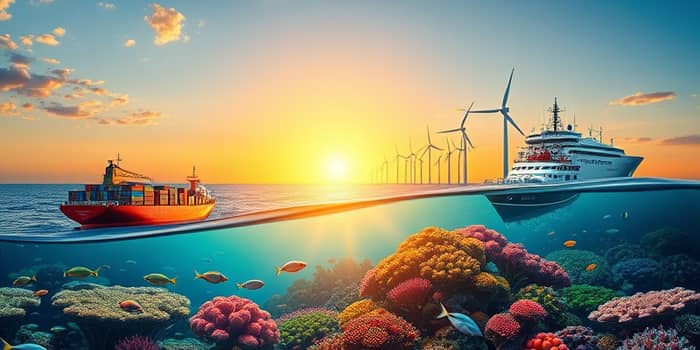
The ocean economy already generates more than $3 trillion in annual value and is poised to reach $5–5.1 trillion by 2050. Investors and policymakers are turning their attention to this sum of economic activities that depend on the world’s seas, driven by both traditional strengths and emerging marine technologies. This article explores the defining features, scale, key sectors, investment themes, risks and governance, and long-term prospects of the global blue economy.
Defining the Ocean Economy
The term ocean economy—often used interchangeably with marine or blue economy—encompasses the sum of economic activities that depend on the ocean, seas and coasts. It spans established industries like shipping, ports, fisheries and offshore oil and gas, as well as burgeoning fields such as offshore renewables, marine biotechnology, coastal infrastructure, and ocean data and technology services.
Some experts differentiate the broader ocean economy from the sustainable ocean economy, defined as activity that is environmentally sustainable, socially inclusive and economically productive. If considered a standalone nation, the ocean economy would rank as the world’s fifth largest, underscoring its geopolitical and macroeconomic importance.
Scale and Growth: A Trillion-Dollar Marine Frontier
Over the past two decades, ocean-based industries have outpaced global economic growth by a factor of 1.3x, expanding 2.5 times between 1995 and 2020 compared to 1.9 times for the world economy. Today, the sector supports over 600 million people worldwide and accounts for approximately 7% of global trade.
UNCTAD reported that global ocean trade reached $2.2 trillion in 2023, split between $1.3 trillion in services and $900 billion in goods. Tourism represents the single largest component, while high-tech ocean goods—such as renewables equipment and marine pharmaceuticals—now make up 16% of ocean trade.
- Tourism: Approximately $725 billion, about one-third of total ocean trade.
- Ocean services: $1.3 trillion in value.
- Ocean goods: $900 billion, including manufactured marine products.
Key Sectors Driving Opportunity
The breadth of marine industries presents a diverse range of investment avenues, each characterized by unique drivers, challenges and returns.
- Shipping, Maritime Transport and Ports: Carrying over 80% of global trade volume, this backbone sector is investing heavily in fleet decarbonization, port modernization and digital logistics solutions.
- Coastal and Marine Tourism: From cruise lines to eco-resorts, coastal tourism contributes hundreds of billions in annual revenue and is ripe for sustainable development and environmental restoration projects.
- Fisheries and Aquaculture: With wild capture fisheries plateauing around 90 million tonnes, aquaculture has surged to 94 million tonnes in 2022, now supplying over half of global aquatic food consumption.
- Offshore Energy: Traditional offshore oil and gas persist, but offshore wind, tidal, wave and hybrid projects are growing faster than the 6–8% average for the overall ocean economy.
- Marine Construction and Coastal Infrastructure: Encompassing ports, breakwaters and land reclamation, this market is projected to reach $104.75 billion by 2034 at a 5.27% CAGR.
Case Study: The U.S. Marine Economy
The United States offers a detailed national snapshot. In 2023, the U.S. marine economy contributed $511.0 billion in GDP—about 1.8% of total output—and supported 2.6 million jobs, with an average annual wage of $85,000. Key sectoral outputs included tourism and recreation at $225 billion, offshore minerals at $77 billion, and transportation and warehousing at $68 billion.
This case underscores how national policies, labor markets and regional infrastructure can shape investment performance and social impact.
Investment Themes and Strategies
Across sectors, investors are aligning with several emerging themes for resilient returns:
- Decarbonization of maritime fleets through LNG, methanol and hydrogen technologies.
- Digitization of ports and cold chain logistics to boost efficiency and traceability.
- Scaling sustainable aquaculture systems and value-added seafood processing.
- Financing large-scale offshore wind farms and hybrid energy-aquaculture projects.
Private equity, green bonds and blended public-private financing structures are increasingly used to de-risk projects, especially in emerging markets with high growth potential.
Risks, Governance, and Sustainable Pathways
While opportunity abounds, marine industries face significant challenges. Overfishing has led to 37.7% of global fish stocks being overfished, climate change drives ocean warming and acidification, and coastal pollution threatens ecosystems and human health.
Effective governance underpins sustainable growth. International frameworks like the UN Sustainable Development Goal 14, IMO decarbonization targets, regional fisheries management organizations and voluntary certification schemes all play critical roles in promoting equitable, transparent and eco-friendly practices.
Looking Ahead: Projections to 2050
Forecasts suggest the ocean economy could grow to $5–5.1 trillion by mid-century, outstripping global GDP growth. Offshore renewables, sustainable aquaculture and marine biotechnology are expected to expand at double-digit rates, while digital ocean platforms and data services will unlock new value chains.
Coastal communities and investors who integrate sustainable ocean economy principles will be best positioned to capture long-term benefits, from job creation and food security to climate resilience and biodiversity conservation.
The ocean economy’s rise represents one of the century’s most compelling investment frontiers. By blending innovation, sustainability and sound governance, stakeholders can navigate risks and steer toward a thriving marine enterprise that supports both people and planet.
References
- https://coast.noaa.gov/states/fast-facts/marine-economy.html
- https://www.bea.gov/data/special-topics/marine-economy
- https://www.weforum.org/stories/2026/05/ocean-economy-macroeconomic-investment/
- https://unctad.org/news/fast-growing-trillion-dollar-ocean-economy-goes-beyond-fishing-and-shipping
- https://unctad.org/news/ocean-economy-booming-how-long
- https://unctad.org/publication/global-trade-update-june-2025-sustainable-ocean-economy
- https://oceannews.com/featured-stories/the-future-of-the-global-ocean-economy/
- https://www.imo.org/en/KnowledgeCentre/Pages/MaritimeFactsFigures-Default.aspx
- https://www.oecd.org/en/publications/2025/03/the-ocean-economy-to-2050_e3f6a132.html
- https://www.usni.org/magazines/proceedings/2026/march/global-maritime-industry-year-review
- https://www.wri.org/insights/blue-jobs-sustainable-ocean-economy
- https://www.fortunebusinessinsights.com/marine-construction-market-112183
- https://www.worldbank.org/ext/en/topic/environment/fisheries-aquaculture-and-ocean-economies
- https://www.kenresearch.com/global-marine-vessel-market
- https://www.polarismarketresearch.com/industry-analysis/ocean-economy-market