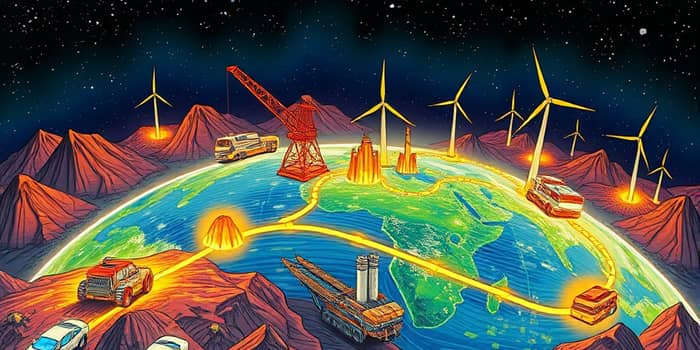
In the 21st century, a silent but powerful battle for critical minerals has erupted, reshaping global power dynamics. The world now hinges on materials like lithium, copper, cobalt, and rare earth elements. These are not mere commodities; they are the bedrock of the energy transition, advanced technologies, and modern defense systems.
As oil once defined geopolitics, today’s conflict centers on the supply and control of essential materials. Nations recognize that industrial policy and security converge in the quest for resilient supply chains. This article explores the contours of the resource race, the actors involved, and the path toward sustainable cooperation.
Geopolitics of Mineral Dominance
Critical minerals have climbed to the top of geopolitical agendas. The United States, European Union, China, and other major players are vying for strategic advantage. A disruption in mining, refining, or processing can cripple entire industries and defense systems.
China emerges as the dominant force with almost complete control of the midstream, handling vast volumes of rare earth concentrate and refined metals. The EU and the US view this imbalance as a vulnerability and are mobilizing vast resources to reduce dependency.
Energy Transition and Technological Imperatives
The green transition demands unprecedented quantities of metals. Electric vehicles, wind turbines, solar power, and grid systems rely on copper, lithium, and cobalt. Simultaneously, the AI revolution and advanced robotics intensify demand for rare earth magnets.
According to the US State Department, these materials will only gain importance as AI, robotics, and defense technologies evolve. Without a stable supply, clean energy targets and digital innovation may stall, reversing progress on climate goals and technological leadership.
Concentrated Supply Chains: A Double-Edged Sword
Mining operations occur in limited regions, but the true choke point lies in refining and processing. While countries like Chile and Australia produce large volumes of lithium and copper, China’s refinery capacity outstrips all competitors combined.
Any geopolitical tension or logistical hiccup at these facilities can ripple across continents. A single major refinery shutdown could delay battery production lines, slow renewable energy deployments, and disrupt high-tech manufacturing.
Industrial Policy and the New Arms Race
The US and EU are investing heavily to secure alternative supply chains. The US has signaled over $100 billion in upstream and midstream investments to shore up critical mineral access. The EU plans €20 billion over ten years for similar projects.
Beyond funding, policymakers are crafting trade agreements, strengthening partnerships with resource-rich allies, and incentivizing onshore processing capacity. These moves aim to create diverse and resilient supply networks outside the shadow of any single dominant actor.
- Onshoring: Building domestic mining and processing plants.
- Friend-shoring: Partnering with like-minded nations such as Canada, Australia, and Greenland.
- Trade Deals: Negotiating long-term purchase agreements tied to sustainability standards.
- Strategic Reserves: Establishing stockpiles to buffer against supply shocks.
Social and Environmental Costs
While the scramble intensifies, the toll on communities and ecosystems rises. Mining can lead to deforestation, water pollution, and land degradation. In regions like the Democratic Republic of the Congo, labor abuses and armed conflict are tragically intertwined with cobalt extraction.
Global Witness warns of worsening human rights abuses and inequality. Child labor and dangerous working conditions persist in artisanal mines. Without robust governance, the mineral boom risks repeating the fossil-fuel era’s pattern of profit extraction and environmental harm.
Regional Flashpoints and Case Studies
Different geographies illustrate distinct challenges. In Africa, China’s investments in mining infrastructure have sparked both economic growth and concerns over debt dependency. Latin American nations such as Chile and Colombia debate how to convert lithium wealth into local industries and jobs.
Myanmar has seen post-coup rivalries fuel a rush for rare earth deposits, while Ukraine’s mineral wealth has become a bargaining chip in broader geopolitical conflicts. Each case underscores the complexity of balancing resource development with stability and justice.
- China: Midstream powerhouse and global trader.
- United States: National security framing and $100bn push.
- European Union: €20bn investment and regulatory measures.
- Democratic Republic of the Congo: Human rights and cobalt conflict.
Investment and Policy Comparison
To illustrate the scale of commitments, consider the following table comparing major investment plans:
Cooperation: A Strategic Imperative
No nation can single-handedly secure every critical mineral. The International Materials Observatory stresses that multinational collaboration and dialogue are essential. Producers, consumers, industry leaders, and civil society must forge frameworks for fair, sustainable, and transparent supply chains.
Possible measures include expanded trade agreements, joint investments in processing facilities, shared research on extraction technologies, and international standards for labor and environmental protection. Only through collective effort can the world ensure reliable access without repeating past mistakes.
Conclusion: Navigating the Resource Race
The global chase for essential materials is more than an economic competition; it is a defining feature of contemporary geopolitics. Achieving the energy transition, advancing AI, and safeguarding national security depend on uninterrupted mineral flows.
Yet the greatest victory lies not in dominance but in cooperation. By building diversified supply chains, enforcing social and environmental safeguards, and fostering inclusive development in resource-rich regions, the international community can transform the resource race into a catalyst for sustainable progress and shared prosperity.
References
- https://www.iom3.org/resource/the-race-is-on-distributing-critical-materials.html
- https://www.youtube.com/watch?v=HZFFRIcpYVY
- https://www.arabnews.com/node/2628183
- https://apply.masschallenge.org/mcch-sustainable-materials-challenge-2026
- https://globalwitness.org/en/campaigns/transition-minerals/the-critical-minerals-scramble-how-the-race-for-resources-is-fuelling-conflict-and-inequality/
- https://www.bassetti-group.com/en/material-innovation-2026-data-trends/
- https://tcf.org/content/commentary/the-critical-minerals-imperative-competing-in-the-twenty-first-century-resource-race/
- https://www.setcor.org/conferences/gams-2026
- https://materials-scienceconferences.precisionglobalcon.com
- https://www.state.gov/releases/office-of-the-spokesperson/2026/02/2026-critical-minerals-ministerial
- https://www.youtube.com/watch?v=m8JQRfH_9Oo
- https://www.whitecase.com/insight-our-thinking/mining-metals-2026-adapting-policy-driven-business-cycle