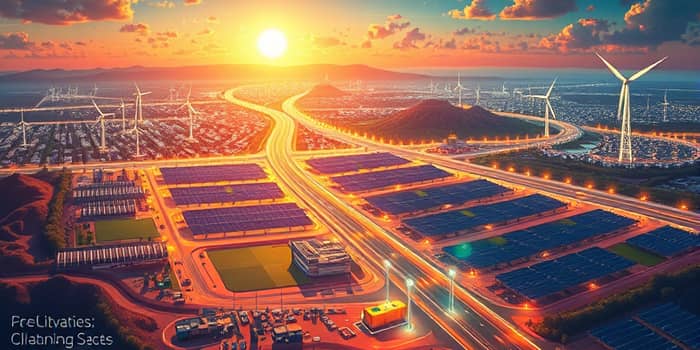
In 2025, the world witnessed a staggering record-setting $2.3 trillion global investment in the energy transition. This monumental surge underscores how electrification, powered by renewables, has evolved into a strategic imperative for economic growth, security, and environmental stewardship.
A Historic Surge in Clean Energy Investment
Clean energy funding now outpaces fossil fuels by a wide margin. In 2025, total energy investment reached $3.3 trillion, of which $2.2 trillion was directed toward clean technologies. Renewable energy alone attracted $690 billion, while grid infrastructure received $483 billion and electrified transport captured $893 billion.
Notably, more than 90% of new capacity added globally in 2024 came from solar, wind, hydro, and geothermal sources. This shift reflects not only climate commitments but also a tectonic economic realignment, where renewables became cheaper than fossil alternatives in most markets.
From Generation to Infrastructure: The Grid Bottleneck
While renewable installations accelerate, infrastructure has lagged behind. Over the past decade, power-grid investment averaged $300–400 billion annually. The International Energy Agency now estimates that this figure must double by 2030 to support burgeoning electricity demand and integrate distributed renewables.
Europe exemplifies this challenge. The continent may need up to €1.4 trillion in transmission and distribution upgrades by 2035, requiring a 60–100% acceleration compared to past decades. Similar demands are emerging in North America and Asia-Pacific, where aging networks struggle to handle higher loads from data centers, EV charging, and industrial electrification.
Driving Forces Behind Electrification
The electrification revolution is propelled by multiple, interlocking trends:
- Electric vehicles and charging networks expanding rapidly worldwide, boosting electricity demand.
- Industrial and building electrification as companies and homeowners shift away from direct fossil fuel use.
- Data center growth and digitalization, especially in North America and Europe, placing new stress on grid capacity.
- Rising temperatures driving up cooling needs, further elevating peak electricity loads.
- Energy security concerns prompting nations to invest in domestic generation and storage rather than importing fuels.
Together, these factors mark a transition from a climate-only rationale to a system-building phase focused on grid, storage, and transport integration.
Regional Dynamics: Leaders and Laggers
As investment climbs, regional patterns reveal both successes and gaps. China remains the largest single market, investing $800 billion in 2025—about one-third of global clean-energy spending. Yet BloombergNEF reports China’s renewables funding dipped for the first time, reflecting regulatory shifts and market uncertainty.
Asia-Pacific overall accounted for 47% of global energy-transition investment. In contrast, emerging markets and developing economies received just 15% of clean-energy financing in 2024, or roughly $300 billion, highlighting a critical equity challenge.
Europe’s energy investment must surge to avoid grid congestion and blackouts. Meanwhile, the United States sees robust demand from EVs, reshoring industries, and data centers, though wind and solar financing faces some volatility.
- India set a new record with $150 billion in total energy investment, including $101 billion in clean energy.
- Emerging markets struggle with high financing costs and policy uncertainty, hampering their transition pace.
Economic and Job Impacts of the Transition
Beyond infrastructure, the clean-energy sector has become a major employer. Global clean-energy jobs rose from 30 million in 2019 to about 35 million in 2023. Renewable energy employment alone reached 16.2 million last year, up from 13.7 million in 2022.
The United Nations notes that clean energy creates three times as many jobs per dollar invested as fossil fuels. Under current policies, the sector could add 10 million more jobs by 2030, while fossil industries may shed 3 million positions.
Projected job gains by 2030 include:
- EVs and batteries: +3.8 million jobs
- Power grids and storage: +1.5 million jobs
- Solar energy: +1.4 million jobs
- Energy efficiency measures: +1.1 million jobs
Challenges and the Road Ahead
Despite remarkable growth, the transition faces significant headwinds. Grid bottlenecks risk slowing new renewable deployments, while capital remains concentrated in advanced markets. Private and blended finance must bridge the funding gap in lower-income countries.
Critical minerals and supply-chain resilience have joined traditional energy policy debates. Nations are crafting industrial strategies to secure battery materials and support domestic manufacturing, reflecting a broader focus on industrial competitiveness, security of supply, AI loads, and resilience.
Looking forward, stakeholders must accelerate policy reforms, streamline grid permitting, and diversify financing. Public-sector capital alone cannot meet the trillions needed; private investors and multilateral institutions must step up to fund the entire energy value chain upgrades that underpin a truly electrified future.
The electrification revolution has entered its decisive phase. As countries, companies, and communities mobilize billions to build generation, transmission, storage, and transport networks, the promise of a secure, sustainable, and prosperous energy system comes into focus. The choices made today will determine whether this bold transformation delivers on its promise for people and the planet.
References
- https://about.bnef.com/insights/clean-energy/bloombergnef-finds-global-energy-transition-investment-reached-record-2-3-trillion-in-2025-up-8-from-2024/
- https://energy-infrastructure-partners.com/five-trends-shaping-energy-infrastructure-in-2026/
- https://www.statista.com/topics/10992/global-renewable-energy-investments/
- https://www.wri.org/insights/state-clean-energy-charted
- https://www.weforum.org/stories/2025/01/energy-infrastructure-grid-finance/
- https://rsmus.com/insights/industries/energy/the-top-6-trends-shaping-the-energy-sector.html
- https://www.iigcc.org/insights/world-energy-investment-2025-highlights-electricity-demand-and-energy-security-new-drivers
- https://www.un.org/en/climatechange/raising-ambition/renewable-energy
- https://www.canarymedia.com/articles/clean-energy/chart-global-renewable-energy-investment-breaks-records
- https://about.bnef.com/insights/finance/energy-transition-investment-trends/
- https://www.nuveen.com/global/investment-capabilities/real-assets/global-clean-energy
- https://www.deloitte.com/us/en/insights/industry/renewable-energy/renewable-energy-industry-outlook.html
- https://www.youtube.com/watch?v=m9rNMgOdyg8
- https://www.c3controls.com/blog/understanding-renewable-energy-infrastructure-new-trends-in-technology
- https://reglobal.org/energy-transition-investment-landscape/