We stand at a crossroads where incremental change gives way to a sweeping transformation. The contours of tomorrow’s world are emerging today through breakthroughs in technology, shifts in global finance, and a rebalancing of economic power. From AI-driven productivity surges to tokenized rails for cross-border payments, the economic landscape is being rewired.
In this era, understanding the forces at play is not an academic exercise; it is a survival guide for businesses, policymakers, and individuals alike. As the old order falters, a new model—the new operating system for the economy—is taking shape before our eyes.
A world in flux: why the old paradigm is breaking
For decades, forecasting relied on linear assumptions: stable labor markets, predictable inflation, and gradual technological adoption. Yet today, that predict-and-control economic mindset is losing its validity. Rapid advances in AI, sudden shifts in geopolitics, and unexpected supply shocks challenge traditional models.
The Kenan Institute warns that labor-market uncertainty and data gaps from government shutdowns are clouding our view of the future. Meanwhile, the Santa Fe Institute calls for a paradigm shift in the science of economics itself, citing the need to incorporate complexity, quantum computing, and genetic engineering into our frameworks.
- Inflation forecasts swinging wildly after pandemic rebounds.
- Labor participation disrupted by hybrid work and AI automation.
- Data reliability affected by policy-induced reporting gaps.
- Financial markets subject to rapid technology reevaluations.
The consequence is clear: models designed for a stable, neoliberal era are straining under nonlinear, digital, and fractured conditions.
The engines of the new economy
Amid uncertainty, powerful drivers are accelerating the shift to a different paradigm. AI has transcended its origins as a niche technology to become a macroeconomic force, reshaping productivity and capital flows globally. Yet this boom carries risk: high asset valuations in AI sectors could trigger a volatile reappraisal.
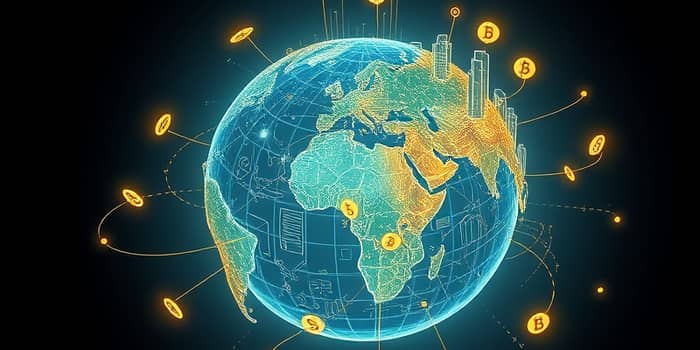
Simultaneously, financial infrastructure is undergoing its own revolution. By mid-2026, nearly three-quarters of G20 countries will have deployed tokenized cross-border payment systems, enabling instant settlements and dramatically lower transaction costs. This build-out of digital rails is a tangible marker of change.
Trade itself is evolving away from hyperglobalization toward a more strategic, fragmented order. Protectionism is on the rise, and advanced economies are grappling with the highest debt levels in a century. Fiscal space is tightening even as calls for stimulus persist.
- AI-driven productivity gains versus valuation bubble risks.
- Rapid adoption of tokenized payments and digital currencies.
- Rising trade barriers and strategic decoupling.
- Fiscal constraints limiting traditional stimulus tools.
- Climate pressures forcing new infrastructure investments.
Emerging markets: the beating heart of global growth
While advanced economies wrestle with low growth and high debt, emerging markets are capturing a larger share of the world’s prosperity. The IMF projects global growth at 3.3% in 2026, while UNCTAD expects 2.7%. Goldman Sachs’s forecast sits at 2.9%, highlighting divergence in outlooks. Yet all agree on a common theme: emerging economies are outpacing mature markets.
Beyond annual data, the long-run shift is unmistakable. By 2030, emerging markets may claim half of the world’s top ten economies, with China, India, Indonesia, Brazil, and Mexico firmly in the lead. The World Economic Forum predicts that by 2035, roughly 65% of global growth will originate from these dynamic regions.
Demographics reinforce this momentum: the world population will exceed 8.5 billion by 2030, with nearly a billion over age 65 and the majority living in rapidly expanding megacities. Asia alone will host a dozen new urban giants—each a growth engine in its own right.
Rethinking economics: beyond Homo economicus
The conceptual foundation of the old order—rooted in self-interest maximization and equilibrium models—is giving way to an emerging narrative grounded in complexity science and evolutionary theory. Increasingly, thought leaders argue for an economics that recognizes humans as relational, moral, and meaning-seeking.
This approach frames organizations as culturally evolving complex systems that thrive when governance fosters prosocial dynamics. It challenges us to move past narrow optimization and embrace cooperation, adaptability, and shared purpose.
Such a shift in perspective is not mere academic speculation. It informs practical policy choices: from designing social safety nets that adapt to automation’s disruptions, to crafting climate finance mechanisms that align incentives across borders, to building digital platforms that democratize access to capital.
Charting a course: practical steps for the new paradigm
The emerging economic order demands fresh strategies. For policymakers, investing in resilient digital infrastructure and enhancing multilateral cooperation is paramount. Fiscal credibility must be paired with targeted spending on education, health, and climate adaptation.
Businesses must retool their talent models for an AI-augmented workforce, prioritize sustainability, and engage with partners across borders to access new markets. Individuals can cultivate lifelong learning habits, participate in digital financial services, and advocate for transparent governance.
At every level, embracing a more nonlinear, more digital, more fragmented reality will unlock opportunities. Those who adapt quickly—by leveraging AI responsibly, aligning with emerging-market growth, and fostering collaborative networks—will shape the next chapter of global prosperity.
Conclusion: seize the moment
The future is not a distant horizon; it is unfolding right now. The interplay of technology, demographics, and finance is forging an economic paradigm that rewards adaptability, cooperation, and innovation. In this moment of profound change, the question is not whether we can influence the outcome, but how we will position ourselves to thrive.
By recognizing the signs of transformation and taking concrete action—whether in boardrooms, trading floors, or community halls—we become architects of a more inclusive and resilient global economy. The tools are at hand; the imperative is clear. The future is now.
References
- https://kenaninstitute.unc.edu/commentary/five-economic-trends-to-watch-in-2026/
- https://www.oecd.org/en/publications/1999/10/the-future-of-the-global-economy_g1ghg245.html
- https://www.imf.org/en/publications/weo/issues/2026/01/19/world-economic-outlook-update-january-2026
- https://interactive.satellitetoday.com/the-global-economy-in-the-next-decade-an-uncertain-future/
- https://www.santafe.edu/info/complexity-futures-new-paradigms-2026/welcome
- https://www.goldmansachs.com/insights/articles/forecasts-for-the-worlds-biggest-economies-in-2026
- https://www.prosocial.world/posts/strengthening-and-safeguarding-the-new-paradigm
- https://www.atlanticcouncil.org/dispatches/five-trends-to-watch-in-the-global-economy-in-2026/
- https://civicventures.substack.com/p/were-ready-for-an-economic-paradigm
- https://unctad.org/publication/world-economic-situation-and-prospects-2026
- https://www.usbank.com/corporate-and-commercial-banking/insights/economy/macro/k-shaped-economy.html
- https://www.imf.org/en/publications/weo
- https://www.ebsco.com/research-starters/economics/future-global-economic-trends
- https://www.youtube.com/watch?v=kEScSQbtopw