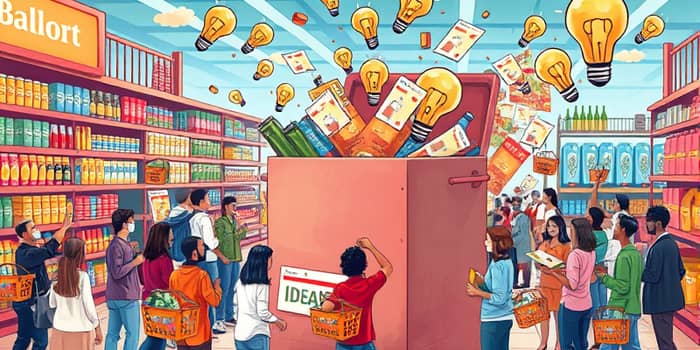
In today’s interconnected economy, consumers do more than buy—they shape the very fabric of markets. Every transaction sends a signal that ripples through boardrooms, production lines, and global supply chains.
Foundational Idea: How Consumer Choice Shapes Markets
Markets often masquerade as a consumer democracy, where each purchase is akin to a vote. This narrative holds that aggregated individual decisions determine which products flourish and which fade away. By examining the basics of economic theory, we uncover how these everyday votes translate into real-world outcomes.
Classical economics tells us that expanding choice typically enhances welfare: buyers find bundles that best match their tastes, and firms compete on quality, price, and innovation. Yet this competition is neither abstract nor distant; it arises directly from the choices made at the checkout counter.
- distributed consumer choice determines industry growth, directing capital and attention toward emerging winners.
- consumer surplus and welfare optimization increases when people can tailor purchases to personal preferences.
- demand-driven innovation and strategic adaptation spur businesses to refine offerings and pioneer new categories.
Viewed through this lens, every shopping cart becomes a microcosm of preference expression. Consumer choices aggregate into powerful market forces, rewarding the most resonant products and business models.
Consumers as Market Shapers: Mechanisms of Influence
Behind the scenes, firms translate purchase patterns into strategic shifts. When buyers gravitate toward eco-friendly items, for instance, companies reallocate research budgets and redesign supply chains to reduce carbon footprints.
- Demand signals guide assortment decisions and entry by new competitors.
- Price sensitivity prompts adjustments in packaging, promotions, and value tiers.
- Brand switching—with 72% of shoppers trying new names—pushes rivals to innovate or risk obsolescence.
Data is the lifeblood of modern marketing. Through sophisticated analytics, firms close a continuous feedback loop of consumer data, refining products and messaging in real time. This cycle—choices generating insight, insight prompting changes, changes driving new choices—fuels rapid adaptation in competitive markets.
- Website analytics reveal which features and price points resonate most.
- Search and social media metrics uncover emerging interests and grievances.
- Surveys and customer feedback explain the motivations behind every cart addition or abandonment.
By treating consumer behavior as strategic input, companies align product roadmaps with shifting tastes, often before those shifts become apparent to the wider public.
The Psychology and Sociology of Choice
Choice is never purely rational. Psychological, social, and cultural factors intertwine with economic incentives to drive decision-making. Recognizing these dimensions helps explain why some products achieve runaway success while seemingly superior alternatives falter.
These interlocking drivers ensure that consumer actions often diverge from textbook predictions. For example, high-end coffee sales may rise in a downturn because brewers seek affordable luxury—prioritizing small indulgences over abstention.
Research shows that when individuals feel less powerful, they compensate by seeking variety. A perceived sense of personal power influences how boldly shoppers explore new brands or flavors. Even minor cues—a colleague’s compliment or a calming store environment—can tip the balance toward experimentation or conservatism.
Modern Trends in Consumer Power and Behavior
Entering the mid-2020s, several trends underscore the dynamic interplay between shoppers and sellers. Economic uncertainty has sharpened price sensitivity, while technology has broadened the avenues for research and discovery.
- Financial pressures lead many to trade down to private labels or delay nonessential purchases.
- Brick-and-mortar stores reclaim a role in discovery, with 60% of shoppers finding new products in person.
- Brand agnosticism reigns, as 72% of consumers switch from usual choices to novel alternatives.
- Personalized recommendations drive repeat purchases for 37% of buyers.
- Cross-channel research—online reviews, social media, in-store trials—has become standard prior to checkout.
Experience now rivals price and product in deciding where people spend. With 76% expecting consistent communication across touchpoints and 71% prioritizing seamless journeys, brands must orchestrate every digital and physical interaction.
Meanwhile, conscious consumption and values-based choices are reshaping portfolios. Ethical sourcing, carbon reduction, and social justice credentials often determine which labels earn loyalty, especially among younger segments. Aggregated ethical preferences can nudge entire categories toward more sustainable practices, demonstrating the potency of collective action at checkout.
The Counter-Narrative: Limits and Myths of Consumer Power
Despite the lofty ideal of market democracy, powerful constraints limit genuine choice. Many traditions and tastes owe more to supply-side curation than to grassroots demand.
- Producers and retailers act as de facto choice architects, deciding which products appear on shelves.
- Regulations, subsidies, and trade policies restrict what can be profitably offered.
- Marketing and branding construct preferences, often manufacturing desires rather than responding to them.
Moreover, market concentration can erode diversity. Dominant retailers and suppliers exert monopoly and monopsony market power, squeezing out smaller competitors and narrowing real options. A handful of companies often control shelf space, pricing, and promotional calendars, leaving consumers at the mercy of oligopolistic structures.
- Retail giants drive smaller chains out of business, reducing points of access and product variety.
- Category captains manage entire product lines, favoring their own brands and limiting shelf presence for challengers.
- Antitrust retreat since the 1970s has accelerated consolidation in airlines, banking, and broadband, undermining authentic competition.
These structural forces reveal that latent demand versus constructed consumer demand is a nuanced tension. While individual choices matter, the universe of options itself is shaped by powerful actors far upstream of the checkout.
Embracing the Power of Choice
Given both the strengths and limits of consumer influence, how can individuals wield their purchasing power most effectively? By aligning spending with personal and societal priorities, buyers can amplify their impact.
- Research brands’ ethical and environmental records before deciding.
- Support smaller or local businesses to foster market diversity.
- Demand transparency in supply chains and ingredient sourcing.
- Engage with community feedback to shape future offerings through reviews and surveys.
Every purchase remains a vote for the future of our economy. Even within constraints, the collective weight of consumer decisions nudges markets toward sustainability, innovation, and inclusivity. By understanding the mechanisms and myths of choice, we can become more intentional voters with our wallets and more confident agents of change.
References
- https://www.market-xcel.com/blogs/importance-of-consumer-behavior-in-marketing-trends
- https://www.openmarketsinstitute.org/learn/consumer-choice-monopoly
- https://www.salsify.com/blog/how-consumer-buying-behavior-is-changing-in-2026
- https://www.resilience.org/stories/2025-06-02/the-consumer-power-myth/
- https://www.oneupweb.com/blog/consumer-behavior-marketing/
- https://hbr.org/2022/10/research-when-consumers-feel-less-powerful-they-seek-more-variety
- https://www.salesforce.com/blog/stay-ahead-of-consumer-behavior/
- https://finred.usalearning.gov/Consumer-Protections/MarketingDecisions
- https://www.keiseruniversity.edu/articles/consumer-behavior-understanding-your-market/
- https://pmc.ncbi.nlm.nih.gov/articles/PMC10300328/
- https://www.mckinsey.com/industries/consumer-packaged-goods/our-insights/how-todays-consumers-are-spending-their-time-and-money
- https://www.deloitte.com/us/en/insights/industry/retail-distribution/consumer-behavior-trends-state-of-the-consumer-tracker.html